FBI Warns Weaponized ARTEX Framework Targets Healthcare, ConnectWise Breach
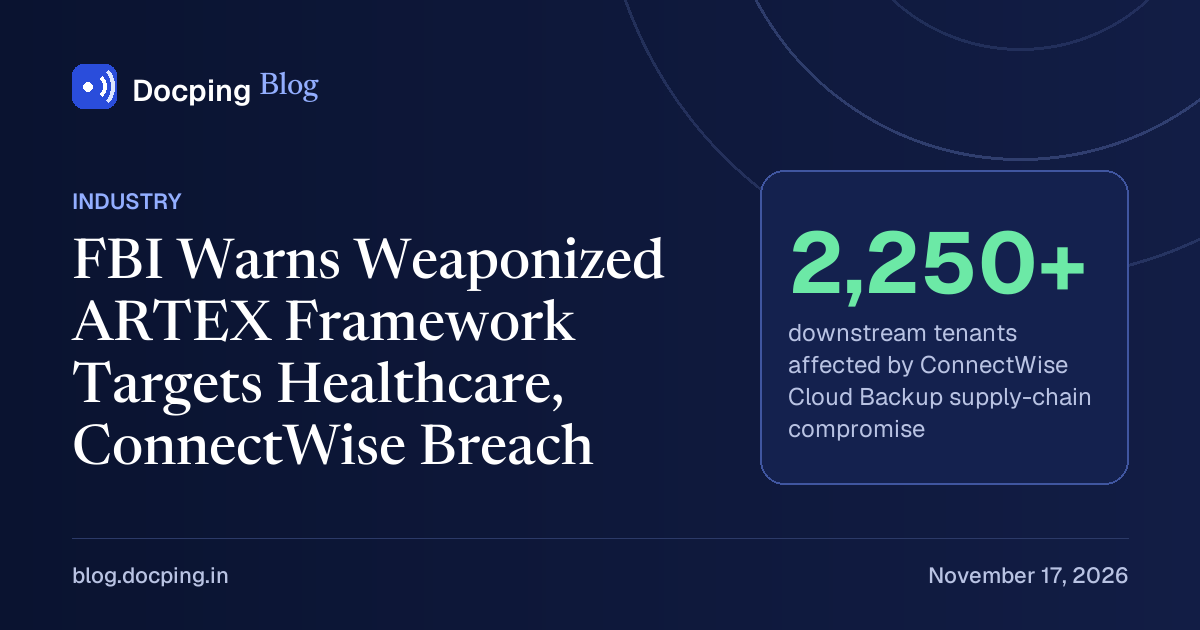
The FBI's November 13 Flash Advisory details how a weaponized open-source pen-testing tool is automating attacks at machine speed, with a ConnectWise supply-chain compromise hitting over 2,250 tenants.
The FBI has confirmed that threat actors are using a weaponized version of the ARTEX open-source penetration testing framework to automate attacks on healthcare organizations, with a recent ConnectWise supply-chain compromise demonstrating the tool’s reach. BeyondTrust’s Morey J. Haber warns that threat actors no longer need to be skilled to scale intrusions, as the weaponized ARTEX framework chains reconnaissance, exploitation, and data exfiltration at machine speed 1.
Key takeaways - The FBI’s November 13 Flash Advisory identifies a weaponized ARTEX framework actively targeting healthcare and other sectors since at least August 2026 1. - More than 1,600 publicly exposed ARTEX Console instances have been identified, with many more likely on private networks 1. - A ConnectWise Cloud Backup supply-chain compromise has already affected over 2,250 downstream tenants, demonstrating the tool’s ability to exploit trust relationships between organizations 1.
What the FBI Advisory Says
The FBI Flash Advisory, issued November 13, 2026, describes ARTEX as an agentic LLM-driven framework originally developed as an autonomous defensive penetration testing tool for security assessments 1. The original creator released it on GitHub in July 2026 but shut down the project in October 2026 after learning threat actors had weaponized it 1. The advisory notes that weaponized ARTEX has been used since at least August 2026 to automate and chain multiple attack phases simultaneously, from reconnaissance to data exfiltration 1.
Victims span multiple sectors including financial services, government, technology, defense, semiconductor, energy, healthcare, manufacturing, legal, and telecommunications 1. The framework is particularly effective at identifying and exploiting vulnerabilities in peripheral systems — partner and supplier portals, employee applications, mobile backends, legacy services, and applications used by different business units that typically receive less security attention than core systems 1.
How ARTEX Works and Why It Matters
Google’s threat intelligence team reports that the Cairn framework uses AI agents to share information and decide what hacking techniques to try next as they work toward penetrating a system 2. ARTEX, alongside other open-source systems including CyberStrikeAI and PentAGI, is being used to execute multi-stage intrusions at greater operational velocity compared to earlier activity where hackers manually prompted AI chatbots 2. This automation allows attacks to proceed at machine speed, significantly increasing attack velocity and expanding operational scale 1. While the tool generates high volumes of forensically noisy traffic that may be flagged by security solutions, the speed of attacks makes it challenging to identify an attack in progress in time to thwart the attacker’s objectives 1.
As BeyondTrust’s Morey J. Haber explained, “With the public release of ARTEX, threat actors have changed the tempo. When an AI-driven framework chains reconnaissance, exploitation, and privilege escalation in under a few hours, the threat actor no longer must be skilled. They only have to be pointed in the right direction using a toolkit pre-tuned for their nefarious activities” 1. Haber emphasized this is an identity and privilege problem: “ARTEX is not breaking in so much as logging in with keys it finds lying around, including machine identities and service accounts that nobody is monitoring or that have been forgotten about” 1.
The ConnectWise Supply-Chain Compromise
The weaponized ARTEX framework was used in a recent ConnectWise Cloud Backup supply-chain compromise that affected more than 2,250 downstream tenants 1. This incident illustrates how the tool maps trust relationships between organizations, extending the blast radius well beyond a single perimeter 1. Google’s threat intelligence team also flagged ARTEX in their findings released the same week, noting it alongside other AI-driven frameworks like Cairn, CyberStrikeAI, and PentAGI that are being used to execute multi-stage intrusions at greater operational velocity 2.
What Security Teams Should Do Now
The FBI Flash Advisory provides observed Tactics, Techniques, and Procedures (TTPs) and Indicators of Compromise (IoCs) for hunting 1. Recommended mitigations include:
- Reducing the external attack surface
- Hardening identity and access controls
- Strengthening application protections
Organizations should immediately hunt for ARTEX indicators in their environments and verify ConnectWise configurations, while hardening peripheral systems as the advisory specifically notes the framework’s effectiveness against these targets 1.
Our read: The weaponization of ARTEX marks a shift from AI-assisted hacking to AI-automated intrusion chains. For healthcare organizations, the ConnectWise compromise underscores that supply-chain risk is no longer theoretical — a single compromised vendor tool can expose thousands of downstream tenants. The FBI’s emphasis on identity and privilege hygiene (monitoring service accounts, removing unused credentials) is the practical starting point, but teams should also assume that perimeter defenses alone will not catch machine-speed attack chains.
Sources
- Weaponized ARTEX Pen Testing Framework Used in Attacks on Healthcare Orgs — The HIPAA Journal, 2026-11-16
- AI hacking tool used in US aerospace sector intrusion, Google says - Nextgov/FCW — nextgov.com, 2026-11-16
- Office of Public Affairs | Attorney General, FBI Director Announce Significant Law Enforcement Action | United States Department of Justice — justice.gov, 2026-10-22
- Grassley Statement on Former FBI Officia... | United States Senate Committee on the Judiciary — senate.gov, 2026-10-23
Researched and drafted with AI from the sources above, and checked claim by claim against them before publishing.