FTC Hims & Hers Lawsuit Expands as Five States Join Action
State attorneys general join federal regulators challenging sensitive health data sharing and subscription billing practices.
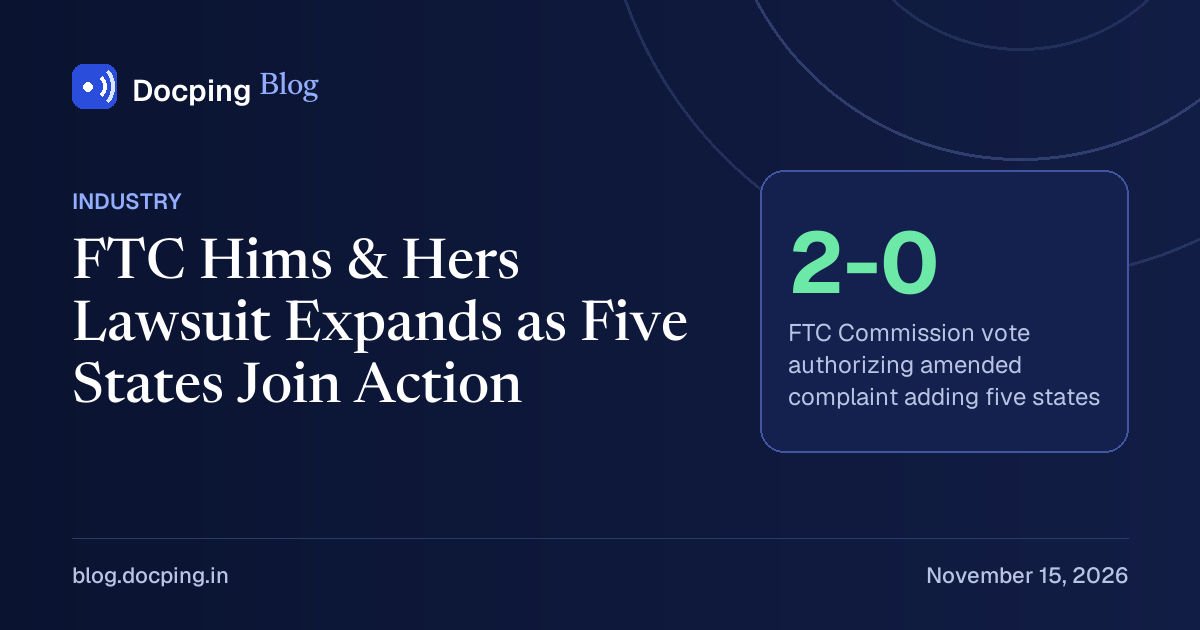
Five states have joined the Federal Trade Commission (FTC) in an expanded lawsuit against direct-to-consumer telehealth provider Hims & Hers, escalating federal enforcement into a coordinated multi-state action 1. The amended complaint in the FTC Hims & Hers lawsuit signals that state attorneys general are actively aligning with federal regulators to penalize digital-health companies that route sensitive intake and browsing data to third-party ad networks 12.
Key takeaways - Arizona, Florida, Nebraska, Ohio, and Wisconsin have joined California and Utah as co-plaintiffs alongside the FTC in the U.S. District Court for the Northern District of California 1. - Regulators allege Hims & Hers shared sensitive health information with advertising platforms including Meta and Snap while promising consumers that their information was private and secure 13. - The lawsuit also targets billing and cancellation practices under the FTC Act, the Restore Online Shoppers’ Confidence Act (ROSCA), and state consumer protection statutes 13.
Which states joined the FTC Hims & Hers lawsuit?
Arizona, Florida, Nebraska, Ohio, and Wisconsin joined the lawsuit as co-plaintiffs following a 2-0 Commission vote authorizing the amended filing 1. They join original co-plaintiffs Utah and California, the latter acting by and through Los Angeles County Counsel 1. The amended complaint was filed in the U.S. District Court for the Northern District of California 1.
The initial complaint was filed earlier in 2026—identified by the FTC and trade reports as originating in July and August—alleging that San Francisco-based Hims & Hers engaged in deceptive practices regarding customer privacy and recurring subscription billing 123. By adding five state attorneys general, the litigation broadens the company’s exposure across multiple state consumer protection laws alongside federal claims under Section 5 of the FTC Act and ROSCA 13.
What tracking technologies and data sharing practices did regulators uncover?
Regulators allege that Hims & Hers deployed third-party tracking tools, including Meta Pixel and the Meta Conversions API, to transmit sensitive consumer interactions directly to commercial advertising platforms 3. According to the complaint, these tools automatically recorded user activities on the company’s platform and forwarded data in response to specific user events 3.
The complaint also details the integration of advertising and analytics tools from a broad group of third parties, including Snap, Microsoft, Google, Criteo, Pinterest, TikTok, Trade Desk, and X 3. In addition to client-side and server-side tracking scripts, Hims & Hers allegedly transferred custom audience lists containing customer records directly to Meta and Snap to power targeted advertising campaigns 3.
These data transfers involved consumers seeking treatments for sensitive medical conditions, including hair loss, weight management, mental health conditions, erectile dysfunction, and premature ejaculation 23. Regulators assert that while the company assured users that its intake process was “100% online, private, and secure,” and previously claimed that medical records and sensitive information were accessed only by treating providers, user details and browsing behaviors were simultaneously sent to advertising partners 23.
How is Hims & Hers responding to the allegations?
Hims & Hers has asked the federal court to dismiss the lawsuit, arguing that its public privacy policy clearly disclosed that health-related data could be shared with commercial ad partners 23. In a motion to dismiss filed in California federal court, the company contends that regulators failed to substantiate claims of deception because website visitors were explicitly directed to and required to acknowledge its privacy policy when creating an account 23.
In its court filings, Hims & Hers points to explicit terms in its privacy documentation stating that the company “may provide personal information to marketing and advertising partners,” including “sensitive information” related to user activity 23. The policy also disclosed tracking by third-party analytics and advertising firms—including the collection of identifiers, device details, geolocation, site usage, and related inferences—and provided links to manage tracking settings on platforms like Meta and Google 2.
Hims & Hers specifically argues that its policy described how a visit to a page concerning hair loss or sexual dysfunction could be shared with ad partners for off-site targeted advertising 2. Furthermore, the company asserts that marketing slogans describing its services as “private” and “discreet” referred to the personal convenience of receiving medical treatment at home rather than visiting a clinic in person, rather than serving as an absolute guarantee against advertising data flows 23. The company also maintains that an older website FAQ, which stated medical records were only accessed by treating providers, applied strictly to clinical records rather than broader web analytics or intake telemetry 2.
What do privacy experts say about privacy policies versus marketing claims?
Legal experts note that extensive privacy disclosures in fine print may not shield digital-health companies from FTC Section 5 enforcement if outward marketing messages give a different impression 2. Privacy attorney Jordan Cohen of Akerman LLP observed that Section 5 evaluates the overall net impression created for consumers, explaining that a hedged “may share” clause in a privacy policy cannot easily neutralize contradictory marketing claims, advertisements, and FAQs promising privacy 2. Cohen also highlighted that notice of potential data sharing is legally distinct from affirmative express consent, although the FTC’s claims here are structured around deception rather than pure consent mechanics 2.
Lucia Savage, former chief privacy officer at the Department of Health and Human Services (HHS) Office of the National Coordinator for Health IT (ONC), pointed out that while the FTC brought this case under Section 5 rather than its Health Breach Notification Rule (HBNR), the litigation could help establish whether digital-health platforms need explicit affirmative consent rather than standard terms of service when sharing health information 2. Savage also emphasized that the presence of state co-plaintiffs introduces distinct state consumer protection claims that may survive even if federal claims face procedural challenges 2.
District Judge Vince Chhabria has scheduled a hearing on Hims & Hers’ motion to dismiss for January 7, 2027 23.
What billing and subscription practices are challenged?
Beyond data sharing, the lawsuit alleges that Hims & Hers deceived consumers regarding how and when they were billed for prescription treatments 13. Regulators assert that the company informed prospective customers that they could consult with a medical provider to find an appropriate treatment, yet charged them for recurring prescriptions almost immediately after they submitted an online intake form 13.
The complaint states that actual provider consultations rarely occurred prior to enrollment in recurring payment plans, and that the company failed to clearly disclose refill dates 3. Furthermore, regulators allege that Hims & Hers created substantial obstacles to cancellation, prohibiting users from cancelling subscriptions directly online and forcing them through phone, email, or chat workflows that made ending recurring charges difficult 13.
In its defense, Hims & Hers argues that its intake screens clearly present pricing plans and terms of service before submission, that charges occur only if a prescription is actually issued, and that cancellation options—including online chat added in 2023—are made plain to customers entering fixed-term contracts paid in installments 3.
What should digital-health product and compliance teams do now?
For engineering, product, and compliance leaders operating direct-to-consumer health platforms, the expansion of this lawsuit reinforces that standard web-tracking stacks carry serious regulatory risk 13. Previous FTC enforcement actions against the fertility tracking app Premom, BetterHelp, and GoodRx targeted the use of tracking technologies, but the addition of five state attorneys general demonstrates that enforcement is spreading rapidly across state jurisdictions 13.
Teams should take specific inventory of their client and server tracking pipelines:
- Audit client-side and server-side tracking endpoints: Inspect every third-party SDK and conversion pipeline—including the Meta Pixel, Meta Conversions API, Google tags, TikTok, and Snap scripts—running on intake forms, symptom checkers, and condition-specific landing pages 3.
- Review Custom Audience and CRM data syncs: Ensure that user lists, email hashes, and purchase records tied to specific medical conditions or treatments are not exported to social advertising networks 3.
- Reconcile marketing copy with technical data flows: Examine landing pages, FAQs, and influencer scripts 2. Disclaimers buried in a formal privacy policy will face intense regulatory skepticism if public-facing copy advertises 100% private care while scripts broadcast user visits to third parties 23.
- Evaluate subscription cancellation UX: Ensure subscription terms, recurring billing schedules, and cancellation paths comply with ROSCA and state consumer protection standards, providing simple, frictionless cancellation mechanisms 13.
Our read: Digital-health engineering teams can no longer treat marketing pixels as low-risk marketing tools isolated from compliance review. When an intake form captures condition-specific queries—whether for mental health, hair loss, or weight management—sending that metadata alongside device identifiers to an ad exchange directly invites regulatory action under both federal and state consumer protection statutes 123.
Sources
- Five States Join FTC Lawsuit Alleging Hims and Hers Engaged in Deceptive and Unlawful Privacy Practices — FTC, 2026-11-10
- Hims & Hers Seeks Dismissal of FTC, States' Data Privacy Case — govinfosecurity.com
- Him & Hers Seeks Dismissal of FTC Lawsuit Alleging Deceptive Practices and Privacy Violations — hipaajournal.com, 2026-10-29
- Hims & Hers Health seeks dismissal of FTC lawsuit over user data - Modern Healthcare — modernhealthcare.com, 2026-10-22
Researched and drafted with AI from the sources above, and checked claim by claim against them before publishing.