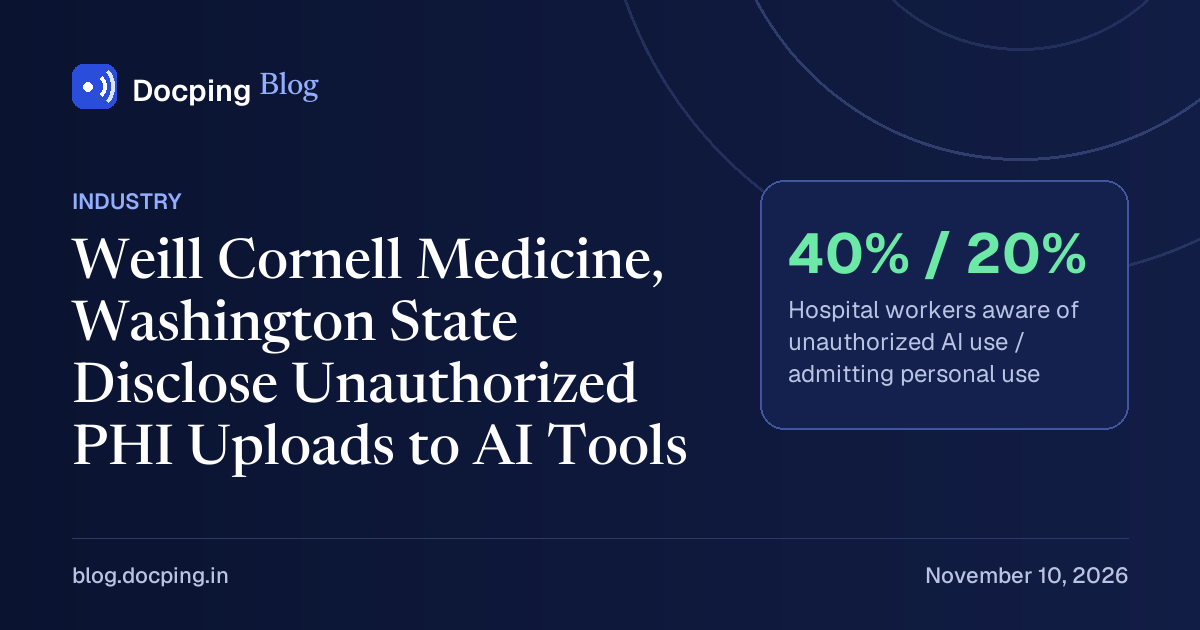
Weill Cornell Medicine, Washington State Disclose Unauthorized PHI Uploads to AI Tools
Two healthcare organizations report researchers and staff uploaded patient data to consumer AI without authorization, highlighting a growing breach vector.
Weill Cornell Medicine and the Washington Department of Social and Health Services have disclosed in the past week that researchers and staff uploaded protected health information to consumer AI tools without authorization — a concrete warning for any organization deploying clinical AI. The incidents illustrate how quickly well-intentioned workflow shortcuts become reportable privacy breaches.
Key takeaways - Weill Cornell Medicine discovered on September 6, 2026 that radiology research data for patients imaged at NewYork-Presbyterian was uploaded to AI and machine learning tools between June 10–20, 2026, without authorization 1. - A Washington Department of Social and Health Services employee used a personal ChatGPT account to draft case-note summaries containing patient names, diagnoses, and medications, affecting 12 families at Lake Burien Transitional Care Facility and four patients at Western State Hospital 1. - A Wolters Kluwer Health survey found 40% of hospital workers are aware of colleagues using unauthorized AI tools, and 20% admitted using such tools themselves 1.
What happened at Weill Cornell Medicine
On September 6, 2026, Weill Cornell Medicine identified that protected health information from a radiology research study had been entered into AI and machine learning tools without authorization and in violation of institutional policies 1. The uploads occurred between June 10 and June 20, 2026, and involved patients who received medical imaging services at NewYork-Presbyterian (WCINYP) or NewYork-Presbyterian Hospital.
The data uploaded did not include patient names, contact information, Social Security numbers, or financial information. It was limited to medical record numbers, radiology accession numbers, dates and times of radiology services, facility names, healthcare provider names, and clinical information relating to radiological examinations — which may have included diagnoses, treatment information, surgical and procedural histories, and medication information 1.
Weill Cornell Medicine stated it has not identified any misuse of patient data, has suspended the research activity, submitted a request to have the data deleted, and provided additional education to appropriate individuals regarding appropriate use of AI tools and the importance of protecting patient information. The number of affected individuals has not yet been publicly disclosed 1.
What happened at the Washington state facilities
The Washington Department of Social and Health Services disclosed that a Lake Burien Transitional Care Facility staff member used their personal ChatGPT account to draft summaries for client case notes, which included patients’ personal health information such as names, diagnoses, and medications 1. The department identified one instance of impermissible use; further investigation revealed multiple previous instances by the same employee. The state has written to 12 families of affected patients.
A similar incident was identified affecting four Western State Hospital patients. Employees were instructed to delete all ChatGPT prompts before deleting their accounts 1.
Why consumer AI tools create HIPAA risk
Consumer versions of AI tools lack the necessary safeguards to comply with the HIPAA Rules and must not be used by healthcare staff in connection with any protected health information 1. While many AI tools can be used in healthcare in compliance with HIPAA, consumer versions do not provide the protections required for PHI.
Beyond privacy risks, these tools can pose patient-safety risks. The HIPAA Journal notes a recent case in which a woman with epilepsy followed a medication-reduction regimen suggested by ChatGPT, suffered a fatal seizure, and a lawsuit was filed against OpenAI alleging the tool effectively practiced medicine without a license 1.
How widespread is unauthorized AI use?
The Wolters Kluwer Health survey conducted earlier this year suggests the Weill Cornell and Washington incidents are not isolated. Forty percent of hospital workers said they were aware of colleagues using unauthorized AI tools, and 20% admitted to using the tools themselves 1. Employees often turn to these tools to get more done in less time, but the survey underscores that shadow AI use is already common in clinical settings.
What this means for AI tool governance
Our read: These disclosures should prompt every healthcare organization to audit three things immediately. First, inventory which AI tools — sanctioned or not — are touching PHI. Second, verify that business associate agreements explicitly cover AI processing, including model training, inference logging, and cross-tenant data leakage. Third, brief leadership on the rising breach vector: well-meaning researchers and clinicians uploading identifiable or limited data sets to consumer interfaces because approved alternatives are slow, unavailable, or unknown.
The Cloudflare incident disclosed in October — where 155 responses from the GLM 5.3 model on Workers AI contained data from other customers’ requests due to a configuration mismatch and an SGLang inference-engine bug — shows that even enterprise AI platforms can leak data across tenants when context windows and KV caches are misaligned 3. That risk compounds when staff bypass procurement entirely.
What to do this week
- Audit AI tool access: Ask IT and privacy teams to enumerate every AI service (ambient scribes, coding assistants, research notebooks, summarization bots) that has received PHI in the last 90 days. Include shadow IT discovered via network traffic analysis or CASB logs.
- Check BAAs for AI-specific language: Confirm each vendor’s BAA addresses model training on your data, prompt/response retention, cross-tenant isolation, and breach notification timelines. If a vendor cannot produce a BAA, treat the tool as unauthorized for PHI.
- Deploy approved alternatives with guardrails: Provide clinicians and researchers with sanctioned, BAA-covered AI environments that enforce data-loss prevention, audit trails, and role-based access — so the path of least resistance is also the compliant path.
- Update workforce training: Incorporate the Weill Cornell and Washington cases into annual HIPAA training. Make clear that pasting PHI into a personal ChatGPT, Claude, or Gemini session is a reportable breach, not a productivity hack.
- Brief the board and C-suite: Frame unauthorized AI uploads as an emerging breach vector with regulatory, reputational, and patient-safety dimensions. Use the 40%/20% survey data to quantify cultural risk 1.
The bigger picture
These disclosures follow recent research documenting a threat actor rotating through 32 fake AI bot identities to scan organizations for exposed credentials and keys — a reminder that the AI attack surface extends beyond insider misuse to active impersonation of legitimate AI agents 4. Meanwhile, the Cloudflare cross-tenant leak demonstrates that even vetted platforms can fail in ways that expose customer data to other customers 3.
Taken together, the signals are clear: AI tool governance is no longer a future project. It is a current compliance requirement, a breach-readiness priority, and a patient-safety imperative. Organizations that treat it as optional will discover the cost the hard way — just as Weill Cornell Medicine and the Washington Department of Social and Health Services did this month.
Sources
- Healthcare Providers Discover Unauthorized PHI Disclosures to AI Tools — The HIPAA Journal, 2026-11-09
- Data breach caused 'significant distress' for hospital staff - BBC — bbc.com, 2026-11-06
- In Other News: Anthropic Breach Dispute, UEFI Flaw Hits Most Servers, Cloudflare AI Data Leak - SecurityWeek — securityweek.com, 2026-10-30
- Attacker Impersonates AI Bots to Scan Orgs for Keys, Credentials - Dark Reading — darkreading.com, 2026-10-28
Researched and drafted with AI from the sources above, and checked claim by claim against them before publishing.