CMS Health AI Slack Workspace Draws Scrutiny Over Backchannel Policy
An investigation reveals CMS coordinated reimbursement and FDA guidance with 1,700 tech executives in an unannounced Slack workspace.
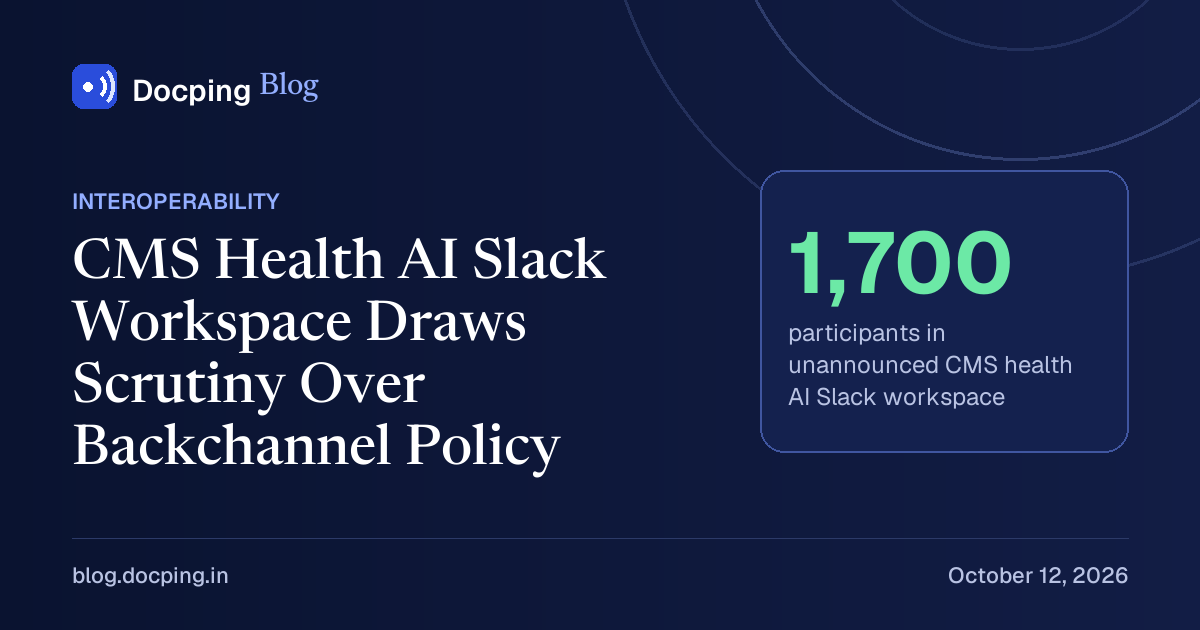
Federal health regulators have spent the past year coordinating federal CMS health AI policy inside an unannounced, 1,700-member Slack workspace alongside technology vendors and venture capitalists 12. The backchannel arrangement gave commercial developers an unpublicized forum to shape Medicare reimbursement pipelines, federal guidance, and records access under national exchange networks without standard public notice-and-comment procedures 123.
Key takeaways - The Centers for Medicare & Medicaid Services (CMS) ran an unannounced Slack workspace with 1,700 members to coordinate AI health app reimbursement and policy with industry leaders 12. - Federal officials promised participants the agency would serve as a “sales engine” and used the chat to arrange private Food and Drug Administration (FDA) listening sessions 12. - Industry vendors in the channel lobbied for “frictionless” access to pull patient medical records through the Trusted Exchange Framework and Common Agreement (TEFCA) 12.
What is the CMS health AI Slack workspace?
The Slack workspace was launched in August 2025 by Amy Gleason, the former acting administrator of the Department of Government Efficiency who currently serves as chief product officer for the newly created Office of Health Technology and Products at CMS 12. Gleason welcomed entrepreneurs, investors, and executives under a broader agency initiative branded the “Health Technology Ecosystem” 12.
While CMS Administrator Mehmet Oz publicly described the broader ecosystem initiative in September as giving industry “a chance to play in the sandbox of government-supported healthcare,” the underlying Slack chat room was never formally announced through federal regulatory registers 12. Instead, it grew quietly to 1,700 participants, drawing representatives from technology and AI corporations such as Microsoft, Anthropic, OpenAI, Apple, Google, and Palantir, alongside digital wellness firms like Oura Health and investment outfits including 8VC 12. Only a handful of patient advocates, physicians, and hospital representatives were included in the workspace 12.
A code of conduct distributed by Gleason when setting up the channel documented that CMS had established a technology working group 12. That internal document asserted the forum did not constitute a formal “advisory committee” and stated it would not be used “to obtain advice or recommendations for HHS, CMS, or any HHS/CMS officials” 12. It also noted that federal employees are legally prohibited from endorsing commercial products or services 12.
How did regulators use the workspace to shape policy?
Despite the disclaimers in the code of conduct, federal officials repeatedly used the workspace to organize regulatory input and coordinate commercial rollouts outside standard public administrative channels 12.
In February, officials used the chat room to invite selected businesses to an unannounced FDA listening session focusing on patient-facing conversational AI products 12. FDA regulates health software and mobile applications that function as medical devices, yet this meeting did not appear on the agency’s public calendar or in federal regulatory notices 12. CMS senior policy adviser Morgan Taylor told participants in the workspace that the private session offered a chance to “help FDA shape future guidance” on conversational AI monitoring and safety 12. Representatives from at least 35 industry organizations attended the closed meeting 12.
Beyond regulatory guidance, agency officials leveraged meetings tied to the channel to pitch Medicare distribution channels to commercial app developers 12. During a February Zoom session, Jacob Shiff, chief AI and technology officer at the CMS Innovation Center, told industry participants he hoped CMS’s work would act as a “sales engine” for participating apps 12. Shiff stated on a recorded call that CMS planned to maintain a directory of organizations where companies with functioning tools would “be the winners” and be positioned to “scale” profitably 12. When reporters questioned the agency about Shiff’s statements, a publicly accessible Google Drive recording of the meeting was switched to private the next day 12.
This commercial push fed directly into the public rollout of the Medicare App Library 12. During an informal April 7 meeting, Taylor told developers that older adults would naturally trust software listed on medicare.gov 12. The library currently features two dozen commercial applications, including consumer products from large tech firms as well as early-stage software like Slothwise, a $9.99 monthly app run by a solo founder out of a residential apartment that had accumulated only a handful of public app store reviews 12. Officials indicated across at least two meetings this year that applications featured in the library will be prioritized for upcoming CMS programs that reimburse vendors directly for wearable device tracking and AI chatbot advice 12.
Why are data privacy and TEFCA access drawing concern?
The most consequential debates inside the workspace centered on how consumer AI applications extract clinical data from national exchange networks 12. Under TEFCA, healthcare organizations exchange sensitive patient records across certified networks 12. In the Slack channels and related meetings, digital health vendors pushed CMS to establish a framework where apps requesting records are treated as standing “in the shoes” of the patient once initial consent is given 12.
Ryan Howells, a consultant lobbying for the CARIN Alliance, argued on Slack for third-party vetting bodies to govern access, asking fellow members, “What more can you do to have trust in these apps?” 12. Kristen Valdes, CEO of b.well, echoed that position in the chat, writing that healthcare stakeholders “need to stop protecting patients from themselves. Full stop.” 12. Valdes later told reporters her comments reflected frustration with system paternalism, though she acknowledged there will inevitably be “good and bad apps” 12.
Other builders inside the channel pushed back on frictionless pathways 12. Jason Kulatunga, founder of Fasten Health, warned in the Slack group that security architectures must account for malicious actors rather than assuming all software developers are good-faith participants 12.
Physician organizations have raised alarms over patient protection and accountability 12. American Medical Association CEO John Whyte stressed that many consumer AI tools lack sufficient performance data, leaving clinicians in the dark regarding liability and algorithmic errors 12. Meanwhile, legal specialists like Joseph Daval, a former FDA attorney now at Harvard Medical School, pointed out that the forum mirrors an advisory committee structured without statutory safeguards designed to prevent interest-group capture 12.
Our read: When federal agencies blend technical collaboration channels with Medicare distribution promises, regulatory predictability degrades. Digital health teams building clinical tools under strict HIPAA business associate agreements now face competition from direct-to-consumer software seeking frictionless TEFCA queries without equivalent clinician oversight 12.
What this means in practice for health-IT teams
Health-system IT leaders, compliance officers, and digital health engineering teams should evaluate their integration pipelines in light of these disclosures:
- Audit third-party TEFCA individual access requests. Technical teams managing TEFCA endpoints should review audit logs for patient-mediated application programming interface (API) requests. Verify whether incoming requests carry sustained scopes or single-transaction tokens, and confirm how your network gateway enforces identity verification.
- Review consumer health app policies with clinical informatics. Health system CMIOs should meet with compliance officers to establish institutional guidance on patient-directed data transfers. When patients ingest EHR data into unvetted consumer AI chatbots, clinical liability remains undefined if incorrect recommendations return to the clinic 12.
- Do not rely on informal CMS assurances for reimbursement. Startups building AI models for remote patient tracking should note that CMS has not formally announced the chat room through federal regulatory channels 12. Base your product roadmap on finalized Medicare Physician Fee Schedule rules rather than directory listings or informal agency sandboxes 12.
What we’d watch: Whether congressional oversight committees or administrative law challenges force CMS to formalize the Health Technology Ecosystem under the Federal Advisory Committee Act, which would make member rosters, meeting transcripts, and working group charters public record 12.
Sources
- AI, Tech Leaders Are Lobbying Trump Health Officials in a Government-Run Chat Room — KFF Health News, 2026-10-09
- AI, tech leaders are lobbying Trump health officials in a government-run chat room - CBS News — cbsnews.com, 2026-10-09
- AI, tech leaders lobby Trump health officials in a government-run chat room - Modern Healthcare — modernhealthcare.com, 2026-10-09
- AI in the NYC Council spotlight - Politico — politico.com, 2026-10-05
Researched and drafted with AI from the sources above, and checked claim by claim against them before publishing.