FHIR-AgentEval Benchmarks Clinical LLM Agents on FHIR
Researchers introduce an open sandbox with 43 clinical workflows and deterministic validation to test memory-augmented agents before EHR integration.
A research team from Boston Children’s Hospital and Harvard Medical School has published FHIR-AgentEval, an extensible evaluation sandbox designed to benchmark large language model (LLM) agents executing clinical operations against Health Level Seven Fast Healthcare Interoperability Resources (HL7 FHIR) 1. The framework arrives as digital health engineering teams increasingly move LLMs beyond passive summarization into active agentic execution layers that interact directly with underlying clinical systems 15.
Key takeaways - FHIR-AgentEval establishes 43 modular tasks covering realistic appointment management and genetic testing workflows evaluated against a resettable FHIR server 1. - Grounding clinical LLMs with long-term memory reduced strategic failures such as incorrect tool selection and resource-type confusion, lifting success on held-out tasks by 9.1% over baseline 1. - Commercial clinical platforms and agent architectures are rapidly adopting autonomous execution, heightening the need for reproducible, state-level verification before live production rollout 45.
What is FHIR-AgentEval?
FHIR-AgentEval is an open evaluation sandbox that benchmarks how reliably LLM agents translate natural-language requests into structured FHIR operations 1. Published in npj Digital Medicine by researchers at Boston Children’s Hospital’s Division of Genetics and Genomics and the Computational Health Informatics Program, the framework evaluates models across 43 modular clinical tasks 1. The benchmark focuses on two complex outpatient domains: appointment management and genetic testing workflows 1.
Unlike traditional natural-language benchmarks that evaluate only the text a model generates, FHIR-AgentEval executes actions against a dedicated, resettable FHIR server 1. It conducts custom deterministic validation that inspects both the direct agent responses and the resulting state changes on the server 1. The project was developed with grant support from the National Human Genome Research Institute (NHGRI grant R01HG012655) and is distributed under an open-access license 1.
Why do clinical agents struggle with FHIR?
Clinical LLM agents struggle with FHIR because the standard’s implementation complexity requires agents to correctly map nested schemas, select appropriate API tools, and handle precise resource relationships 1. When an agent parses an instruction such as booking an appointment or ordering a diagnostic panel, it must choose the correct FHIR resource type and parameters without corrupting clinical record state 1.
In the ablation study accompanying the benchmark, researchers examined five distinct agent configurations across four experimental settings 1. They tested agents with access to an on-demand FHIR R4 specifications server, alongside long-term memory trained either with or without specification grounding 1.
Without structured memory and specification access, baseline agents frequently suffered from strategic execution failures 1. These errors centered on selecting the wrong tool for an operation and confusing related FHIR resource types during multi-step tasks 1. These failure modes mirror broader industry hurdles in agentic development, where models struggle to select from broad choice sets without specialized classifiers or constrained action boundaries 4.
How does memory improve FHIR-AgentEval performance?
Long-term memory improves FHIR-AgentEval performance by consistently raising task success and preventing repetitive tool missteps 1. Across the study’s four experimental settings, adding memory helped agents maintain operational context across multi-turn interactions 1.
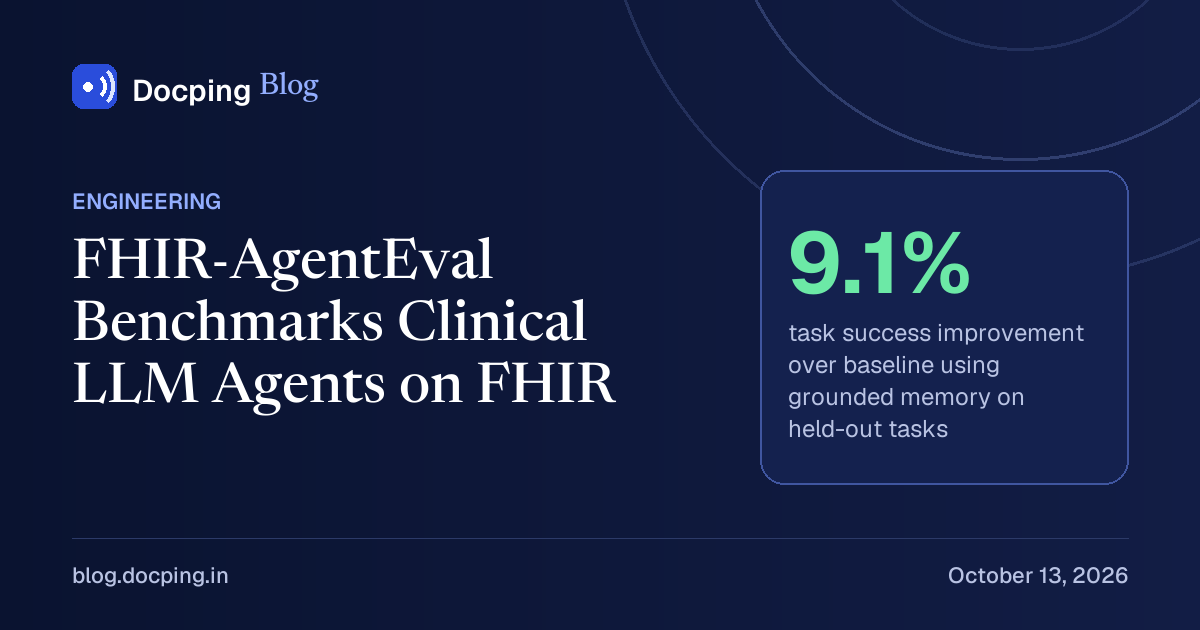
On held-out evaluation tasks, the best-performing memory configuration improved task completion rates by 9.1% over the unaugmented baseline 1. Grounding that memory with explicit FHIR R4 specifications specifically mitigated strategic failures, enabling agents to retain schema requirements and select the correct API endpoints when modifying patient records 1.
This finding parallels production trends across commercial healthcare AI 15. For example, clinical care platform Heidi recently rolled out its Heidi II architecture, incorporating autonomous agents backed by continuous adaptive memory to handle post-encounter administrative tasks across practice tools 5. Commercial teams are increasingly deploying persistent memory to learn provider preferences and workflow patterns, making formal benchmarks like FHIR-AgentEval critical for validating whether these memory mechanisms maintain schema accuracy under pressure 15.
Why is state verification essential for EHR deployments?
State verification is essential because checking an LLM’s conversational output alone cannot prove that a clinical database accepted a valid, uncorrupted transaction 1. A model might generate plausible FHIR JSON that nevertheless fails schema validation, writes to an unintended resource, or breaks relational references in the destination server 1.
FHIR-AgentEval addresses this gap by requiring a live, resettable FHIR environment with deterministic validation that compares expected database changes against actual server state after each task completes 1.
Outside of academic research, software automation teams are grappling with similar reliability challenges 4. As developers deploy autonomous agents that run multi-step actions across web interfaces and internal databases, monitoring each step can become prohibitive 4. In general software automation, engineers have turned to specialized decision models and fast classifiers to verify agent actions before execution, seeking to prevent unintended commands at sustainable compute costs 4.
In clinical systems, where downstream errors directly affect care coordination and patient records, validating deterministic state transitions before connecting agents to live EHR endpoints is a baseline safety requirement 15.
Our read: Benchmarks that measure text generation without inspecting database mutation have outlived their usefulness for health-tech engineers. If an agent claims it scheduled an appointment or logged a diagnostic report, the only metric that matters to an engineering lead is whether the target FHIR server reflects that exact change without foreign-key breaks or misattributed resources.
What does this mean in practice for health-tech teams?
For engineering teams building or deploying agentic FHIR workflows, the release of FHIR-AgentEval provides concrete architectural takeaways:
- Incorporate automated state validation into CI/CD pipelines. Rather than evaluating agent pull requests solely on synthetic conversational prompts, engineering teams should wire integration tests to local, resettable FHIR servers (such as HAPI FHIR or equivalent R4 test containers) that verify end-state mutations after agent tool execution 1.
- Ground agent tool calling in formal schemas. The 9.1% lift achieved by specification-grounded memory demonstrates that raw frontier models still need runtime or retrieval-based schema constraints 1. Teams building automated FHIR write operations should equip agents with on-demand access to implementation guide definitions or schema-checking layers to avoid resource confusion 14.
- Maintain human-in-the-loop review for mutating actions. Even with memory enhancements, agents exhibit strategic failure rates on complex tasks 1. Commercial agent platforms navigating these constraints, such as Heidi II, enforce physician-in-the-loop approval gates where agents draft actions across EHRs and calendars but require explicit clinician sign-off prior to execution 5. Teams building on APIs like Docping Bridge—which standardizes EHR connections with managed OAuth and audit trails—should retain explicit audit logging and confirmation steps whenever an agent initiates an operational write back to clinical records.
What we’d watch: As open benchmarks expand beyond appointment management and genetics into broader clinical domains, the decisive metric will be whether memory-augmented architectures can eliminate resource-type confusion across localized institutional profiles, not just core FHIR R4 specifications 1.
Sources
- FHIR-AgentEval: a modular sandbox for benchmarking clinical LLM agents with memory-augmented configurations - npj Digital Medicine — npj Digital Medicine, 2026-10-10
- https://www.ncbi.nlm.nih.gov/entrez/query.fcgi?cmd=search&term=Kamalakkannan%20Ravi — nih.gov
- https://www.ncbi.nlm.nih.gov/entrez/query.fcgi?cmd=search&term=Mengshu%20Nie — nih.gov
- OpenAI’s Jev clone could help the frontier lab stop its swarming agents - TechCrunch — techcrunch.com, 2026-09-30
- Heidi II Launches Autonomous Clinical Agents to Execute 10M Weekly Visit Tasks - - HIT Consultant — hitconsultant.net, 2026-10-02
Researched and drafted with AI from the sources above, and checked claim by claim against them before publishing.