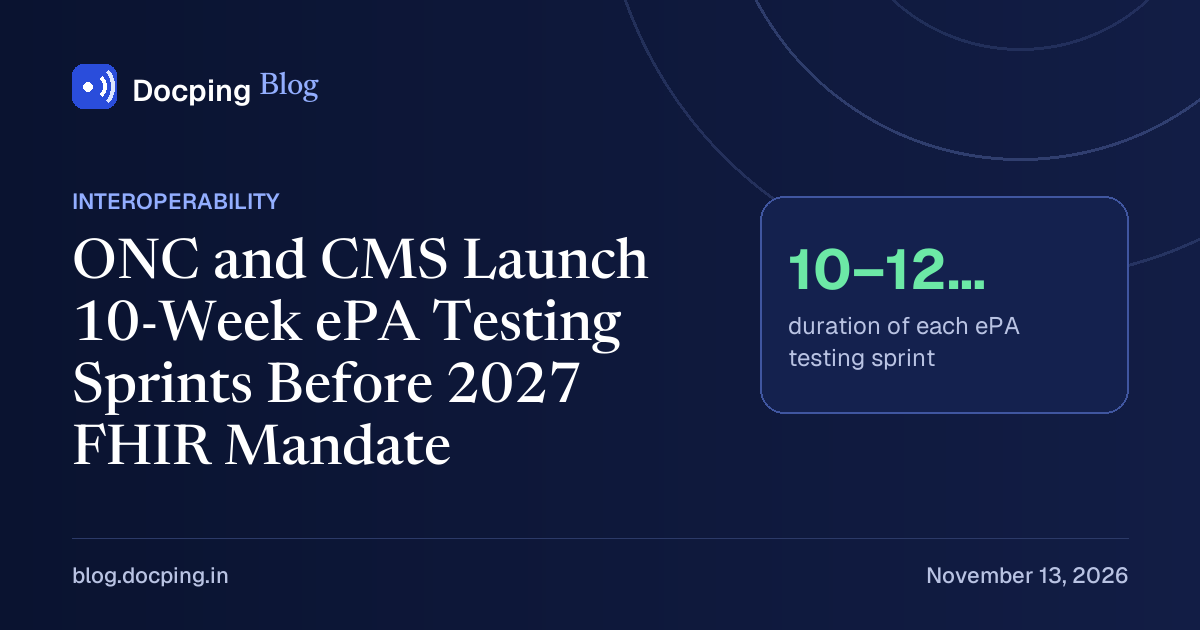
ONC and CMS Launch 10-Week ePA Testing Sprints Before 2027 FHIR Mandate
Federal agencies invite payers, providers, and EHR developers to validate end-to-end prior-authorization workflows using HL7 FHIR Da Vinci guides in production-like environments.
The Office of the National Coordinator for Health IT (ONC) and the Centers for Medicare & Medicaid Services (CMS) announced a joint industry testing initiative on November 12 to validate end-to-end electronic prior authorization (ePA) workflows in production-like environments before the January 1, 2027 federal deadline 12. The voluntary 10–12-week sprints let health plans, hospitals, EHR developers, and intermediaries run their own workflows across connected systems using the HL7 FHIR Da Vinci implementation guides for Coverage Requirements Discovery (CRD), Documentation Templates and Rules (DTR), and Prior Authorization Support (PAS) 126.
Key takeaways - ONC and CMS opened registration for 10–12-week ePA testing sprints on November 12; organizations must express interest by November 20 16. - Testing uses the HL7 FHIR Da Vinci CRD, DTR, and PAS implementation guides in a virtual environment (FHIRplace) operated by Drummond Group with MITRE support 12. - CMS regulations require impacted payers — Medicare Advantage, Medicaid managed care, CHIP, and ACA exchange plans — to deploy standardized Prior Authorization APIs by January 1, 2027 2.
What the testing sprints cover
Each sprint runs 10–12 weeks and focuses on high-volume clinical services that require prior authorization 1. Participants use their actual workflows to examine how prior-authorization requests and decisions move across connected systems, aiming to find technical barriers and workflow gaps that could appear in real-world implementation 16. The events include coordinated scenarios based on those high-volume services, plus supporting resources to help trading partners test together 1.
ONC and CMS engaged the MITRE-led Health Federally Funded Research and Development Center and Drummond Group to handle stakeholder recruitment, readiness discussions, participant matching, and testing coordination 12. Drummond Group operates FHIRplace, the virtual interoperability testing environment where developers, providers, payers, and intermediaries simulate real-world transactional traffic across connected endpoints 12.
Which standards are being tested
The initiative anchors on three sequential HL7 FHIR Da Vinci Burden Reduction implementation guides 2:
- Coverage Requirements Discovery (CRD) — enables a provider’s EHR to query a payer’s system in real time at the point of order entry to determine whether a proposed service requires prior authorization 23. CRD clients are typically EHRs, practice management systems, or scheduling systems; CRD servers act on behalf of payers to share coverage rules 3.
- Documentation Templates and Rules (DTR) — pulls payer-specific clinical documentation requirements directly into the clinical workflow, allowing automated extraction of structured data from the patient’s chart without manual entry 24. DTR leverages FHIR Questionnaires with embedded CQL logic and value sets to retrieve existing information and prompt for additional relevant data 4.
- Prior Authorization Support (PAS) — packages the clinical evidence into a standardized FHIR payload and transmits it electronically to the health plan for automated adjudication and immediate status tracking 25. PAS also defines capabilities for checking status, updating, and canceling requests 5.
All three guides are published as Standards for Trial Use (STU) and continue to evolve through connectathon testing and implementer feedback 345.
Who can participate and how
The agencies encourage interest from organizations of all sizes, including smaller organizations and those serving rural communities 16. Eligible participants include payers, providers, hospitals, EHR developers, clearinghouse intermediaries, and other industry partners 126. Registration is voluntary; testing activities do not constitute certification under the ONC Health IT Certification Program or a determination of compliance with CMS requirements 1.
Organizations can learn more and express interest by November 20, 2026 16. First-round space is limited; ONC notes future announcements about additional testing opportunities 1. For questions, contact Susan Hull at shull@mitre.org 1.
What the 2027 deadline requires
Under CMS regulations finalized in the Interoperability and Prior Authorization final rule (CMS-0057-F), impacted payers must deploy standardized Prior Authorization APIs by January 1, 2027 2. Impacted payers include Medicare Advantage organizations, state Medicaid and CHIP fee-for-service programs, Medicaid managed care plans, and Qualified Health Plan issuers on the federally facilitated exchanges 2.
The rule also sets stricter turnaround times: 72 hours for expedited requests and seven calendar days for standard decisions 2. Additionally, CMS finalized an electronic prior authorization quality measure that becomes an optional bonus metric for eligible clinicians and hospitals in calendar year 2027 before becoming mandatory in 2028, creating direct financial incentives for providers to adopt FHIR-based authorization workflows 2.
What happens with the findings
ONC and CMS plan to turn findings into practical improvements 1. Some findings may point to standards that need clarification or revision; others may reveal a need for clearer educational materials for developers, providers, and hospitals, or more useful implementer guidance 1. Participant feedback and lessons learned will inform future testing and implementation activities 1. The goal is to identify critical updates quickly and help industry prioritize improvements needed for successful implementation across care settings 1.
What this means in practice
If you are a payer, EHR developer, or provider organization subject to the 2027 mandate, the sprints are the clearest pre-deployment check available. Join a sprint by expressing interest before November 20 to test your actual workflow against live trading partners in FHIRplace. Use the results to fix integration gaps — whether in CRD hook triggering, DTR questionnaire rendering, or PAS bundle assembly — while the STU specifications are still evolving 345. If you are not selected for the first round, monitor ONC and CMS channels for future sprint announcements and treat the published Da Vinci IGs as your implementation baseline 1.
Sources
- ONC and CMS Launch Industry Initiative Advancing Electronic Prior Authorization Testing — HealthIT.gov (ONC/ASTP), 2026-11-12
- ONC and CMS Launch 10-to-12-Week ePA Testing Sprints Ahead of 2027 FHIR Mandates — HIT Consultant, 2026-11-12
- CRD IG Home Page - Da Vinci - Coverage Requirements Discovery v2.2.1 — build.fhir.org
- Documentation Templates and Rules Implementation Guide Home Page - Da Vinci - Documentation Templates and Rules v2.2.0 — hl7.org
- Prior Authorization Implementation Guide Home Page - Da Vinci Prior Authorization Support (PAS) FHIR IG v2.2.1 — build.fhir.org
- ONC, CMS move electronic prior authorization into real-world testing | Fierce Healthcare — fiercehealthcare.com, 2026-11-12
- Federal Register :: Medicare and Medicaid Programs; CY 2027 Payment Policies Under the Physician Fee Schedule and Other Changes to Part B Payment and Coverage Policies; Medicare Shared Savings Program Requirements; and Medicare Prescription Drug Inflation Rebate Program — federalregister.gov, 2026-11-09
Researched and drafted with AI from the sources above, and checked claim by claim against them before publishing.