Google Cloud Previews Gemini for Healthcare with Epic and MCP
Read-only Epic and Oracle Health connectors join open MCP servers from GoodRx and UiPath in Google Cloud's healthcare preview.
Google Cloud launched Gemini for healthcare in U.S. preview on Nov. 10, 2026, delivering an enterprise agentic orchestration layer designed to coordinate clinical, financial, and administrative operations across health systems and health plans 14. For integration engineers and health-IT leaders, the rollout signals an operational pivot toward open tooling standards, pairing read-only electronic health record (EHR) connectors with the Model Context Protocol (MCP) to bridge foundation models with production healthcare data 123.
Key takeaways - Google Cloud launched Gemini for healthcare in preview for Gemini Enterprise Standard and Enterprise Plus customers, targeting clinical chart synthesis, medical necessity reviews, and prior authorization appeals 14. - The platform enforces strict zero-write-back rules on read-only connectors for Epic Systems and Oracle Health to safeguard primary clinical records 1. - Production MCP servers from GoodRx and UiPath establish the open Model Context Protocol as a practical alternative to custom REST wrappers for clinical artificial intelligence (AI) agents 123.
What is Gemini for healthcare?
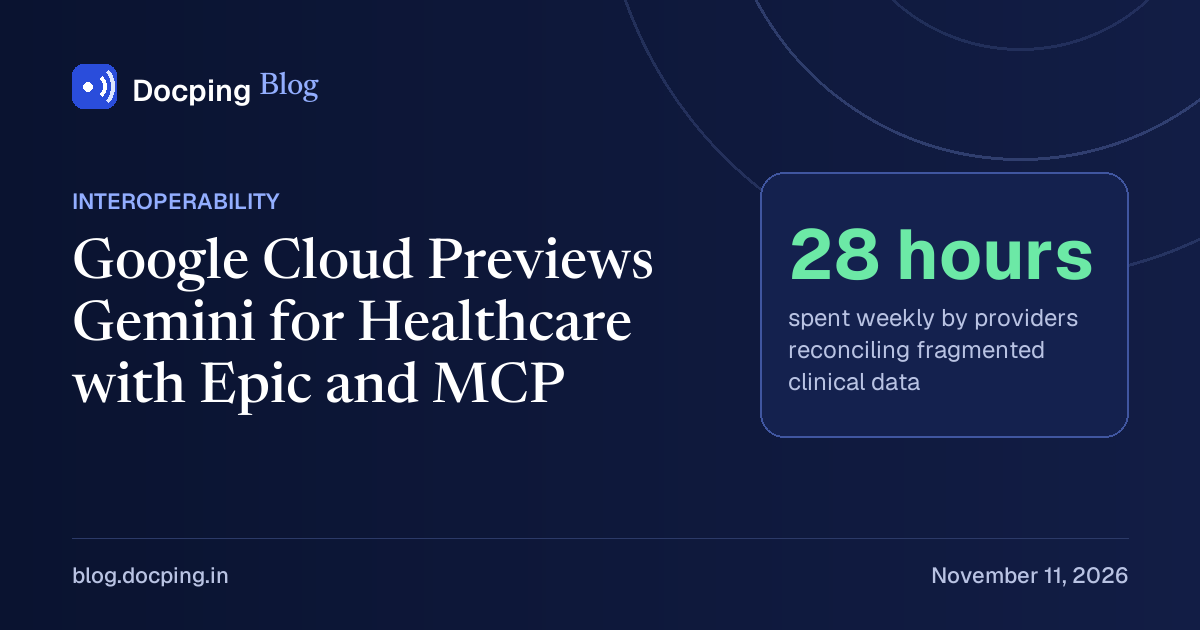
Gemini for healthcare is an enterprise agent platform built to resolve administrative and clinical data fragmentation 14. According to Google Cloud, providers spend nearly 28 hours per week manually reconciling clinical information trapped across disconnected EHRs, claims clearinghouses, and payer policy portals 1. The system was developed alongside clinical and health plan leaders to support Health Insurance Portability and Accountability Act (HIPAA) compliance 4.
“The fundamental challenge in healthcare isn’t a lack of information—it’s the immense friction of making that data actionable across a highly regulated ecosystem,” said Thomas Kurian, Google Cloud CEO, in a statement 4. “By working directly alongside our healthcare customers, we’ve built a platform that resolves chronic bottlenecks so that the industry can put its focus entirely back on human health” 4.
The platform architecture is structured around four functional layers 14:
- Skills: Expert-authored, modular instructions and context packages that guide Gemini agents through multi-step healthcare workflows such as chart preparation and medical necessity reviews 1. Organizations can enforce custom operational rules 1.
- Enterprise Connectors: Secure links into existing clinical, financial, and administrative systems that inherit source-system permissions and user identity without requiring data migration 1.
- Partner Ecosystem: Integrations with third-party specialized agents—including the American Society of Clinical Oncology (ASCO) Oncology Guideline Assistant—and global system integrators such as Accenture, Deloitte, Cognizant, PwC, KPMG, Slalom, and Wipro 1.
- Governed Platform and Model Choice: A runtime that dynamically routes tasks between high-reasoning frontier models for clinical chart analysis and lightweight models for administrative routing 1. Every generated output includes clickable source citations linking directly to authenticated progress notes or policy manuals 1.
Gemini for healthcare is available in preview to Gemini Enterprise Standard and Gemini Enterprise Plus customers through per-user subscriptions or pay-as-you-go pricing 4. Launch partners and pilot organizations include HCA Healthcare, Northwell Health, Highmark Health, Blue Cross Blue Shield of Massachusetts, and ASCO 4.
How does the platform connect to Epic and Oracle Health?
The platform’s clinical data integration layer connects directly to Epic Systems and Oracle Health using native connectors that extract clinical notes, diagnoses, active medications, laboratory results, and vitals 1. Both EHR connectors enforce strict zero-write-back rules, ensuring the primary system of record cannot be altered directly by agent outputs 1.
Beyond primary EHRs, the clinical data tier incorporates several specialized data platforms 1: - InterSystems FHIR Server: Manages Fast Healthcare Interoperability Resources (FHIR) repositories to scale interoperability across disparate data stores 1. - Verato: Provides master patient identity matching across fragmented hospital encounters and external facilities 1. - Keragon: Delivers a connectivity gateway into more than 400 specialized clinical applications 1. - Cyera Dataport: Inspects and classifies protected health information (PHI) across agent execution paths to enforce HIPAA compliance and maintain audit logs 1.
“Through our work with Google Cloud, we’re exploring how Gemini can interpret and synthesize complex patient information from multiple electronic health record systems and care settings, connecting data from different sources to give clinicians a more complete and cohesive understanding of a patient’s medical history,” said Dr. Michael Schlosser, EVP and chief clinical officer at HCA Healthcare 4.
Why is the Model Context Protocol gaining ground?
A notable technical element of the launch is Google Cloud’s adoption of the open Model Context Protocol (MCP) to standardize how AI models call external tools and retrieve context 123.
In Gemini for healthcare, GoodRx launched the first enterprise deployment of its MCP server 2. Rather than relying on custom REST application programming interface (API) wrappers or static retrieval-augmented generation (RAG) vector embeddings—which can decay quickly when drug pricing fluctuates—the GoodRx MCP server lets Gemini query real-time pharmacy cash pricing, manufacturer copay assistance programs, and discount coupons using natural language 12. The query cross-references medication entities, dosages, package quantities, and patient ZIP codes against retail pharmacy networks during the clinical decision-making process 2.
“AI is transforming how people discover and access healthcare,” said Nitin Shingate, Chief Technology Officer of GoodRx 2. “By bringing GoodRx’s trusted prescription pricing and savings capabilities directly into AI-powered workflows, we’re surfacing affordability information when healthcare decisions are being made. Starting with Google Cloud, our standards-based MCP integration creates a scalable foundation to expand GoodRx capabilities across the broader AI ecosystem” 2.
UiPath also joined as a launch partner with the UiPath MCP Server 3. The integration lets Gemini for healthcare invoke deterministic automations, robotic process automation (RPA) tasks, and agents across legacy interfaces, mainframes, and APIs while preserving the UiPath Platform’s existing permission and audit controls 13.
“With UiPath’s MCP server integration, teams using Gemini can run agents, automations, and orchestration in one governed workflow, giving the peace of mind that their most critical workflows move faster with every step auditable,” said Mark Geene, group senior vice president of Product Management at UiPath 3.
Aashima Gupta, global managing director of Healthcare at Google Cloud, noted that pairing Gemini with the UiPath MCP Server helps healthcare organizations move “from conversational AI to trusted, governed action that directly supports clinicians and improves patient care” 3.
Which clinical and administrative workflows are supported?
The platform targets specific touchpoints across clinical care delivery and insurance administration 14:
- Longitudinal Timeline Synthesis: Reconciles conflicting medication lists, aggregates fragmented records, and separates active chronic conditions from resolved diagnoses 1.
- Pre-Visit Clinical Chart Preparation: Audits records before procedures to flag missing consent documents, outstanding diagnostic clearances, and overdue preventive screening gaps 1.
- Audit-Ready Prior Authorization and Appeals: Extracts clinical documentation to meet payer coverage criteria, flags missing data prior to submission, and drafts appeal letters grounded in medical records and specific policy language if claims are denied 1. UiPath RPA agents assemble evidence packets and submit requests into external payer portals 1.
- Medical Policy Adjudication: Matches incoming prior authorization packets against internal health plan clinical guidelines, compiling an evidence-indexed summary for medical directors 1.
- Benefit Calculation and Coverage Rules: Computes out-of-pocket patient liability, deductibles, and network tiering from benefit booklets 1. For Medicare Advantage plans, the platform enforces statutory Centers for Medicare & Medicaid Services (CMS) National Coverage Determinations (NCDs) and Local Coverage Determinations (LCDs) when internal commercial guidelines are more restrictive 1.
Other native connectors supporting these workflows include IMO Health for terminology normalization, an ICD-10 coding engine, an RxNorm vocabulary connector, the NPPES National Provider Identifier (NPI) Registry, Optum (for Network Eligibility, Coordination of Benefits, and EvidenceVue clinical data), Suki for ambient documentation, Synthpop Careflow for referral fax processing, Infinitus Relay for automated payer verification calls, and Salesforce Health Cloud 14.
“It needs to take action, navigate complex systems, and handle the administrative work that too often gets in the way of patients getting care,” said Ankit Jain, CEO of Infinitus 4.
What this means in practice
For health systems and digital health engineering teams, Gemini for healthcare outlines a clear operational template for deploying agentic AI:
- Review EHR access boundaries: Google Cloud’s decision to restrict Epic and Oracle Health connectors to read-only extraction reflects enterprise resistance to autonomous AI write-backs in core clinical databases 1. Integration leads should assume primary systems of record will remain strictly read-only for third-party agents in the near term 1.
- Evaluate MCP for external tool design: Health-tech developers building clinical microservices or point-of-care tools should evaluate exposing capabilities via MCP servers rather than custom API integrations 123. As major cloud providers incorporate MCP into foundation model runtimes, standardized protocol interfaces will reduce the friction of deploying tools into health-system environments 23.
- Audit grounding and citation trails: Because Gemini enforces clickable citations to authenticated clinical notes and published coverage policies, builders should ensure all multi-step LLM outputs maintain direct reference links to source records 1.
Our read: Google Cloud’s support for MCP is an important validation of the Model Context Protocol within enterprise healthcare. By allowing third parties like GoodRx and UiPath to connect through MCP servers rather than closed proprietary plugins, the platform lowers integration barriers for specialized clinical software vendors seeking distribution across hospital AI platforms 123.
What we’d watch: As pilot health systems like HCA Healthcare and Northwell Health deploy the preview, track whether dynamic model routing can maintain clinical accuracy during complex chart synthesis while keeping cloud inference expenses predictable 14.
Sources
- Google Cloud Launches Gemini for Healthcare as an Enterprise Agentic Orchestration Layer — HIT Consultant, 2026-11-10
- GoodRx Launches MCP Integration with Google Cloud Gemini for Healthcare: Real-Time Prescription Pricing at the Point of Care — HIT Consultant, 2026-11-10
- UiPath Accelerates Enterprise AI Transformation with Google Cloud's Gemini for Healthcare – Company Announcement - FT.com — ft.com, 2026-11-10
- Google unveils Gemini for healthcare — fiercehealthcare.com, 2026-11-10
- Google Cloud launches AI tool Gemini for healthcare - Modern Healthcare — modernhealthcare.com, 2026-11-10
Researched and drafted with AI from the sources above, and checked claim by claim against them before publishing.