CMS Proposes Rule on MA Directories, Part D Copays, and PBM Payments
The proposed rule implements three Consolidated Appropriations Act sections with a December 15 comment deadline.
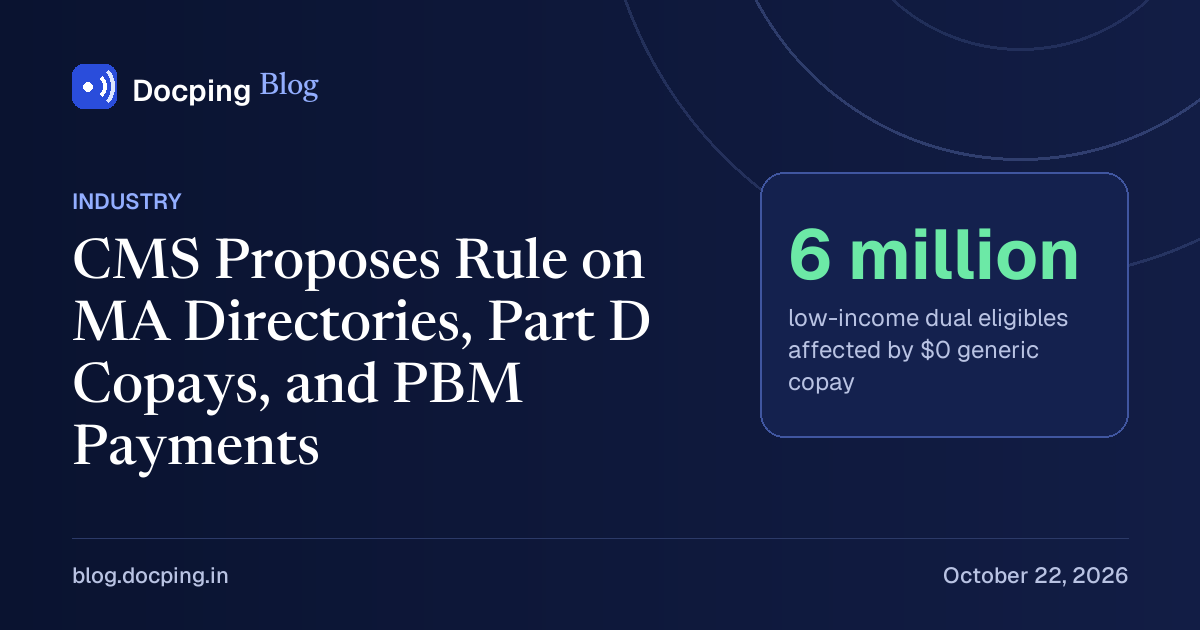
CMS published a proposed rule on October 20 that bundles three major Medicare provisions from the Consolidated Appropriations Act, 2026 into a single package with a December 15 comment deadline. The rule, CMS-4214-P, would impose new provider directory accuracy standards for Medicare Advantage plans, eliminate generic drug copays for the lowest-income dual-eligible beneficiaries, and reshape how pharmacy benefit managers are paid in Part D 1.
Key takeaways - The rule implements three sections of the February 2026 funding law: provider directory accuracy (REAL Act), Part D low-income cost-sharing, and PBM accountability 1 - MA plans must verify directories every 90 days and protect enrollees from out-of-network charges due to directory errors, starting contract year 2028 13 - Generic copays for full-benefit dual eligibles at or below 100% FPL drop from $1 to $0 effective plan year 2028 1
What the proposed rule covers
The Federal Register notice (CMS-4214-P, RIN 0938-AV88) implements sections 6219, 6220, and 6224 of the Consolidated Appropriations Act, 2026 (Public Law 119-75) 1. Each section operates independently: section 6219 adjusts Part D cost-sharing for low-income individuals, section 6220 enacts the Requiring Enhanced and Accurate Lists of (REAL) Health Providers Act, and section 6224 establishes new Pharmacy Benefit Manager accountability requirements. CMS emphasizes that the provisions are severable and intended to operate independently 1. Comments are due by 5 p.m. Eastern Standard Time on December 15, 2026 1.
Provider directory accuracy: REAL Act implementation
Section 6220 establishes new provider directory accuracy and accountability requirements for Medicare Advantage organizations beginning in contract year 2028, heightening existing standards 13. The proposed rule would require MA organizations to verify and update their provider directories at least once every 90 days beginning in contract year 2028 13. Enrollees who receive care from an out-of-network provider because of inaccurate directory information would pay no more than their in-network cost-sharing amount 13.
Plans must also conduct annual accuracy analyses and report accuracy scores to CMS. Starting in contract year 2029, CMS would publicly display those scores in machine-readable format, and MA organizations must prominently display them in their directories 1. A 2023 study cited in trade coverage found upwards of 80% of provider listings contained inconsistencies; a 2018 CMS review of MA directories found inaccuracies ranging from 5% to 93% depending on the plan 3. CMS Administrator Dr. Mehmet Oz stated the proposals will give seniors “more reliable information, stronger financial protections, and greater confidence” in Medicare 3.
The directory data collected under this rule could ultimately feed into a national provider directory CMS is developing as a centralized repository for all insurers 3.
Part D cost-sharing: zero generic copays for low-income dual eligibles
Section 6219 amends the Social Security Act to reduce the generic drug copayment from $1 to $0 for full-benefit dual eligible (FBDE) individuals with incomes at or below 100% of the Federal Poverty Level, effective for plan years beginning on or after January 1, 2028 1. The existing annual CPI inflation adjustment methodology would apply only to plan years before 2028 for this population 1.
Currently, FBDE individuals at or below 100% FPL pay a $1 generic copayment adjusted annually for CPI — $1.60 for generic drugs and $4.90 for other covered Part D drugs in plan year 2026 1. CMS estimates approximately 6 million enrollees would be affected 1. The change does not alter copayments for brand-name or other covered drugs, which continue to be adjusted annually for CPI 1.
PBM accountability: flat fees and reporting requirements
Section 6224 targets pharmacy benefit manager compensation in Medicare Part D. The proposed rule would limit PBM remuneration to flat service fees that reflect fair market value and cannot be based on drug price, rebates generated, or formulary placement 13. PBMs must pass through any rebates on drugs to the Part D plan sponsor 3.
PBMs and their affiliates would also face new data reporting requirements to Part D plan sponsors and CMS, including annual reports on spending, formulary decisions, drugs dispensed, and revenue retained 13. The rule proposes transparency in price guarantee arrangements between PBMs and plan sponsors, and disclosure of certain agreements between PBMs and pharmaceutical manufacturers 1. Enforcement mechanisms include disgorgement of funds to CMS for violations of remuneration requirements 1.
Comment deadline and timeline
All comments on CMS-4214-P must be received by December 15, 2026 at 5 p.m. EST, submitted electronically via regulations.gov (docket CMS-2026-2533), by regular mail, or by express mail to the addresses listed in the Federal Register notice 1. CMS notes that any new marketing and communications policies in the rule, once finalized, would apply for contract year 2028 marketing beginning October 1, 2027 1. The agency also indicated it anticipates releasing another proposed rule of policy and technical changes for MA and Part D later this fall 3.
What the separate drug importation delay means for pharmacy tools
Separately, the Trump administration delayed a U.S. Customs and Border Protection rule that would have required detailed content coding and tariff payments on low-value international parcels — including personal prescription drug shipments from Canada and other countries — from October 22, 2026 to January 20, 2027 2. That rule is not part of CMS-4214-P. KFF Health News reports the delay followed pressure from advocacy groups, congressional Democrats, and Florida Republicans concerned about disruption to personal drug imports before the midterm elections 2.
An estimated 2.3 million Americans regularly imported medications from abroad as of a 2020 study, and roughly 4 in 10 Americans in a recent KFF survey said cost led them to not take medications as prescribed over the past year 2. The underlying customs rule would require shippers to transmit detailed package data and post bonds for each shipment, adding cost and complexity 2. FDA and CBP have not clarified how they will adjudicate personal prescription shipments once the rule takes effect 2.
What to do now
MA plans and directory vendors: Build 90-day verification cycles, accuracy scoring methodology, and cost-sharing protection workflows for contract year 2028 compliance. Plan for public display of machine-readable accuracy scores by contract year 2029.
Part D sponsors: Model the financial impact of $0 generic copays for an estimated 6 million low-income dual eligibles starting plan year 2028. Update benefit designs and member communications accordingly.
PBMs and Part D sponsors: Audit current compensation arrangements against the proposed flat-fee, fair-market-value standard. Prepare systems for annual reporting of compensation, cost performance, price guarantees, and manufacturer agreements.
All affected entities: Submit comments by December 15, 2026. Coordinate with trade associations on joint submissions where appropriate.
Digital health companies building pharmacy, price-transparency, or formulary tools: Track the separate customs rule on personal drug importation (delayed to January 20, 2027) as it affects data sources and patient cost assumptions. Monitor CMS for the anticipated follow-up MA/Part D proposed rule later this fall.
Our read: Packing three distinct statutory mandates into one proposed rule creates a single comment window for stakeholders with very different interests — MA plans, Part D sponsors, PBMs, and directory vendors. The December 15 deadline is tight for organizations that need to model operational and financial impacts across all three domains. The REAL Act’s 90-day verification cycle and cost-sharing protection are the most operationally demanding for MA plans; the PBM flat-fee requirement could reshape Part D contracting if finalized as proposed.
What we’d watch: Whether CMS finalizes the PBM disgorgement provision without modification, and how the agency defines “fair market value” for PBM services in subsequent guidance. Also whether the national provider directory effort accelerates now that MA directory data will flow to CMS in standardized accuracy scores.
Sources
- Medicare Program; Implementation of Sections 6219, 6220, and 6224 of the Consolidated Appropriations Act, 2026 — Federal Register, 2026-10-20
- ‘Go to Canada’: Trump Touted Americans’ Access to Cheaper Drugs. A New Rule Threatens It. — KFF Health News, 2026-10-22
- CMS proposes rule to clean up MA provider directories, shine light on PBMs — healthcaredive.com, 2026-10-19
- Home - Centers for Medicare & Medicaid Services — cms.gov, 2026-10-21
Researched and drafted with AI from the sources above, and checked claim by claim against them before publishing.