VA Opens External Provider Scheduling to Epic Health Systems
Direct booking via WellHive turns read-only record exchange into bi-directional scheduling.
The Department of Veterans Affairs has connected its External Provider Scheduling platform to commercial Epic electronic health record systems through middleware vendor WellHive, allowing VA staff to view community provider availability and book outpatient specialty appointments directly 12. The integration moves public-private health data exchange from document-level query retrieval into live, transactional scheduling 12.
Key takeaways - All VA medical centers deployed the External Provider Scheduling platform in late 2025, which encompasses 27,000 participating non-VA providers across 78 clinical specialties 3. - Epic-based health systems connect through an integration managed by WellHive, giving VA staff direct access to book open clinic slots while providers retain control over their scheduling templates 12. - Early implementation at Deaconess Illinois booked 688 veterans, cut average scheduling turnaround times to under five minutes, and supported a nearly 30% year-over-year increase in VA patient encounters 3.
How does External Provider Scheduling work with Epic?
External Provider Scheduling connects VA enterprise networks to private-sector EHR calendars through an integration layer built by WellHive 12. The VA awarded WellHive a contract for the platform in 2023 to bridge federal care-coordination systems and civilian electronic health records 3.
Under the legacy workflow, booking care outside the VA required staff to rely on telephone calls, faxes, and manual record requests 12. Because the majority of the nation’s 18-plus million veterans receive at least some clinical care from private-sector community providers outside VA medical facilities, that administrative friction frequently delayed care delivery 12.
When a participating civilian health system enables the connection, credentialed VA medical support assistants gain real-time visibility into open clinic appointment slots within the health system’s scheduling grid 12. Participating community groups retain sovereign administrative control over their scheduling templates, dictating which locations, provider hours, and appointment types are exposed to the VA 1.
Once a VA staff member selects and confirms an appointment in the platform, the transaction closes automatically on the receiving end. The referral packet, the veteran’s clinical history, and the formal billing authorization number transmit electronically to the community clinic, completing the booking workflow in a single step 12.
What operational results are early adopters reporting?
Early health system data demonstrate significant reductions in scheduling overhead and administrative turnaround times 3. Evansville, Indiana-based Deaconess Health System adopted the platform in February, linking staff at the Marion VA Medical Center to clinic slots at Deaconess Illinois 23.
According to Andrew Beck, system director of business development at Deaconess Health System, staff have booked 688 veterans to Deaconess Illinois through the system 3. Beck noted that at one point this year, appointment booking times at Deaconess Illinois averaged under five minutes, compared to the extended back-and-forth typical of telephone coordination 3.
That operational speed has translated into higher patient volumes. William Davis, regional president of Deaconess Illinois, reported a nearly 30% increase in year-over-year VA patient encounters, attributing the change to improved access 3. Clinical documentation from those encounters is subsequently transmitted back to the VA using EpicCare Link 3. Deaconess is currently preparing to open scheduling visibility for radiologist appointments in Illinois and plans to expand the integration across additional geographic locations 3.
Why is transactional interoperability replacing document queries?
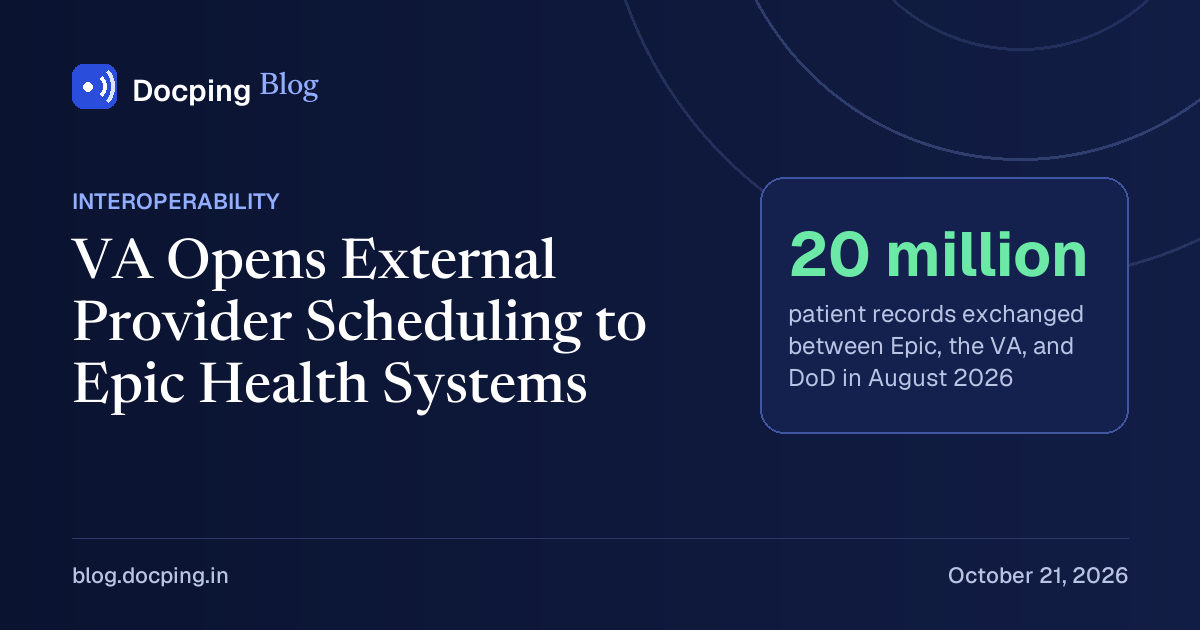
Cross-enterprise interoperability between federal agencies and civilian health systems has historically focused on read-only clinical record exchange rather than transactional workflow execution 1. That data-exchange volume is substantial: in August 2026 alone, health systems using Epic exchanged more than 20 million electronic patient records with the VA and the Department of Defense 12.
In addition to record queries, automated veteran identification checks in Epic have helped care teams identify more than 300,000 veterans and link them to federal benefits over the past year as part of the federal Veteran Interoperability Pledge 2.
Yet query-based exchange does not solve the administrative hurdle of initiating care. While a civilian doctor can view historical military exposures or prior surgical notes to prevent duplicate diagnostic tests and drug interactions 1, getting the patient into the clinic chair has still required manual intervention. The addition of transactional scheduling bridges the gap between knowing a patient’s clinical history and securing their appointment 1.
Howard Manuel, J.D., VA deputy senior advisor, noted that the agency is “really cooking with grease and being able to schedule veterans much faster” 3. Manuel is scheduled to present the system at Epic’s annual Open@Epic conference in Verona, Wisconsin, alongside leaders from Deaconess Health System and WellHive to encourage broader civilian provider participation 13.
Which health systems and EHRs can participate?
While the current expansion highlights health systems running Epic, the underlying scheduling platform is designed to be EHR-agnostic 12. According to the VA, the system supports integrations across more than 150 community EHR and practice management software platforms to prevent rural and independent specialty clinics from being excluded 13.
All VA facilities completed their internal deployment of the platform in late 2025 3. As of a March 2026 agency release, the network included 27,000 participating non-VA providers covering 78 specialties 3.
Adoption has accelerated following federal oversight. At the start of the second Trump administration, Representative Tom Barrett (R-Mich.) pressed the VA on implementation timelines, pointing to delays under the prior administration 3. Secretary Doug Collins told lawmakers in June 2025 that the agency was doing “everything we possibly can” to accelerate adoption 3.
Chris Faraji, president of WellHive, stated that the company is actively onboarding additional enterprise systems nationwide 3. Beyond Deaconess Health System, active implementation work is underway with the Medical University of South Carolina, the University of Arkansas for Medical Sciences, Allegheny Health Network, and West Virginia University 3.
What it means in practice for health system IT leaders
For health system chief information officers, CMIOs, and integration engineers serving veteran populations, connecting to federal scheduling networks requires specific technical and operational alignment:
- Template governance and slot release: Participating community providers retain full sovereign control over their scheduling templates, deciding which hours, appointment types, and locations are made available to VA staff 1.
- Referral document routing: Once a VA staff member books an appointment, the referral packet, clinical history, and formal authorization number are delivered electronically to the community clinic, closing the administrative loop in a single digital transaction 1.
- Bidirectional loop closure: Early adopters like Deaconess Health System share medical information from treated veterans back to the VA through the EpicCare Link system 3.
Our read: The operational success at Deaconess demonstrates that health systems view direct scheduling integration not just as a civic accommodation for veterans, but as an effective channel for patient acquisition and capacity utilization 13. For digital health platforms and integration architects building on multi-EHR ecosystems—where tools like Docping Bridge manage OAuth security, schema validation, and audit tracking across disparate endpoints—this deployment illustrates how healthcare APIs are progressing. As federal programs prove the feasibility of external schedule access, health system IT leaders will face increasing pressure from private payers, accountable care organizations, and digital health networks to expose the same bi-directional booking capabilities beyond the VA.
Sources
- VA-Epic Connection Enables Direct Specialist Scheduling for Veterans — HIT Consultant, 2026-10-19
- Epic health systems can now link scheduling to the VA — beckershospitalreview.com, 2026-10-19
- VA pushes external providers to adopt tech streamlining veteran specialist appointments - Nextgov/FCW — nextgov.com, 2026-10-19
- 33 CFR Part 165 -- Regulated Navigation Areas and Limited Access Areas — federalregister.gov, 2026-10-16
Researched and drafted with AI from the sources above, and checked claim by claim against them before publishing.