EHR AI Transparency Disclosures Vary Widely Despite Certification
A study of 35 certified vendors finds inconsistent reporting on risk analysis, mitigation, and governance.
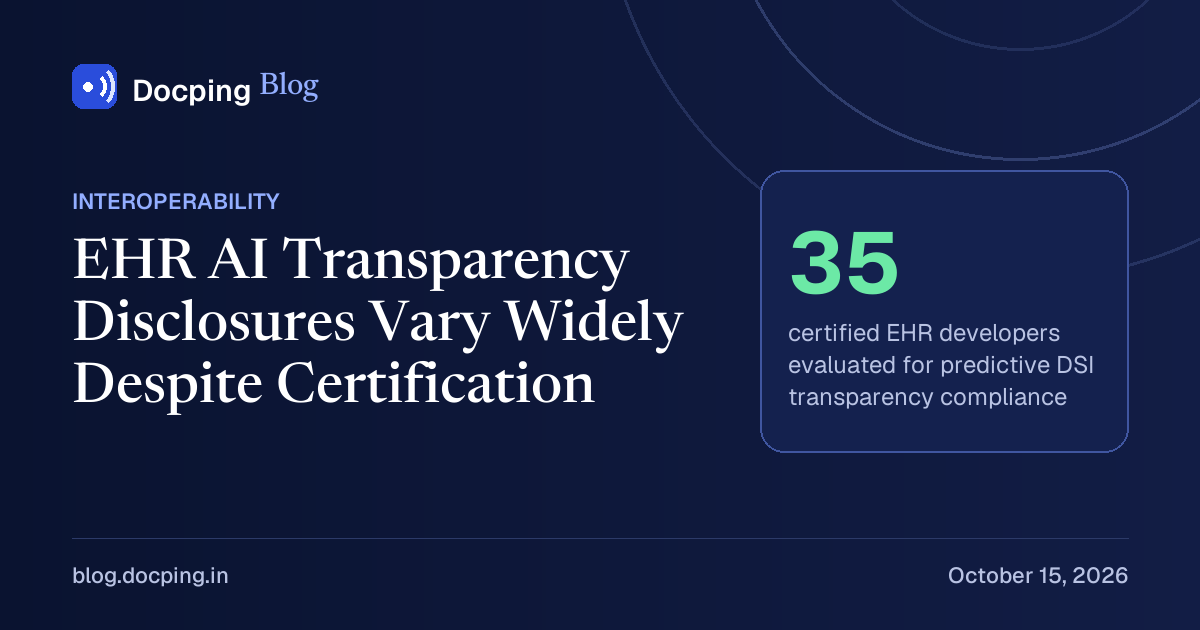
A new peer-reviewed study in npj Digital Medicine finds that across electronic health record developers certified under federal transparency requirements for predictive decision support interventions, public AI transparency disclosures on risk analysis, mitigation, and governance were inconsistent and often incomplete 1. The investigation, led by researchers at Georgetown University School of Medicine and MedStar Health’s National Center for Human Factors in Healthcare, examined 35 certified developers and suggests a need for standardized reporting and more rigorous certification review 1.
Key takeaways - All 35 certified EHR developers met the formal certification bar, yet their public transparency reports showed substantial variation in structure and detail 1. - Required disclosures cover risk analysis, mitigation, governance, and eight other attributes, but reporting was inconsistent and often incomplete across the board 1. - The authors suggest a need for standardized reporting and more rigorous certification review 1.
What the study examined
The research team evaluated how certified EHR developers adhere to federal transparency requirements for AI-enabled predictive decision support interventions 1. Developers must publicly report on risk analysis, risk mitigation, governance, and eight other attributes for each predictive DSI they certify 1. The study collected and analyzed these public disclosures from all 35 developers listed as certified as of the study period.
What the federal rules require
Federal transparency requirements mandate that developers of certified health IT modules containing predictive decision support interventions publicly report on risk analysis, mitigation, governance, and eight other attributes 1.
Key findings: certification ≠ consistency
Across the 35 developers, the study found: - Inconsistent structure: Reporting showed substantial variation in structure and detail 1. - Incomplete detail: Reporting was inconsistent and often incomplete across the board 1. - Universal certification: Despite these shortcomings, every developer in the sample held active certification for their predictive DSI modules 1.
The authors note that results suggest a need for standardized reporting and more rigorous certification review 1.
Broader context: a patchwork of oversight
The findings arrive as state and federal policymakers debate how to govern healthcare AI beyond the federal baseline. The Connected Health Initiative has proposed a shared-responsibility framework that would assign developers, health systems, and clinicians distinct accountability based on their control over AI risks, and urges states to avoid duplicative or conflicting requirements 5. Meanwhile, reporting from KFF Health News describes a private Slack workspace where CMS officials have been engaging directly with AI vendors on policy direction 6. Neither the state framework nor the federal engagement channel has produced binding rules that would standardize the disclosures the study found lacking.
What this means in practice
Our read: For health-tech founders embedding clinical AI into EHR workflows, treat the certified transparency page as a starting point, not a complete risk dossier. Plan to request the underlying risk-analysis artifacts, model cards, and governance charters during vendor due diligence — especially for high-stakes use cases like sepsis alerts or readmission scoring.
Our read: For CMIOs and clinical-informatics leads, build a checklist of the required attributes and score each vendor’s public disclosure against it before contract renewal. Use the gaps as leverage to negotiate contractual commitments for quarterly disclosure updates and independent audit summaries.
Our read: For health-system IT and revenue-cycle leaders, factor disclosure completeness into your EHR module procurement rubric. A vendor that publishes structured, detailed transparency reports today is less likely to require costly retrofitting if oversight shifts toward standardized reporting and more rigorous certification review, as the study suggests 1.
What we’d watch: Whether federal regulators respond by publishing a standardized reporting template or adding disclosure-quality checks to the certification surveillance process. The data make a clear case that the current approach is not producing comparable transparency 1.
Sources
- Electronic health record developer adherence to federal AI risk transparency requirements - npj Digital Medicine — npj Digital Medicine, 2026-10-14
- https://www.ncbi.nlm.nih.gov/entrez/query.fcgi?cmd=search&term=Nidhi%20Manikkoth — nih.gov
- https://www.ncbi.nlm.nih.gov/entrez/query.fcgi?cmd=search&term=Ngan%20Vo — nih.gov
- https://www.ncbi.nlm.nih.gov/entrez/query.fcgi?cmd=search&term=Jessica%20Handley — nih.gov
- Fragmented state AI rules could slow patient access - MobiHealthNews — mobihealthnews.com, 2026-10-08
- AI, tech leaders are lobbying Trump health officials in a government-run chat room - Fierce Healthcare — fiercehealthcare.com, 2026-10-14
Researched and drafted with AI from the sources above, and checked claim by claim against them before publishing.