NY and CT AGs Fine Boston Children's Health Physicians and XTIUM $2.7M
New York and Connecticut secure $2.7 million from pediatric network BCHP and IT vendor XTIUM over a 2024 data breach.
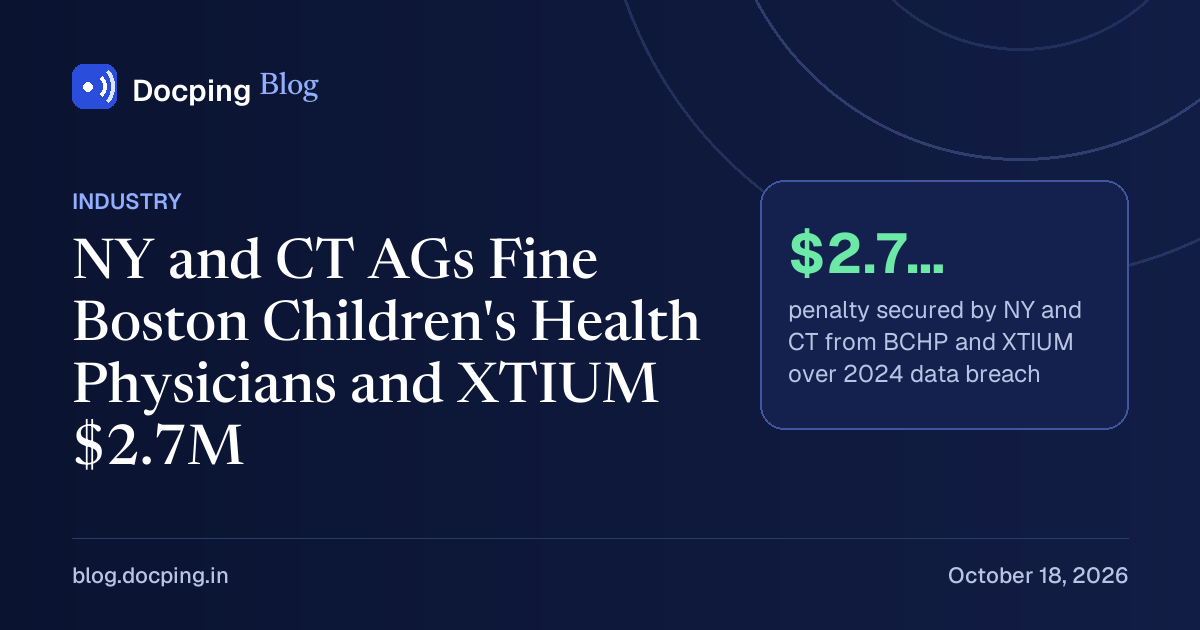
New York Attorney General Letitia James and Connecticut Attorney General William Tong announced a $2.7 million settlement with Boston Children’s Health Physicians (BCHP) and its IT vendor XTIUM over a 2024 breach that exposed records of approximately 825,000 New York and 62,871 Connecticut residents 1. The case matters because state attorneys general held both the provider and its IT vendor liable: the companies collectively agreed to pay penalties and must adopt specific security controls 1.
Key takeaways - The two-state settlement totals $2.7 million ($2.1M to New York, $540,000 to Connecticut) plus conditional penalties if terms are violated 1. - Investigators found BCHP knew of an unencrypted archive with over one million patient billing records for at least two years before the breach and failed to implement basic security policies or a vendor assessment program 1. - XTIUM lacked sufficient logging and monitoring to determine how attackers accessed its systems, and the breach ultimately reached 18 of its client networks 1.
What the settlement requires
Beyond the financial penalties, both entities must implement a comprehensive information security program, maintain a data inventory of private information, enforce reasonable authentication procedures, and deploy logging and monitoring systems with alerting for suspicious activity 1. BCHP faces an additional $1.04 million penalty to New York and $260,000 to Connecticut if it violates the settlement terms; XTIUM is bound by the same corrective actions 1.
How the breach unfolded
In August 2024, XTIUM suffered a breach that allowed hackers to access 18 client networks, including BCHP’s 1. Attackers stole records of approximately 825,000 New York residents and 62,871 Connecticut residents from BCHP’s network, including Social Security and driver’s license numbers for over 170,000 New Yorkers 1. The investigation revealed that XTIUM’s protections were so deficient it remains unable to confirm how hackers gained initial access 1.
Where BCHP fell short
A 2023 security audit identified multiple gaps at BCHP: missing security policies and procedures, absent standard security tools, no incident response plan, and no security vendor assessment program to define XTIUM’s specific responsibilities 1. Critically, BCHP data security executives knew for at least two years that an unencrypted archive containing more than one million patient billing records — names, addresses, dates of birth, Social Security numbers, treatment and billing information — sat largely unprotected until it was stolen in the 2024 breach 1.
Where XTIUM fell short
The investigation found XTIUM failed to adopt reasonable safeguards for both customer network data and the personal data of its own employees (200 of whom were New Yorkers) 1. It did not enforce common standards for its IT systems and lacked sufficient logging and monitoring to detect misuse of its remote support tool account 1.
Why vendor accountability matters for digital health
Our read: This settlement extends a pattern where state attorneys general treat vendor risk as a shared obligation rather than a contractual afterthought. For teams building or buying EHR integrations, the message is concrete: you cannot outsource accountability. The corrective actions — data inventory, authentication standards, logging with alerting — map directly to what a modern integration layer should enforce at the API level. If your product touches PHI, expect regulators to ask how you verify your partners’ controls, not just your own.
What to do next
- Inventory every third-party service that processes or stores PHI on your behalf and document the specific security responsibilities in writing.
- Require vendors to maintain centralized logging, alerting on anomalous access, and multi-factor authentication for all administrative and remote-support accounts.
- Conduct annual vendor security assessments that go beyond questionnaires — request evidence of encryption at rest, incident response testing, and patch management.
- Build contractual provisions that trigger notification, investigation cooperation, and liability sharing in the event of a breach affecting your data.
Sources
- NY AG James and CT AG Tong Secure $2.7 Million from Boston Children’s Health Physicians and XTIUM for 2024 Data Breach — DataBreaches.net, 2026-10-17
- Independence Blue Cross to pay $22.5M in Medicare Advantage inaccurate diagnoses allegations settlement - Fierce Healthcare — fiercehealthcare.com, 2026-10-05
- FTC, states sue ‘pharma bro’ over industry trades - Politico — politico.com, 2026-10-14
- CVS to pay $315 million to settle unlawful opioid prescription claims, Justice Department says - Reuters — reuters.com, 2026-10-13
Researched and drafted with AI from the sources above, and checked claim by claim against them before publishing.