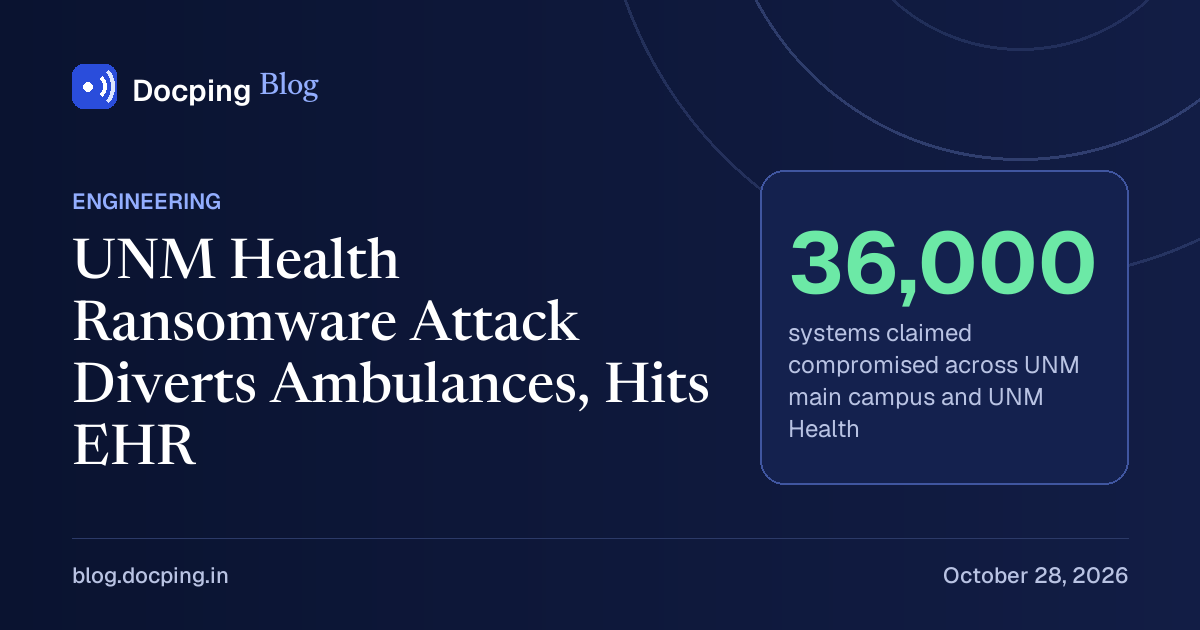
UNM Health Ransomware Attack Diverts Ambulances, Hits EHR
Aggressive containment protected core databases, but endpoint shutdowns and roster exfiltration claims spotlight the fragility of clinical systems.
A cyberattack on the University of New Mexico Health System (UNM Health) forced New Mexico’s only Level I trauma center to divert ambulances, cancel outpatient procedures, and unplug hospital workstations 12. The UNM Health ransomware attack disrupted operations across more than 30 clinics and prompted emergency containment procedures across the academic medical center before critical systems were brought back online the following morning 12.
Key takeaways - Emergency containment forced UNM Health to divert ambulance traffic between 12:30 p.m. and 2:30 p.m. on October 26, 2026, while canceling scheduled care across more than 30 clinics statewide 12. - While internal alerts directed staff to disconnect workstations and mobile devices to protect core servers, a new extortion group claimed to have accessed Cerner electronic health record rosters and 36,000 systems 12. - The disruption follows a series of high-profile cyber incidents across healthcare vendors, highlighting the operational risk when core clinical networks must sever network access during active containment 13.
What happened during the UNM Health ransomware attack?
The security incident was detected on October 26, 2026, triggering an immediate operational shutdown across the University of New Mexico Health Sciences Center 1. As containment efforts began around 11 a.m., the health system initiated precautionary diversions to protect patient safety 1. Ambulance diversions ran from 12:30 to 2:30 p.m. on October 26, directing emergency traffic to alternative facilities across Albuquerque and Santa Fe while UNM Health temporarily restricted new patient admissions 1.
The impact extended rapidly into outpatient and academic operations. The health system canceled appointments at more than 30 clinics across New Mexico and warned patients not to come in for scheduled visits, advising that non-emergencies should be delayed until further notice 2. Outpatient surgeries were called off to allow technical teams to protect the network 1.
According to internal alerts, users were instructed to shut down and unplug desktop computers and disconnect mobile devices from hospital Wi-Fi networks 2. The disruption also cleared the academic campus: all students at the School of Medicine, College of Pharmacy, College of Nursing, and College of Population Health were asked to leave campus on October 26, and classes were cancelled for a second day on Tuesday 12. Nonessential Health Sciences Center staff were instructed to remain at home while remediation continued 2.
What systems and patient data were affected?
UNM Health reported that aggressive containment limited the technical footprint of the breach, preventing the attackers from penetrating core infrastructure 1. While some end-user devices were affected, health-system IT teams and external cybersecurity partners prevented the threat actor from reaching core servers and systems 1.
Recovery moved quickly. By 10:27 p.m. on October 26, UNM Health announced that its hospitals remained open and that clinics would resume scheduled appointments on October 27, 2026 1. In the early hours of October 27, critical systems were brought back online and ambulance traffic returned to normal operations 1.
However, a new ransomware group calling itself Byod claimed credit for the attack, listing UNM Health on its data leak site alongside nine other victims 1. Byod claimed that 36,000 systems across the UNM main campus and UNM Health were compromised 1. The group alleged that it exfiltrated employee, student, and patient data, including payroll records, internal emails, and Cerner electronic health record (EHR) rosters 1.
In an unusual subsequent post, Byod claimed it had not realized UNM Health operated real-time clinical machinery, offering free decryption keys for the hospital sector while retaining the exfiltrated records 1. The group claimed it would offer up to $2,500 to affected patients for the inconvenience, even as it insisted it would retain other data 1. Law enforcement has been notified, a criminal investigation is underway, and UNM Health noted that it remains too early to verify the full scope of data involved 1.
How does the attack compare to recent healthcare breaches?
The UNM Health disruption is the latest in an escalating sequence of infrastructure attacks across the healthcare sector 3. Medical device manufacturers, clinical software vendors, and diagnostic networks have faced sustained operational disruption throughout the year 3.
In March, a cyberattack triggered the mass-wiping of employee devices at medical technology firm Stryker, while an August attack on Boston Scientific forced its network offline for weeks 3. Massive data compromises have also hit medical recordkeeping firm CareCloud, health-tech provider Craneware, and pharmaceutical distributor McKesson 3. Just days before the UNM Health incident, clinical testing laboratory Quest Diagnostics disclosed unauthorized access to its Quanum Lab Services Manager platform, exposing sensitive patient records across a system used by half a million clinicians 34. More context on that vendor-level breach can be found in our look at the Quest Diagnostics Quanum breach.
What sets the UNM Health event apart from platform-level data thefts is the acute physical risk to regional care delivery 1. Because UNM Hospital operates the only Level I trauma center in New Mexico, severing digital connectivity immediately backed up regional emergency services and shifted critical loads to neighboring facilities 1.
What does the incident mean in practice for health-system IT?
For health-system technical teams, clinical engineering leads, and third-party integration developers, the rapid containment sequence at UNM Health illustrates how security incidents immediately translate into clinical downtime 12.
- Formalize physical and wireless cut-off playbooks. When active intrusions occur, automated network segmentation often must be reinforced by human intervention. UNM staff had to manually unplug desktop machines and disconnect mobile devices from Wi-Fi access points 2. Health systems should verify that clinical floors have documented, rehearsed procedures for physical endpoint isolation that do not rely on local intranet messaging 2.
- Isolate and monitor EHR rosters and integration directories. In this incident, Byod claimed to have exfiltrated Cerner EHR rosters 1. Engineering teams managing API bridges, integration ingress points, and FHIR endpoints must ensure that directory services and roster endpoints enforce strict rate limiting, access auditing, and dedicated alerting for bulk administrative queries 1.
- Test air-gapped downtime workflows for acute care. UNM Health successfully kept the ambulance divert window to two hours, from 12:30 to 2:30 p.m. 1. Sustaining emergency department and trauma admissions during network downtime requires local, read-only electronic health record access or hardened, air-gapped downtime printouts that allow triage, medication verification, and emergency blood matching to continue without live network connectivity 1.
- Establish API kill switches for containment windows. Third-party integration engines must handle abrupt upstream server disconnects gracefully, maintaining local data queues and secure audit logs without leaking credentials or overwhelming recovering health-system endpoints during reconnection surges.
Our read: UNM Health’s decision to pull endpoints and divert ambulances before the attackers reached core databases prevented a catastrophic multi-week EHR outage 12. The fact that critical systems were restored in the early hours of October 27 suggests their segmentation and incident containment procedures held where it mattered most 1. However, Byod’s claim regarding exfiltrated Cerner EHR rosters illustrates that perimeter containment does not necessarily prevent data harvesting from compromised endpoints before isolation occurs 1.
What we’d watch: As the criminal investigation progresses, the primary technical question is how the threat actor traversed the university’s main campus environment to reach Health Sciences Center endpoints 1. We will watch whether UNM’s post-incident disclosures identify specific lateral movement paths between university systems and hospital assets 1.
Sources
- University of New Mexico Health System Diverts Ambulances Due to Ransomware Attack — The HIPAA Journal, 2026-10-28
- Cyberattack forces University of New Mexico Health to divert ambulances, cancel appointments — DataBreaches.net, 2026-10-27
- Lab testing giant Quest Diagnostics confirms patients' personal and health data was compromised during breach - TechCrunch — techcrunch.com, 2026-10-23
- Quest Diagnostics reports cyber breach affecting ‘certain patient records’ - NBC News — nbcnews.com, 2026-10-23
Researched and drafted with AI from the sources above, and checked claim by claim against them before publishing.