FTC Hospital Price Transparency Warnings Target Hidden Fees
Warning letters to 24 major health systems signal Section 5 enforcement against incomplete patient estimates.
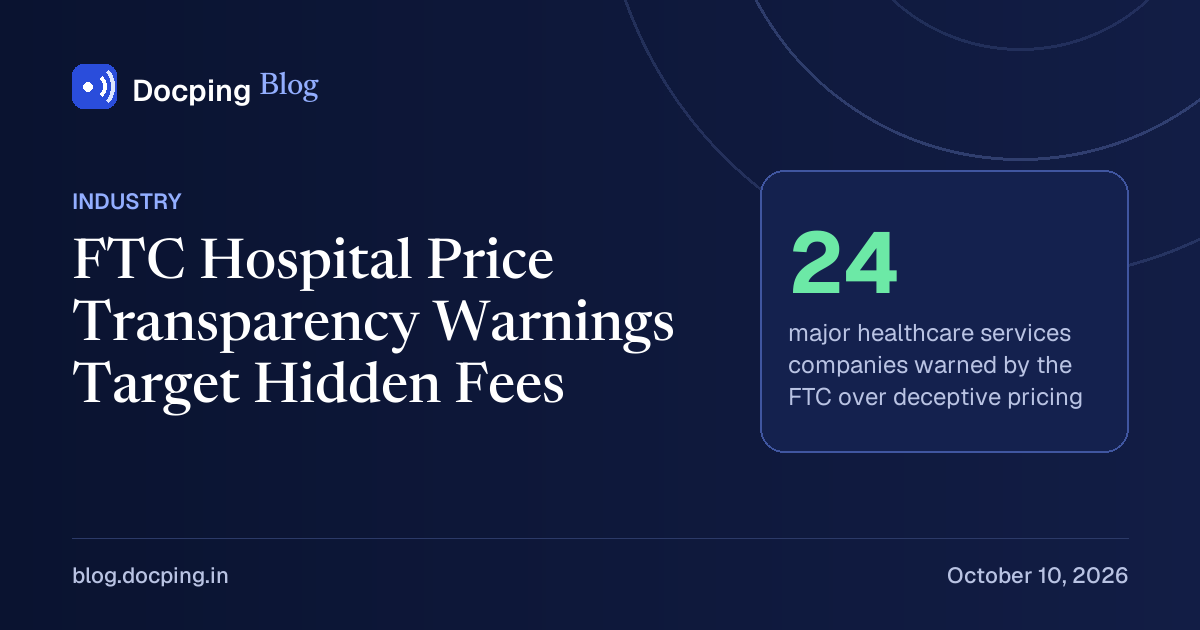
Federal Trade Commission (FTC) Chairman Andrew N. Ferguson warned 24 of the largest healthcare services companies in the United States that inaccurate, incomplete, or untimely price disclosures can violate federal consumer-protection law 13. The enforcement letters, sent on October 5, 2026, put hospital leadership and revenue-cycle teams on notice that technical compliance with Centers for Medicare & Medicaid Services (CMS) regulations provides no safe harbor under Section 5 of the FTC Act 12.
Key takeaways - FTC Chairman Andrew N. Ferguson issued warning letters to 24 major healthcare services companies stating that incomplete or inaccurate price disclosures can constitute unfair or deceptive practices under Section 5 of the FTC Act 13. - The FTC explicitly warned that complying with CMS price transparency mandates does not protect health systems from FTC Act liability if disclosures omit physician fees, facility charges, or total episode costs 12. - While the administration has issued 519 CMS price transparency warning letters since April 2026, the FTC’s entry introduces direct consumer-protection scrutiny to hospital estimation engines and upfront financial disclosures 2.
What did the FTC letters warn health systems about?
The letters remind hospital operators of their legal duty to give patients timely, accurate, and complete pricing for healthcare services, particularly for routine, non-emergency care scheduled in advance 13. Under Section 5 of the FTC Act, the agency polices both “unfair” and “deceptive” practices 1. Because the price of care is a material transaction term, clear and conspicuous disclosures are required 13.
The FTC explained that price disclosures become deceptive when omissions mislead consumers acting reasonably under the circumstances 13. Specifically, a disclosure may violate the law if it covers only a fraction of an expected clinical episode or omits standard components such as facility fees or professional physician charges 13. In the agency’s view, a patient receiving an estimate reasonably expects that figure to represent the total price of their upcoming care 13. Presenting partial figures as total costs is misleading 1.
Beyond deception, Chairman Ferguson highlighted the FTC’s unfairness standard 1. An omission or distortion of price is unfair under Section 5 when it causes, or is likely to cause, substantial injury that consumers cannot reasonably avoid, without countervailing benefits to consumers or marketplace competition 1. When pricing is withheld or delivered without sufficient advance notice, patients cannot comparison shop across competing health systems or make informed financial choices 13. The FTC noted that hiding prices undermines normal competitive dynamics and penalizes providers that price their services honestly and transparently 1.
While the FTC emphasized that the letters do not constitute formal conclusions that the 24 recipients violated the law, Chairman Ferguson urged the organizations to conduct comprehensive audits of their pricing workflows and take swift corrective action 13.
Why doesn’t CMS compliance create a safe harbor?
CMS price transparency regulations establish a baseline legal requirement, but meeting them does not satisfy a health system’s independent duties under the FTC Act 13. The FTC made clear in its letters that CMS rules do not offer a safe harbor against Section 5 enforcement 1.
CMS mandates require hospitals to publish machine-readable files (MRFs) containing standard charges and to provide consumer-friendly displays or automated estimator tools for shoppable services 23. Uninsured and self-pay patients must also receive good-faith estimates of expected charges prior to scheduled treatment 3. Yet a health system can publish fully validated machine-readable files matching federal schemas while still providing pre-service cost summaries to patients that hide physician bills or ancillary fees 13. Under the FTC’s doctrine, an technically compliant CMS file does nothing to cure an estimate that misleads a patient about their actual out-of-pocket exposure 1.
This distinction marks a clear shift in regulatory focus. The FTC’s letters bypass raw data architecture entirely to focus on how health systems communicate bottom-line prices directly to patients before they receive care 13.
How does this shift federal price transparency enforcement?
Federal enforcement of hospital price transparency has historically moved at a deliberate pace through administrative warnings and narrow fines 2. The FTC’s warning arrives amid a broader administration effort to enforce transparency, which has yielded hundreds of administrative notices but few financial penalties 2.
According to an Associated Press report cited by Becker’s Hospital Review, the administration sent price transparency warning letters to 519 hospitals across every state except Alaska between April and June 2026 2. Despite that volume of scrutiny, CMS has levied fines against only one facility in 2026: Pinnacle Hospital in Crown Point, Indiana 2. CMS assessed Pinnacle an initial penalty of $51,615 on February 4, 2026, for 155 days of noncompliance, followed by a second fine of $40,356 in June for continued failures, totaling $91,971 2.
That brings the cumulative total of hospitals fined by CMS since its hospital price transparency regulations took effect on January 1, 2021, to 28 facilities across 16 states and Puerto Rico 2. Penalties across that five-year span have ranged from $32,301 for Southeast Regional Medical Center in Louisiana to $979,000 for UF Health North in Florida 2. Fines have slowed relative to 2025, when CMS penalized 10 hospitals amounts between $32,301 and $309,738, following three fines issued in 2024 2.
Much of that CMS back-and-forth has centered on technical file mechanics 2. Following a February 2025 executive order by President Donald Trump, CMS finalized new rules in its 2026 outpatient payment rule 2. Those mandates forced hospitals to post actual prices instead of estimates, publish median, 10th percentile, and 90th percentile allowed amounts, supply Type 2 national provider identifiers (NPIs), and require an executive attestation of accuracy signed by a CEO, president, or equivalent officer 2. While those requirements took effect January 1, CMS delayed enforcement until April 1, 2026 2. When CMS subsequently issued warning letters, multiple health systems reported that the cited infractions were clerical errors and machine formatting discrepancies rather than missing prices 2.
The FTC’s entry breaks out of that technical box. Rather than debating JSON schemas or CSV header layouts, Chairman Ferguson’s Healthcare Task Force, established earlier in 2026, is evaluating hospital disclosures against general deceptive-trade practices law 1. The agency recently demonstrated its willingness to litigate upfront price omissions by suing online contact lens seller Lens.com for obscuring final pricing in search ads and on its storefront 1.
What should health systems and health-IT teams do now?
Hospital revenue-cycle leaders, chief medical informatics officers (CMIOs), and digital health teams building patient estimation software must reassess their upfront pricing touchpoints 1.
CMS is already evaluating stricter oversight for patient-facing estimation workflows 2. In its proposed 2027 outpatient payment rule, CMS solicited comments on how facilities handle rate tiering, stop-loss arrangements, carve-outs, and outlier charges, while questioning whether to modify or end “deemed compliance” status for online price estimator tools 2. When coupled with the FTC’s warnings, health systems can no longer assume that a patient portal estimator meets consumer protection standards simply because it complies with outpatient regulations 12.
To manage legal risk under Section 5, engineering and revenue teams should take concrete steps across patient estimation products:
- Unify professional and facility fee calculations. The FTC identified the omission of physician or facility fees as a primary driver of deceptive disclosures 13. Patient-facing tools must present a bundled, complete estimate of the care episode or conspicuously state what professional charges remain excluded 1.
- Audit timing thresholds for scheduled care. Under the FTC’s guidance, price disclosures for non-emergency services must be delivered sufficiently in advance of the scheduled appointment so patients can evaluate alternatives 13. Disclosures handed to a patient at the check-in desk minutes before a procedure do not afford adequate time for informed decision-making 1.
- Eliminate partial-care estimates. Presenting an estimate that accounts only for the initial surgical intervention while omitting foreseeable pre-operative labs, imaging, or post-anesthesia recovery introduces direct deception exposure under Section 5 13. Cost engines should map against full clinical care pathways.
Our read: Health systems have treated price transparency as a CMS-specific reporting exercise handled by IT compliance teams. The FTC’s letters change that calculus entirely 1. By treating an incomplete medical bill estimate with the same legal scrutiny applied to retail hidden fees, federal regulators are shifting accountability directly onto the operational engines that calculate what patients are told to pay 13.
Sources
- FTC Issues Letters Warning Hospitals Against Deceptive Pricing Practices — FTC, 2026-10-05
- Hospitals receive price transparency warnings, but few penalties, in 2026 — beckershospitalreview.com, 2026-10-06
- FTC Sends Warning Letters to 24 Healthcare Organizations Over Price Transparency - MedCity News — medcitynews.com, 2026-10-06
- S-1/A — sec.gov, 2026-09-21
Researched and drafted with AI from the sources above, and checked claim by claim against them before publishing.