Oracle Health Cerner Breach Tally Nears 20 Million Patients
Updated state filings show the 2025 legacy-server incident compromised almost 20 million records, making it one of the largest U.S. healthcare breaches on record.
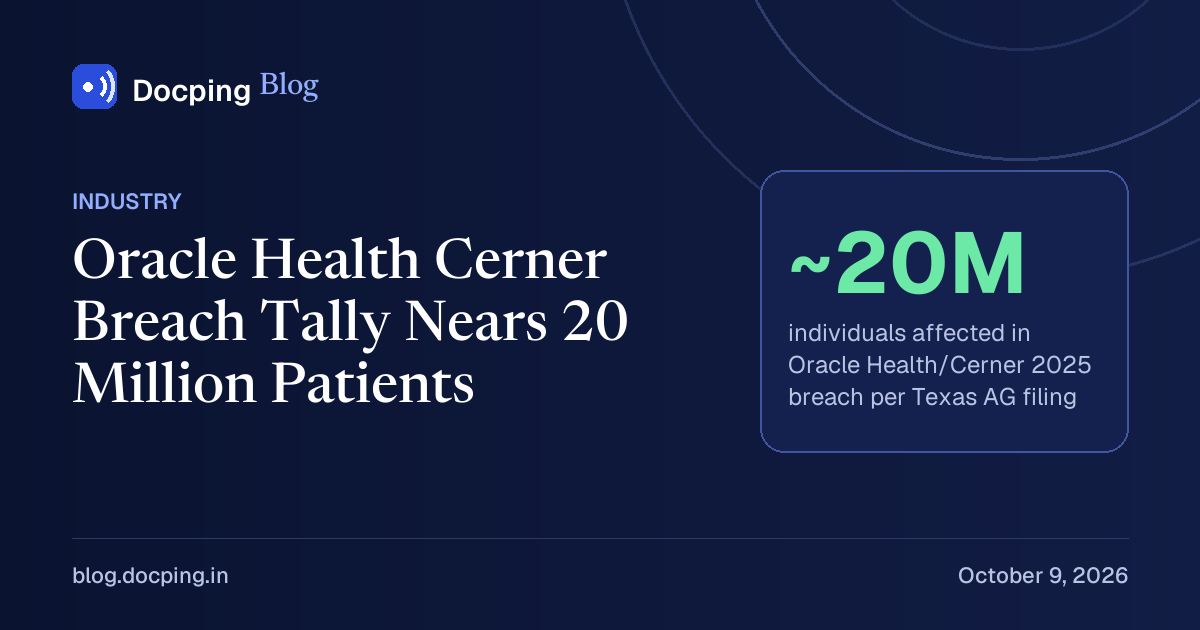
The 2025 cyberattack on Oracle Health’s legacy Cerner servers compromised the protected health information of nearly 20 million individuals, according to updated breach filings released by the Texas Attorney General on October 2, 2026 12. The figure dwarfs earlier public tallies and, if confirmed by federal regulators, would rank the incident among the largest healthcare data breaches in U.S. history — second only to the 2024 Change Healthcare ransomware attack that affected 192.7 million people 2.
Key takeaways - Nearly 20 million patient records were compromised in the 2025 Oracle Health/Cerner breach, per Texas AG filings citing Bloomberg reporting 12. - The breach originated on two legacy Cerner servers not yet migrated to Oracle Cloud after the 2022 acquisition 12. - Affected data includes names, Social Security numbers, diagnoses, medications, test results, medical images, and physician names 12.
What happened and when
An unauthorized individual first accessed the legacy Cerner servers as early as January 22, 2025, and continued through April 1, 2025, according to the Oregon Attorney General’s breach notification 1. Oracle Health identified the intrusion on March 7, 2025 (per Oracle’s notification to Oregon regulators) or on or around February 20, 2025 (per the customer notice cited by SecurityWeek) 12. The attacker copied data to a remote server and later demanded millions of dollars in cryptocurrency to prevent publication of the stolen records 12.
The compromised servers were part of Cerner’s pre-acquisition infrastructure. Oracle acquired Cerner in June 2022 for approximately $28.3–28.4 billion and rebranded the business as Oracle Health 12. Oracle has consistently stated that Oracle Cloud Infrastructure (OCI) was not breached and that the incident involved only obsolete, non-OCI servers 12.
How the tally grew to nearly 20 million
Early 2025 filings showed only 14,485 confirmed affected individuals across a handful of states that publish breach counts 1. By August 2025, the known count had risen to include up to 80 hospitals, with Munson Healthcare in Michigan alone reporting more than 100,000 affected patients 1. The October 2, 2026 Texas Attorney General filing lists 2,992,244 affected Texans 12. Combined with Oregon (1,978,661), South Carolina (283,903), and Washington (69,238), the four-state total exceeds 5.3 million 12. Bloomberg, citing the Texas AG report, places the national total at nearly 20 million 12.
The HHS Office for Civil Rights (OCR) breach portal still lists a placeholder total of 501 individuals as of the Texas AG update; OCR typically updates within weeks of receiving revised figures 1.
What data was exposed
Breach notification letters filed with state regulators describe the compromised information as including: - Names and Social Security numbers - Medical record numbers, diagnoses, medications, test results, and medical images - Care and treatment information - Physician names 12
The data varies by provider because each covered entity determines what was stored on the affected servers and whether a reportable breach occurred under HIPAA — a determination Oracle Health has said is the responsibility of each provider client 1.
Third-party risk and the M&A security gap
The incident underscores a persistent blind spot in healthcare technology: security due diligence during vendor acquisitions. John Strand of Black Hills Information Security told the HIPAA Journal that Oracle’s framing — emphasizing that the breached servers were legacy systems not yet migrated to OCI — amounts to “hand-waving” responsibility 1. “The moment you acquire a company, you become responsible for all aspects of that company, and that includes its security vulnerabilities,” Strand said 1.
For digital health companies integrating with Oracle Health (or any EHR vendor), the breach illustrates how legacy infrastructure inherited through M&A can become an attack surface that bypasses the acquirer’s modern security controls. The attacker used stolen customer credentials to access the servers, then moved laterally — a pattern CISA warned about in its April 21, 2025 alert, which urged enterprises to rotate credentials, scan code and infrastructure templates for embedded secrets, and enforce phishing-resistant MFA 1.
What this means for health systems and digital health partners
If you are a health system that was a Cerner/Oracle Health client in early 2025: - Confirm whether your organization received a breach notification from Oracle Health. Some providers did not receive notices until November 2025 — 11 months after the intrusion began 1. - Verify that your HIPAA breach notification obligations have been met. Oracle Health has stated that each covered entity is responsible for determining reportability and issuing patient notifications 1. - Audit any integrations that stored or cached credentials tied to the legacy Cerner environment. CISA’s guidance on credential rotation and secrets scanning applies directly 1.
If you are a digital health vendor integrating with Oracle Health/EHR data: - Treat this as a third-party risk event. Review your vendor risk assessments for Oracle Health and any sub-processors that may have touched legacy Cerner infrastructure. - Ensure your own credential hygiene: no long-lived tokens in code, CI/CD pipelines, or infrastructure-as-code templates. The CISA alert specifically called out embedded credentials in automation tools as a persistent risk 1. - Document your incident response playbook for upstream EHR vendor breaches — including how you’ll notify your own customers and regulators if PHI you process is implicated.
If you are evaluating EHR vendors or integration partners: - Ask specifically about legacy system decommissioning timelines and how inherited infrastructure is secured during migration. The Oracle/Cerner case shows that “not yet migrated” can mean years of exposure. - Request SOC 2 Type II reports and penetration test results that cover both modern and legacy environments.
Our read: The nearly 20 million figure will likely trigger heightened scrutiny from state AGs, OCR, and Congress. The Senate has already passed a bipartisan bill to strengthen healthcare cybersecurity, citing over 730 breaches affecting 270 million Americans in the prior year 2. Expect more mandatory breach reporting timelines, stricter vendor oversight requirements, and potential liability for acquirers who fail to secure inherited systems.
What we’d watch: Whether OCR updates its breach portal to reflect the revised total (which would make this officially the second-largest healthcare breach on record), and whether any enforcement actions follow against Oracle Health for the extended notification delays reported by some providers. The class action lawsuits already filed in Missouri and Texas will test whether Oracle’s “legacy server” framing limits its legal exposure 1.
Sources
- Almost 20 Million Individuals Affected by 2025 Data Breach at Oracle Health/Cerner — The HIPAA Journal, 2026-10-08
- Oracle Health Data Breach Tally Climbs to Nearly 20 Million - SecurityWeek — securityweek.com, 2026-10-08
- Major Medical Records Firm Uses A.I. Tool and Finds Flaws That Threaten Patient Privacy - The New York Times — nytimes.com, 2026-09-30
- Luminis patients regain access to MyChart online portal after cybersecurity incident - cbsnews.com — cbsnews.com, 2026-09-30
Researched and drafted with AI from the sources above, and checked claim by claim against them before publishing.