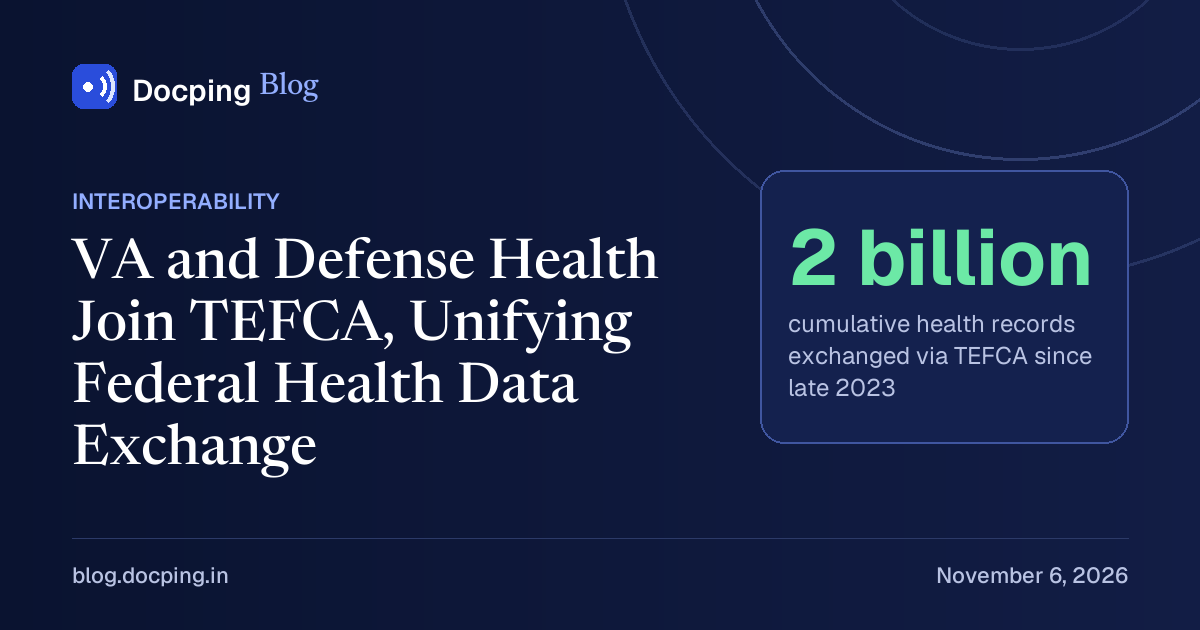
VA and Defense Health Join TEFCA, Unifying Federal Health Data Exchange
The two largest federal health systems are now live on TEFCA, creating a single query pathway for community providers treating veterans and service members.
The Office of the National Coordinator for Health IT (ONC) announced Thursday that the Department of Veterans Affairs (VA) and the Department of Defense have formally joined the Trusted Exchange Framework and Common Agreement (TEFCA), connecting the two largest federal health systems to the national health information interoperability backbone 1. This creates a single query pathway for community providers to access military and veteran records, eliminating the fragmented exchanges that have long complicated care coordination across civilian and federal boundaries 1.
Key takeaways - VA and Defense Health are now live on TEFCA, joining IHS, CPSC, and SSA as federal participants 1. - The move connects military treatment facilities and VA medical centers directly to private-sector networks through QHINs without point-to-point interfaces 1. - TEFCA exchange volume has reached over 2 billion cumulative records across nearly 25,000 participating organizations since late 2023 1.
What does TEFCA participation change for federal health systems?
The VA and Defense Health Agency join an expanding roster of federal agencies already operational on TEFCA, including the Indian Health Service (IHS), the Consumer Product Safety Commission (CPSC), and the Social Security Administration (SSA) 1. The Social Security Administration uses the framework to accelerate automated medical record retrieval for rapid disability adjudication 1.
Overseen by the Federal Electronic Health Record Modernization office, both the VA and military health operations have standardized clinical workflows around a common modern electronic health record core 1. Joining TEFCA expands this shared foundation outward, connecting internal federal charts directly with private-sector regional health information exchanges and hospital networks without requiring customized, point-to-point interface agreements 1.
How does this affect community providers treating veterans and service members?
For community providers, the practical shift is immediate: bidirectional, touchless queries and responses between private-sector systems and VHA clinical software replace the fragmented secondary portals, electronic faxes, and disjointed queries that have historically characterized the VA Community Care Network 1. Under the VA MISSION Act, millions of veterans receive authorized outpatient and inpatient care through civilian third-party networks; integrating the VA into TEFCA reduces claim denials, speeds referral authorizations, and eliminates redundant diagnostic testing 1.
On the military side, active-duty warfighters are stationed across domestic bases, deployed overseas, and frequently referred to civilian clinics for acute orthopedic, behavioral health, and surgical care 1. When clinical notes or diagnostic results remain trapped in private-sector electronic silos, base medical officers must ground personnel or delay deployments pending manual record reconciliations 1. Ingesting civilian encounter data through TEFCA creates a continuous longitudinal record that supports real-time operational force fitness tracking 1.
What does the exchange volume tell us about TEFCA adoption?
Across certified Qualified Health Information Networks (QHINs), exchange velocity has reached unprecedented scale, connecting nearly 25,000 participating organizations and 110,000 unique provider endpoints while surpassing two billion cumulative health records exchanged since initial operations began in late 2023 1. With the federal government now routing the nation’s largest public healthcare systems alongside defense health operations, the Social Security Administration, and the Indian Health Service directly through designated QHIN rails, TEFCA has shifted from an optional policy framework to the de facto operating standard 1.
“Many of America’s veterans and warfighters receive care in multiple locations, making it critical for their providers to have access to secure, timely health information,” said Thomas Keane, MD, MBA, National Coordinator for Health IT 1. “TEFCA will help ensure their providers can get up-to-date information no matter where they receive care.” 1
What this means in practice
If you build digital-health products that serve community providers treating VA or TRICARE patients, the query pathway is now standardized: a single TEFCA connection through a QHIN replaces the patchwork of proprietary gateways and manual requests. Teams should verify their QHIN’s onboarding status for the new federal endpoints and update any care-coordination workflows that still assume delayed or incomplete federal records. For health systems, the operational isolation risk is real — any commercial network outside TEFCA now lacks direct access to the largest federal beneficiary populations.
Our read: The federal government’s own participation is the strongest signal yet that TEFCA is the enduring national rail. The 2-billion-record milestone and the addition of the two largest federal systems make it difficult for any major network to stay on the sidelines without a compelling technical reason.
What we’d watch: How quickly QHINs surface the new federal endpoints in their directories, and whether the VA Community Care Network’s regional administrators shift their technical integration guides to TEFCA-first language in the next quarter.
Sources
- HHS Welcomes VA and Defense Health to TEFCA to Unify Care for Millions of Veterans and Service Members — HIT Consultant, 2026-11-05
- Staff education is essential for AI adoption - MobiHealthNews — mobihealthnews.com, 2026-11-03
- How 3 health systems are exploring new AI use cases - Modern Healthcare — modernhealthcare.com, 2026-11-03
- NYU Langone brings OpenEvidence’s clinical AI into the EHR systemwide - Fierce Healthcare — fiercehealthcare.com, 2026-10-29
Researched and drafted with AI from the sources above, and checked claim by claim against them before publishing.