Independence Blue Cross settles $22.5M MA risk‑adjustment case
The settlement underscores tighter scrutiny of Medicare Advantage coding and what health plans should review now.
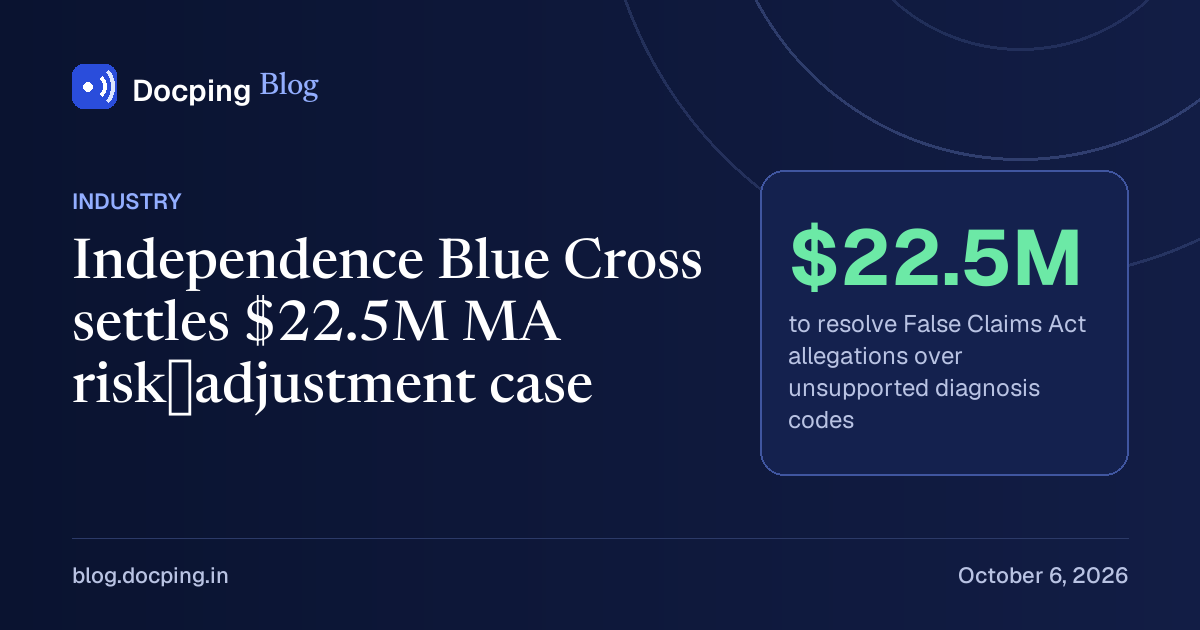
Independence Blue Cross agreed to pay $22.5 million to settle allegations that it violated the False Claims Act by knowingly retaining inflated Medicare Advantage payments based on unsupported diagnosis codes 21. The Department of Justice announced the settlement, and the insurer said it resolved the case to avoid prolonged litigation without admitting wrongdoing 1.
Settlement details
The Justice Department alleges that, for payment years 2017‑2021, Independence Blue Cross operated a chart‑review program in which nurse reviewers examined medical records to identify additional diagnosis codes that could be submitted to CMS for higher risk‑adjustment payments. The insurer relied on those reviews to submit extra codes but did not withdraw or correct codes that the same reviews showed were unsupported, effectively retaining overpayments. Sources differ on the exact years of the program: the Healthcare Dive article states the review ran from 2016 through 2020, while the Justice Department press release cites 2017‑2021 12. The whistleblower, a former IBX employee, is set to receive $3.825 million of the settlement under the qui tam provisions of the False Claims Act 2.
The settlement resolves claims that IBX submitted inaccurate and untruthful patient data to CMS, knowingly failed to repay the agency for unsupported codes, and falsely certified in writing that the data was accurate and truthful. The Justice Department notes that the False Claims Act imposes treble damages and penalties on those who knowingly submit false claims for federal funds, a point confirmed in its FY 2025 settlements report.
How Medicare Advantage risk adjustment works
Under the Medicare Advantage program, CMS pays private plans a fixed monthly amount that is adjusted for each enrollee’s expected health costs based on submitted diagnosis codes. Sicker patients generate higher payments, so the accuracy of those codes directly affects reimbursement. CMS relies on the plans to supply correct data; when plans retain codes that are not supported by the medical record, they receive payments they are not entitled to—a practice commonly referred to as upcoding.
Broader enforcement trend
The IBX case is part of a pattern of increased scrutiny of Medicare Advantage risk‑adjustment practices. In fiscal year 2025, False Claims Act settlements and judgments exceeded $6.8 billion, the highest annual total in the law’s history, with over $5.7 billion related to healthcare fraud 3. Health‑plan affiliates of Kaiser Permanente settled for $556 million in January 2026 to resolve similar upcoding allegations 1, and UnitedHealth and Humana have also faced scrutiny for allegedly exaggerating members’ health needs.
The HHS Office of Inspector General has issued multiple reports warning of improper payments and upcoding in Medicare Advantage. Meanwhile, the Medicare Payment Advisory Commission projects that the federal government will spend about 14 percent more—or an additional $76 billion—this year on seniors enrolled in Medicare Advantage compared with traditional Medicare, attributing part of the difference to upcoding 1.
What this means in practice
Health plans that submit data to CMS should review their risk‑adjustment workflows with an eye toward documentation, auditability, and timely correction of unsupported codes. Specific steps include:
- Ensuring chart‑review processes identify and withdraw any diagnosis codes that lack clinical support, and tracking those withdrawals in an auditable system.
- Implementing automated checks that flag codes added after a review without corresponding documentation updates.
- Maintaining a complete audit trail of who accessed or altered diagnosis data, when, and why, so every submitted code can be traced back to the medical record.
- Training coding staff and clinical reviewers on the requirement to repay CMS for unsupported codes, not just to capture additional revenue.
- Conducting periodic internal audits that mirror the government’s focus on whether retained payments are justified by the medical record.
By tightening documentation and strengthening audit controls, plans can reduce the risk of False Claims Act exposure while preserving the integrity of the Medicare Advantage program.
Sources
- Independence Blue Cross to pay $22.5M to resolve MA fraud allegations — Healthcare Dive, 2026-10-02
- Independence Blue Cross to Pay $22.5M to Resolve False Claims Act Allegations — justice.gov
- False Claims Act Settlements and Judgments Exceed $6.8B in Fiscal Year 2025 — justice.gov
Researched and drafted with AI from the sources above, and checked claim by claim against them before publishing.