ONC data show pajama time falling while CMS rolls out new interoperability rules
Family physicians report less after-hours documentation but prior-authorization burden keeps rising as new FHIR API requirements take effect.
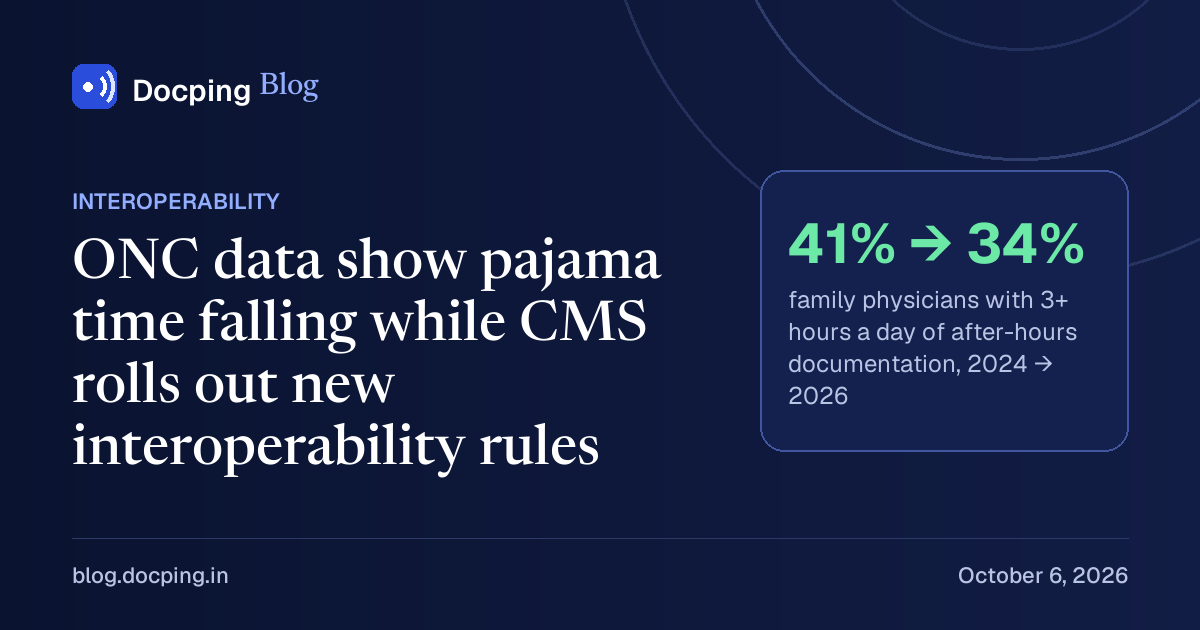
The Office of the National Coordinator for Health IT (ONC) published a blog summarizing its latest study of family physicians’ administrative burden. The study tracks three measures: substantial pajama time (three or more hours per day of after‑hours documentation), burden tracking down external health information, and prior‑authorization burden. Between 2024 and 2026, substantial pajama time declined by 6.2 percentage points, falling from 41% to 34% of family physicians 1. The same period saw a five‑point drop in the burden of retrieving external health information, from 43% to 38% 1. Prior‑authorization burden moved in the opposite direction, rising from 54% to 58% 1.
The ONC blog notes that pajama time showed the largest improvement of the three measures, and that one‑third of family physicians still report spending three or more hours per day on after‑hours documentation 1. The proportion experiencing the “triple burden” — high levels of all three measures — fell from 15% in 2024 to 12% in 2025 and held steady at 12.2% in 2026. Extrapolating nationally, that 2.8‑point decline equals roughly 3,000 fewer family physicians facing all three burdens in 2026 compared with 2024 1.
ONC also describes a complementary study that defines “ideal interoperability” for medication data as occurring when external data are automatically received, easy to find, and easy to use. Only 13% of family physicians met all three criteria often; broadening the definition to include “sometimes” as well as “often” raises the figure to 45% 1. The largest gap identified was data availability, underscoring that exchange alone is insufficient without usability, standards, and data quality 1.
On the regulatory side, the Centers for Medicare & Medicaid Services (CMS) issued its Interoperability and Prior Authorization final rule (CMS‑0057‑F). The rule requires impacted payers — Medicare Advantage organizations, state Medicaid and CHIP FFS programs, Medicaid managed care plans, CHIP managed care entities, and QHP issuers on the Federally Facilitated Exchanges — to implement and maintain several FHIR‑based APIs. These include a Patient Access API (to which prior‑authorization information, excluding drugs, must be added), a Provider Access API for sharing claims, encounter data, USCDI elements and prior‑authorization details with in‑network providers, a Payer‑to‑Payer API for continuity when patients change payers, and a Prior Authorization API that can receive, process and respond to requests 2
Compliance timelines vary. Impacted payers must begin reporting annual Patient Access API usage metrics starting January 1, 2026 2. The core API development and enhancement requirements — including the Provider Access, Payer‑to‑Payer and Prior Authorization APIs — have compliance dates generally beginning January 1, 2027 2. The Prior Authorization API itself must be implemented beginning January 1, 2027 2.
The rule also sets operational expectations. Beginning in 2026, impacted payers must provide a specific reason for denied prior‑authorization decisions (non‑drug) regardless of transmission method 2. Prior‑authorization metrics must be publicly reported annually, with the first set due by March 31, 2026 2. For MIPS‑eligible clinicians, hospitals and critical access hospitals, a new “Electronic Prior Authorization” attestation measure takes effect with the CY 2027 performance period 2.
Technical specifications mandate USCDI, FHIR Release 4.0.1, the US Core IG STU 3.1.1, the SMART App Launch IG Release 1.0.0, and FHIR Bulk Data Access (v1.0.0) 2. CMS encourages use of several implementation guides, including CARIN Consumer‑Directed Payer Data Exchange (STU 2.0.0), SMART App Launch IG Release 2.0.0, Da Vinci PDex STU 2.0.0, Da Vinci PDex US Drug Formulary STU 2.0.1, Da Vinci Plan‑Net STU 1.1.0, Da Vinci CRD STU 2.0.1, Da Vinci DTR STU 2.0.0, and Da Vinci PAS STU 2.0.1 2. Finally, HHS will exercise enforcement discretion for the HIPAA X12 278 prior‑authorization transaction standard for entities that adopt an all‑FHIR‑based Prior Authorization API, allowing a FHIR‑only or FHIR‑plus‑X12 approach 2.
What it means in practice
Health‑tech teams building on EHR data should watch two parallel tracks. First, the ONC data suggest that modest gains in reducing after‑hours documentation are possible when external information becomes easier to retrieve and use. If your product can help clinicians pull medication histories, lab results or prior‑authorization status directly into the workflow — without manual searching — you may contribute to the downward trend in pajama time. Second, the CMS rule creates a concrete timeline for payer‑side FHIR APIs that will start delivering standardized data in 2026‑2027. Early adopters who certify their connections to the Patient Access, Provider Access and Prior Authorization APIs ahead of the January 2027 deadline will be positioned to meet both the MIPS electronic prior‑authorization measure and the payer‑side reporting obligations. Teams should verify that their implementations support the required USCDI elements, handle prior‑authorization requests and responses, and can exchange the non‑drug prior‑information that the rule mandates.
What we’d watch
Our read: While the ONC numbers show movement in the right direction, the persistence of high prior‑auth burden (now 58%) and the fact that over one‑third of physicians still log three-plus hours of after‑hours documentation mean that technical fixes alone will not eliminate pajama time. The CMS rule addresses the data‑exchange side, but workflow redesign, decision‑support tools and possibly AI‑assisted documentation will be needed to drive further reductions. Stakeholders should monitor whether the upcoming FHIR‑based prior‑authorization APIs actually reduce the manual steps that drive the 58% figure, and whether the new MIPS measure incentivizes genuine electronic adoption rather than mere attestation.
Sources
- Less Pajama Time, More Patient Time: How Better Interoperability Can Reduce Physician Burden — HealthIT.gov (ONC/ASTP), 2026-09-30
- CMS Interoperability and Prior Authorization Final Rule CMS-0057-F — cms.gov
Researched and drafted with AI from the sources above, and checked claim by claim against them before publishing.