Teladoc Solo platform adds camera vitals and ambient scribing
The update integrates contactless vital sign monitoring and AI scribing directly into the enterprise telehealth platform, reducing point-solution fatigue.
Teladoc Health has introduced camera-based vital sign monitoring and ambient AI scribing directly into its Teladoc Solo platform 12. The update allows enterprise hospitals to capture physiological data and generate electronic health record clinical notes without deploying separate point solutions 234.
Key takeaways - SoloScribe is generally available today for virtual and inpatient care encounters, pushing structured documentation directly into EHRs such as Epic and Oracle Health 234. - SoloVitals is in private preview with select enterprise systems and measures heart and respiratory rates via smartphone or tablet cameras using remote photoplethysmography 123. - Embedding AI capabilities into existing telehealth infrastructure targets point-solution fatigue while expanding virtual care software into acute inpatient settings 124.
What is new in the Teladoc Solo platform?
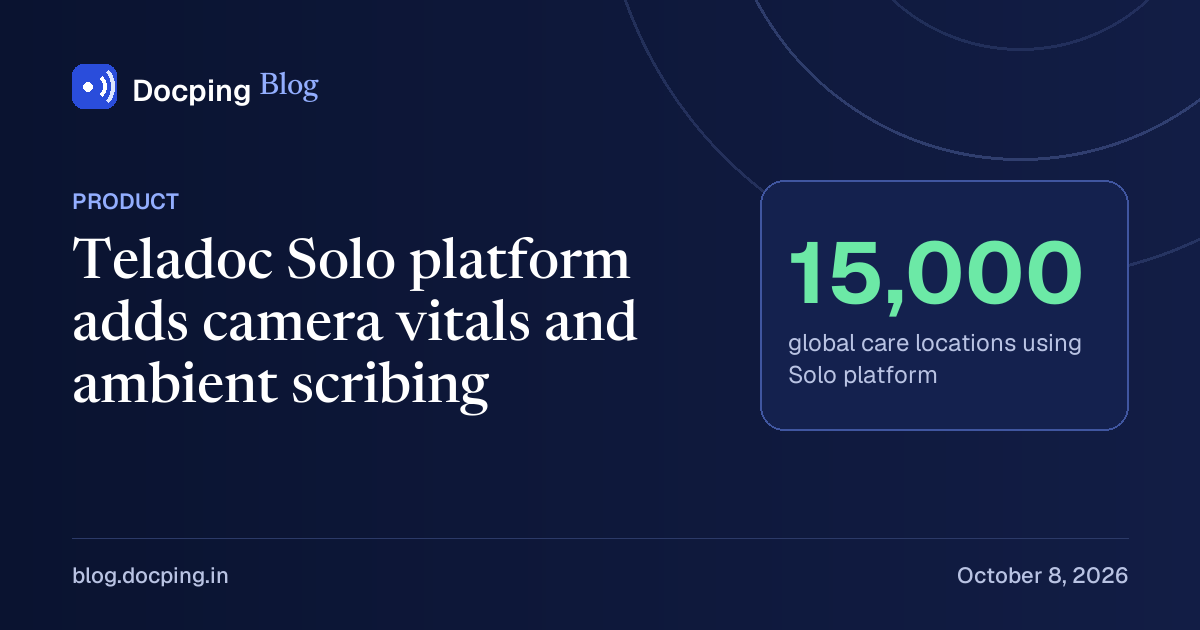
The Teladoc Solo platform update embeds two native artificial intelligence capabilities—SoloVitals and SoloScribe—into the enterprise virtual care system already deployed across more than 15,000 care locations globally 234.
Rather than requiring health systems to procure, install, and manage separate add-on tools, both capabilities operate directly inside the clinician’s existing video consultation window and chart workflow 234.
SoloScribe is an ambient AI documentation engine that listens to clinical dialogue during encounters and generates structured, specialty-specific summaries pushed directly into underlying EHRs, including Epic and Oracle Health 23. The software supports both direct-to-patient virtual appointments and device-based inpatient telehealth encounters, such as telestroke carts and virtual ICU boom stations 34. SoloScribe is generally available immediately across supported enterprise deployments 123.
SoloVitals uses remote photoplethysmography (rPPG) and computer vision algorithms to track vital signs without physical patient contact 234. During intake or remote consultations, the tool uses the camera on a patient’s standard laptop, smartphone, or tablet to analyze micro-vascular facial skin color changes and fine body movements 234. It converts those optical signals into real-time heart rate and respiratory rate measurements without requiring physical hardware cuffs or separate mobile app downloads 234. SoloVitals is currently available in private preview with select enterprise customers, with general availability expected in December 2026 123.
Why are telehealth platforms expanding into inpatient AI documentation?
Telehealth vendors are pushing ambient documentation and contactless biometrics into hospital platforms to address health system point-solution fatigue and offset slowing virtual care revenues 124.
Hospital IT leaders face growing vendor proliferation, where each new clinical tool requires navigating a separate software login, interface, hardware requirement, or workflow 12. As Joby McKenzie, general manager of North American health systems at Teladoc Health, noted, enterprise clients face intense operational pressure to expand capacity and adopt AI without adding administrative layer upon administrative layer 124.
For Teladoc Health, expanding the functional scope of its hospital software offers a strategic growth driver as its consumer business slows 1. The company reported a net loss of $200.3 million in 2025 and lowered its full-year 2026 revenue outlook in July to between $2.36 billion and $2.45 billion—a 5% reduction driven primarily by demand headwinds in its BetterHelp mental health unit 1. Incorporating ambient scribing and biometrics directly into its enterprise platform allows Teladoc to deepen usage across its established hospital client base 12.
How does remote photoplethysmography work without extra hardware?
Remote photoplethysmography captures vital signs by using computer vision to measure subtle facial skin color fluctuations caused by blood flow during each cardiac cycle 234.
According to Danny Sanchez, vice president of technology and innovation at Teladoc Health, SoloVitals pairs rPPG color detection with computer vision assessments of micro-movements 2. Sophisticated algorithms evaluate these optical signals in real time to calculate heart rate and respiration rate, presenting the measurements to care teams before or during a video encounter 234. Because the calculation relies entirely on existing consumer device cameras, patients complete the check through guided on-screen prompts within their normal virtual visit window 23.
What does this mean for health IT teams and EHR integration?
For health system IT leaders and integration engineers, native AI tools within existing telehealth platforms reduce the overhead of maintaining distinct data pipelines 234.
Health systems receive structured notes and physiological indicators through their established Teladoc EHR integrations, eliminating manual copy-pasting 23.
For digital health engineering teams, this shift highlights how EHR integration requirements are moving upstream 34. Ambient scribing tools must write templated summaries directly back into Epic, Oracle Health, or other EHR charts 34.
For clinical teams, native ambient documentation provides a tool to reduce administrative burden 4.
What should health systems and developers do next?
Health system IT leaders and health tech teams should evaluate whether native platform upgrades can consolidate standalone software tools without compromising clinical accuracy 124.
Here is what health IT stakeholders should prioritize in the coming months:
- Enterprise IT leaders: Audit standalone ambient scribing and remote intake contracts expiring in the next 12 months. Assess whether native EHR-integrated capabilities like SoloScribe or upcoming native vitals features can eliminate redundant software fees 123.
- Clinical informatics leads: Establish testing protocols to validate rPPG camera-based vital sign accuracy against physical monitors across varied lighting conditions and patient populations before deploying contactless biometrics in high-acuity virtual nursing workflows 34.
- Digital health product teams: Focus standalone product strategy on specialized clinical workflows, proprietary data models, or complex interventions rather than basic scribing or intake, as platform providers increasingly bundle routine documentation and physiological monitoring natively 123.
Our read: The embedding of ambient AI scribing and contactless biometrics into hospital telehealth platforms signals a clear shift away from standalone point solutions for routine clinical intake 123. While optical rPPG biometrics will require rigorous clinical validation in varied inpatient environments before replacing traditional physiological monitors, building these tools directly into existing hospital EHR workflows gives platform incumbents a distinct operational advantage over standalone software vendors 234.
Sources
- Teladoc unveils remote monitoring, ambient AI features — Healthcare Dive, 2026-10-07
- Teladoc Health Adds Contactless Vitals and Ambient AI Scribe to Virtual Visit Platform - MedCity News — MedCity News, 2026-10-07
- Teladoc Health Unveils SoloVitals and SoloScribe: AI-Powered Contactless Biometrics and Enterprise Documentation — HIT Consultant, 2026-10-07
- Teladoc Health unveils new AI capabilities within Solo platform for hospitals - Fierce Healthcare — fiercehealthcare.com, 2026-10-07
- Ping An launches AI-assisted care for expats - MobiHealthNews — mobihealthnews.com, 2026-09-28
Researched and drafted with AI from the sources above, and checked claim by claim against them before publishing.