Utah approves three AI prescribing pilots as federal program pursues FDA path
Utah's AI sandbox expands while ARPA-H pushes cardiac agents toward FDA authorization.
Utah’s Office of Artificial Intelligence Policy approved three new healthcare AI pilots on Friday that could eventually allow software to prescribe medications and deliver care plans without real-time clinician review 2. In September, a federal ARPA-H program revealed six teams building autonomous cardiac AI agents that must submit FDA authorization packages within 24 months 3. Together, the moves show state and federal governments testing autonomous clinical AI under different regulatory theories.
Key takeaways - Utah approved pilots for acne prescribing (Nolla Health), chronic-condition renewals (August AI), and virtual pelvic-floor therapy (Expect Fitness), all requiring written regulator approval before reducing human oversight 2. - None of the pilots have launched yet, and an earlier Doctronic pilot faced pushback from the state medical board over lack of notification and clinical-judgment concerns 2. - ARPA-H’s ADVOCATE program selected six teams in September to develop autonomous cardiac AI agents that must submit FDA-authorization packages within 24 months 3.
What the new Utah pilots actually do
The three pilots approved Friday share a staged structure: each starts with clinician review of every AI-generated decision, then seeks written regulator approval to move to a phase where review happens after the fact 2.
Nolla Health — a dermatology app that assesses acne from patient photographs. The pilot will test whether the app can prescribe initial medications and refills from a short list of topical drugs to adults in Utah with mild-to-moderate acne. At first, two physicians review every prescription before it is sent; in later stages they would only review prescriptions after the fact 2.
August AI — an AI system that will renew prescriptions for people with chronic conditions, following a similar phased oversight model 2.
Expect Fitness — virtual pelvic-floor therapy for women in Utah to help with urinary incontinence, pelvic pain, and postpartum pelvic-floor problems. This pilot does not involve prescribing 2.
All three operate under Utah’s Artificial Intelligence Learning Laboratory, established by state law in 2024 to provide a supervised environment for testing AI tools before they scale 2.
What happened with the earlier Doctronic pilot
Utah’s first autonomous prescribing pilot, launched earlier this year with Doctronic for medication renewals, drew formal opposition from the state medical licensing board. The board asked that the pilot be suspended, saying it had not been informed before launch and raising concerns that the AI lacked necessary clinical judgment and that patients could risk taking outdated medication 2. Regulators refused to pause the pilot, arguing that clinicians supervise AI systems during the program’s initial stages 2.
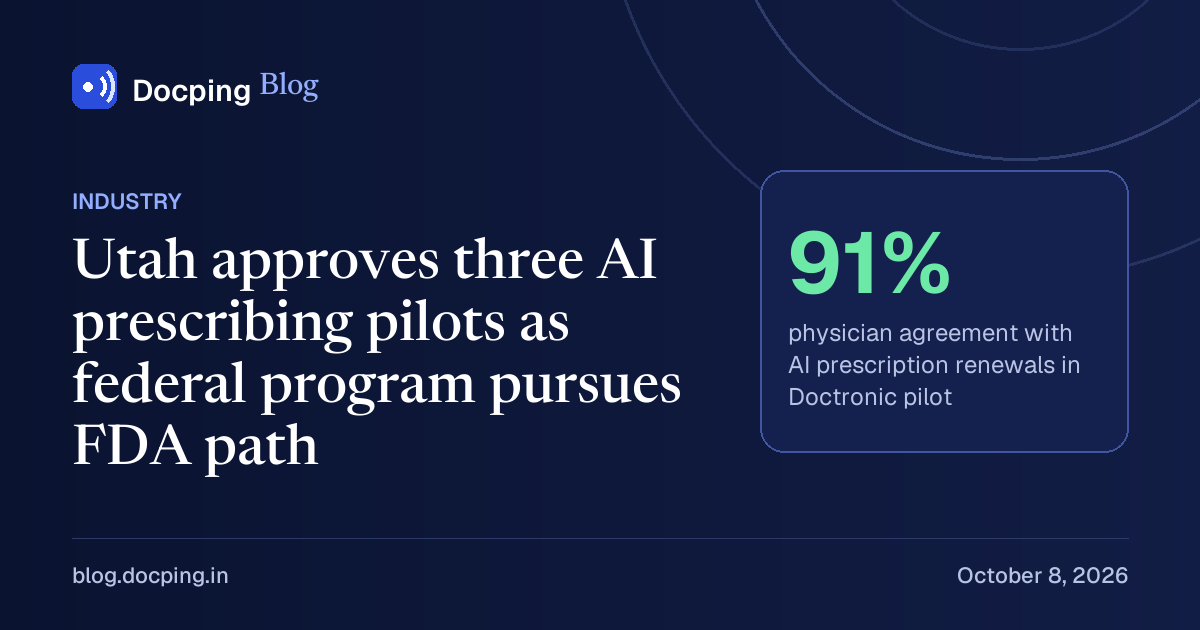
Early results cited in the ARPA-H announcement show human physicians agreed with Doctronic’s prescription renewal recommendations in 91% of cases 3. Stanford law professor Michelle Mello noted in a JAMA Health Forum commentary that Doctronic’s sandbox contract is murky about who bears responsibility for AI-based prescribing errors that injure patients 2.
What the ARPA-H parallel track shows
At the federal level, ARPA-H’s ADVOCATE program selected six teams in September to develop autonomous AI agents that adjust cardiac care plans without human cardiologist oversight 3. The program aims to create the world’s first clinical agentic AI system that can serve as a member of cardiac patients’ clinical team 3.
Contract winners include Atman Health, Tempus AI, and Updoc for clinical AI agents; Stanford University for a supervisory AI system; Duke University for a multi-site validation platform across five health systems on Epic and Oracle EHRs; and Kaiser Permanente for implementation across 21 medical centers and more than 260 clinics, embedding agents into Epic workflows for heart-failure patients 3.
Each clinical AI agent team must submit an FDA-authorization package within 24 months 3. Stanford’s supervisory AI will use a three-stage pipeline — outlier filtering, rule-based screening, and a deep-research auditing agent — to detect unsafe recommendations 3. Kaiser will also create reusable deployment blueprints through shadow-mode deployments and pragmatic randomized clinical trials 3.
ARPA-H Director Alicia Jackson said agentic AI “represents a massive opportunity for democratizing healthcare access” and that ADVOCATE will “pave the way for FDA-authorized agentic tools for many other conditions” 3. Program manager Haider Warraich described the goal as “a technology that can serve as a clinician-extender” 3.
What this means in practice
For digital-health founders: If you are building prescribing or care-plan automation, map every autonomous clinical decision your product makes to FDA’s risk classification and check whether a De Novo or PMA pathway is required. Document the human-in-the-loop design — prospective vs. retrospective review — because state-sandbox requirements reference that distinction 2.
For compliance leads: Track both the Utah sandbox agreements and FDA’s evolving guidance on clinical decision support software. The Utah pilots require written regulator approval before moving to reduced-oversight phases 2, while ADVOCATE teams must submit FDA packages within 24 months 3.
For health-system IT and CMIOs: Any pilot that writes orders into your EHR — even in a sandbox — needs local IRB or governance review, a clear liability agreement, and a rollback plan. The Doctronic episode shows medical boards may not be notified before launch; insist on seeing the sandbox contract and the state’s adverse-event reporting requirements before integrating 2.
What we’d watch: Whether the FDA issues guidance clarifying how state sandboxes interact with device regulation, and whether any Utah pilot advances to its reduced-oversight phase with or without an FDA authorization on file. The ARPA-H timeline puts first FDA submissions within 24 months 3.
Sources
- STAT+: Why health AI pilots in Utah may be on a collision course with the FDA — STAT, 2026-10-07
- Utah approves slew of health AI pilots for drug management, women’s health — Healthcare Dive, 2026-10-06
- ARPA-H selects 6 teams for agentic cardiovascular AI program | TechTarget — techtarget.com, 2026-09-10
- Tuesday, October 6, 2026 - KFF Health News — kffhealthnews.org, 2026-10-06
Researched and drafted with AI from the sources above, and checked claim by claim against them before publishing.