athenahealth Launches athenaPatient MCP for Claude EHR Access
Patients can now connect their athenahealth records directly to Anthropic's Claude via the Model Context Protocol.
athenahealth has launched athenaPatient MCP, an enterprise server built on the Model Context Protocol (MCP) that lets patients connect their official electronic health records directly to Anthropic’s Claude. The integration is live for Claude Pro and Claude Max subscribers across the United States, who can activate the connector from within their Claude account settings 1.
Key takeaways - athenaPatient MCP uses the open Model Context Protocol to serve EHR data on demand rather than dumping entire records into the LLM context window 1. - Patients authenticate with their athenahealth portal credentials, choose specific data scopes, and can revoke access at any time 1. - The server enforces zero-data-retention and non-training commitments so PHI never enters foundation model pre-training corpora 1.
What is the Model Context Protocol?
MCP is an open, standardized client-server convention transported over JSON-RPC. Unlike static data exports or screen-scraping plugins, the athenaPatient MCP server functions as a governed middleware layer that structures EHR data before exposure to the LLM 1. Clinical records are queried dynamically only when the patient asks a specific question requiring historical context — there is zero static pre-loading of the patient’s entire medical history into Claude’s training set or prompt window 1.
What clinical data can Claude access?
When a patient authorizes a scope, Claude can reference discrete EHR fields across the chart including laboratory results, vital signs, active medication regimens, problem lists, immunization histories, encounter summaries, diagnostic imaging narratives, allergies, outpatient procedures, and longitudinal care plans 1.
How consent and security work
Security and consent remain entirely with the consumer. Access requires patients to authenticate with their official athenahealth patient portal credentials, select specific clinical data scopes, and retain the unilateral ability to revoke model authorization at any time 1. The interaction layer ensures that health information retrieved via the MCP endpoint remains restricted to the active session and is governed by strict zero-data-retention and non-training commitments, preventing PHI from entering foundation model pre-training corpora 1.
Why this matters for builders
For digital-health teams, athenaPatient MCP provides a vendor-supported, standard integration path for patient-authorized data access. Instead of building custom FHIR clients or negotiating individual EHR partnerships, developers can point patients to a connector that already exists inside Claude. Anthropic’s Claude Pro and Max subscribers in the U.S. can enable it today 1.
Market context
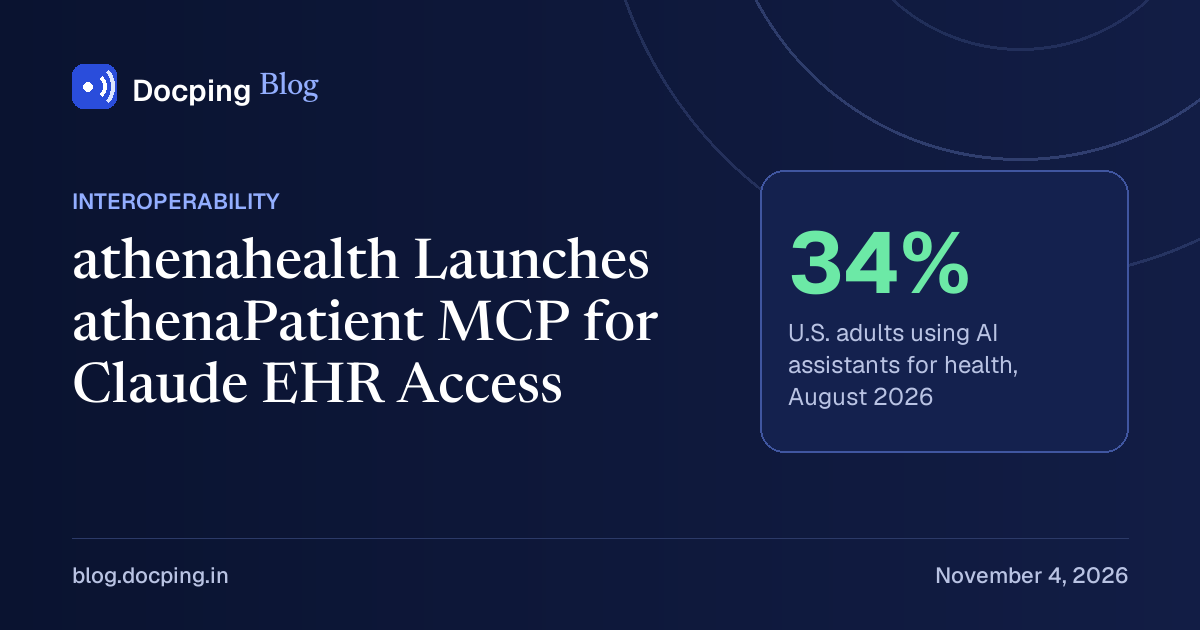
The launch responds to shifting patient behavior. An August 2026 Pew Research Center survey reported that 34% of U.S. adults have used artificial intelligence assistants for health-related purposes, ranging from symptom exploration to diagnosis interpretation 1. Clinicians see AI moving toward patient-facing functionality: Nancy Cibotti, MD, regional CMIO at Heidi Health, expects AI to take on tasks like reminding patients about due exams or preparing them for visits with educational materials 2. Michael Attilio, MD, CMIO at Rome Health, describes AI as a “third, but invisible, patient in the room” that can bridge knowledge and communication gaps 2.
What we’d watch
Whether Epic, Oracle Health (Cerner), or others follow with their own MCP endpoints — or adopt a different standard — will shape how quickly patient-authorized AI becomes a routine integration pattern. The zero-data-retention commitment also sets a precedent; if other vendors match it, the trust barrier for consumer health AI drops significantly.
What to do next
If you’re building a patient-facing application that needs verified clinical data, evaluate whether routing users through the athenaPatient MCP connector in Claude reduces your integration surface. For teams on other EHRs, ask your vendor about MCP roadmap or equivalent patient-authorized API programs. And if you’re a Claude Pro or Max subscriber with an athenahealth portal account, you can test the connector today in your Claude settings 1.
Sources
- athenahealth Launches athenaPatient MCP to Bridge Official Patient Records into Anthropic’s Claude — HIT Consultant, 2026-11-02
- Like Iron Man's JARVIS, providers see AI as the ultimate assistant for physicians | TechTarget — techtarget.com, 2026-10-13
- Home Realm Discovery — epic.com
- AI job displacement is looking extra painful — axios.com, 2026-11-03
Researched and drafted with AI from the sources above, and checked claim by claim against them before publishing.