ONC Finalizes HTI-5 Rule: 14 Certification Criteria Cut, AI Model Cards Removed
The final rule shifts safety oversight from federal certification to health systems, cuts certification costs for developers, and changes what EHR vendors must prove.
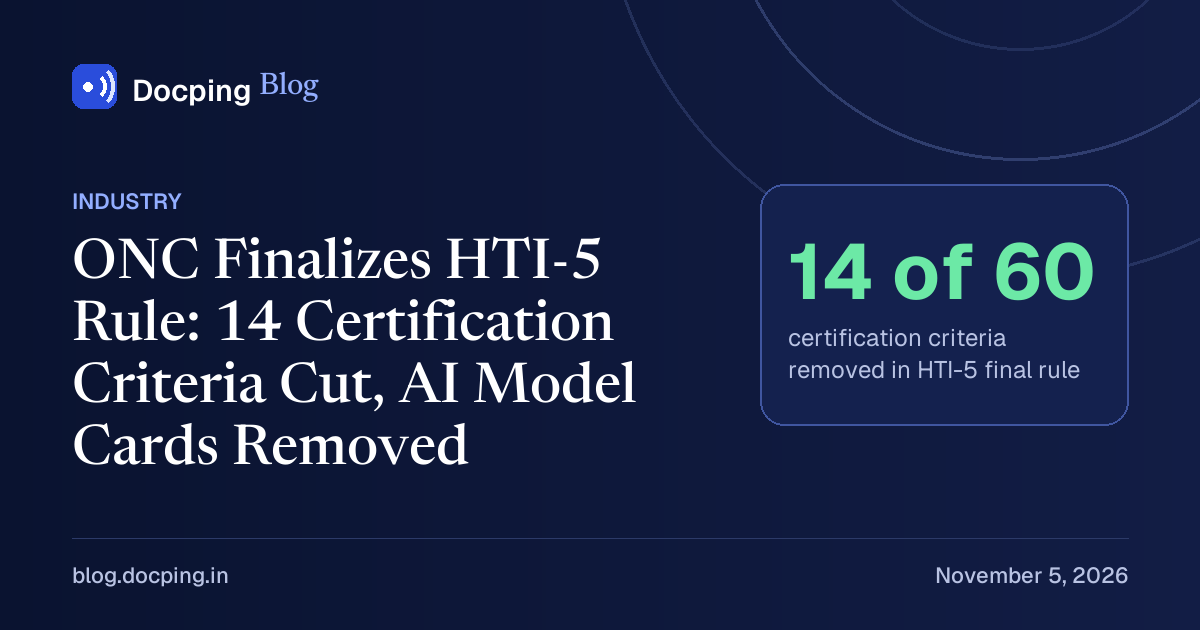
The Office of the National Coordinator for Health Information Technology (ONC) has finalized the Health Data, Technology, and Interoperability: ONC Deregulatory Actions to Unleash Prosperity rule — known as HTI-5 — cutting 14 of the 60 certification criteria in the ONC Health IT Certification Program and revising seven others 14. The rule, published in the Federal Register on October 28, 2026, takes effect December 28, 2026 for most provisions, with a few amendments effective January 1, 2027 1. ONC projects the changes will save more than $1.5 billion in present-value regulatory costs and $108.1 million in annualized net savings beginning in 2027 34.
Key takeaways - ONC removed 14 certification criteria and revised seven, retaining 39 unchanged, a significant scale-back from the proposed 34 removals 145. - Predictive decision-support interventions no longer require source-attribute transparency (model cards) or intervention risk-management documentation 245. - Voluntary certification criteria for security tags — used to shield sensitive behavioral-health and substance-use records — are eliminated, though HIPAA requirements remain 2.
What certification criteria were removed or revised?
The final rule removes 14 criteria across clinical, care-coordination, clinical-quality-measure, patient-engagement, public-health, design-and-performance, and transport-method categories 1. Notably, the predictive decision support intervention (DSI) source-attribute requirements established under HTI-1 — including training-data descriptions, demographic validation benchmarks, and algorithmic funding sources — are fully removed 5. Separately, the rule makes conforming edits to Conditions and Maintenance of Certification requirements for Assurances (§170.402), APIs (§170.404), Attestations (§170.406), and scaled-back Real World Testing (§170.405) and Insights (§170.407) reporting 4.
Why did ONC cut the AI model-card requirements?
ONC justified the removal by stating that clinicians in high-pressure workflows rarely access technical model cards, while the regulatory overhead depressed developer investment in frontier AI 5. The agency said oversight of clinical algorithmic safety is more properly anchored within the Food and Drug Administration (FDA) and civil-rights non-discrimination rules (45 CFR §92.210) rather than standard EHR certification 5. Mel Soliz, an attorney focused on health data privacy and interoperability, warned that hospitals lose a standardized way to evaluate AI products and must now build their own disclosure, validation, and bias-testing requirements into procurement contracts 2.
What happens to security tags for sensitive data?
The rule eliminates the voluntary certification criteria for security tags used to shield sensitive health information such as behavioral-health or substance-use-disorder records 2. While HIPAA requirements remain unchanged, Soliz called this “one of the most disappointing changes for healthcare providers” because tagging enables providers to create summary records tagged as restricted and subject to redisclosure restrictions that support compliance with sensitive-data laws and patient privacy preferences 2. Without it, applying appropriate consent rules at the desired granularity becomes “exceedingly challenging” 2.
How does this accelerate FHIR-based APIs?
The rule’s executive summary states that “America’s interoperability arc in healthcare has bent decisively toward FHIR-based APIs” and that removing long-standing, functionality-oriented, non-FHIR-based criteria resets the certification program’s regulatory scope to build future FHIR-based API requirements 1. ONC intends to prioritize FHIR-based APIs that enhance automation and API performance, move beyond read-only interactions, and expand data scope for clinical efficiency, patient-centered care, and timely reporting 1. The final rule also establishes a 2030 sunset for legacy Consolidated CDA (C-CDA) transitions of care, recognizing that small clinics, long-term post-acute care facilities, and behavioral-health providers remain heavily reliant on document-based workflows 5.
What about information blocking proposals?
ONC did not finalize the proposed changes to information blocking regulations, including revisions to the definition of “access” and “use” to allow autonomous AI to retrieve and share health data, or removal of many information blocking exceptions 4. Comments on those proposals remain under consideration for a later rule 34.
What it means in practice
Health IT developers no longer need to certify 14 criteria or maintain model-card documentation for predictive DSIs. They should update certification plans by the December 28, 2026 effective date and adjust Real World Testing and Insights reporting per the revised conditions 14. Health systems and providers must now self-assess AI tool safety, training data, performance, and limitations — building evaluation processes into procurement contracts rather than relying on federal certification 2. They also need to develop internal mechanisms for handling sensitive data previously managed through security-tag standards 2. Compliance teams should audit which of the 39 retained criteria apply to their certified modules and verify that Real World Testing plans and Insights reporting align with the scaled-back requirements 45.
Our read: The rule reflects a deliberate bet that market forces and FDA oversight will police AI safety better than certification checklists. But the immediate burden shift to health systems is real — especially for organizations without mature AI governance programs. The 2030 C-CDA sunset gives a clear deadline, but the transition period will be messy for providers still dependent on document exchange.
What we’d watch: Whether ONC’s future FHIR-API rulemaking delivers on the promised “successor technology” flexibility (including Model Context Protocol) and how quickly health systems build procurement standards that fill the model-card gap. The information-blocking proposals left on the table could resurface with significant implications for autonomous AI agents.
Sources
- Health Data, Technology, and Interoperability: ONC Deregulatory Actions To Unleash Prosperity — Federal Register, 2026-10-28
- Looser Health IT Certification Requirements Shift Oversight to Health Systems - MedCity News — MedCity News, 2026-11-03
- https://www.hhs.gov/press-room/hhs-finalizes-hti-5-deregulatory-rule.html — hhs.gov
- HHS finalizes health IT rule projected to slash $1.5B in costs — fiercehealthcare.com, 2026-10-26
- ONC Finalizes HTI-5 Deregulatory Rule to Cut $1.55B in Health IT Compliance and Accelerate FHIR APIs — hitconsultant.net, 2026-10-26
Researched and drafted with AI from the sources above, and checked claim by claim against them before publishing.