Lehigh Valley Health Network Settlement: OCR Fines LVHN $800K
HHS OCR cites risk analysis gaps and notification delays after BlackCat breach.
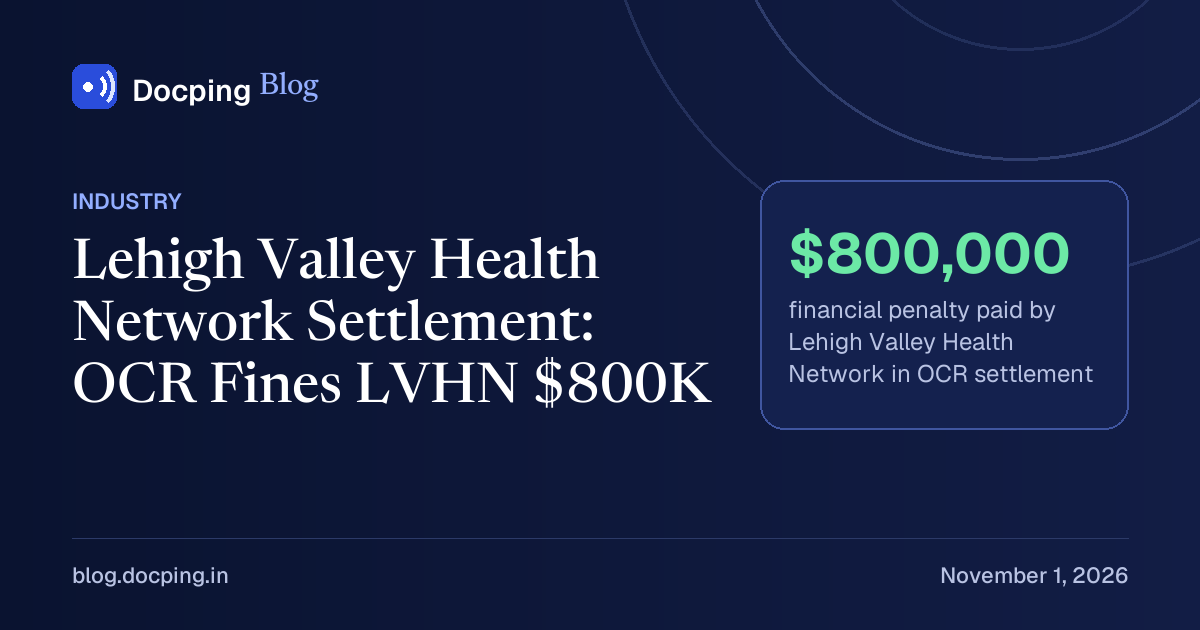
The United States Department of Health and Human Services (HHS) Office for Civil Rights (OCR) announced an $800,000 financial penalty and a three-year corrective action plan to resolve potential Health Insurance Portability and Accountability Act of 1996 (HIPAA) violations by Lehigh Valley Health Network (LVHN) 12. The Lehigh Valley Health Network settlement resolves OCR’s investigation into a ransomware attack that exposed the protected health information (PHI) of 248,359 individuals, establishing OCR’s 22nd enforcement action stemming from a ransomware investigation 12.
Key takeaways - OCR penalized Lehigh Valley Health Network $800,000 and imposed three years of compliance monitoring after an ALPHV/BlackCat ransomware incident compromised the protected health information of 248,359 individuals 12. - Federal investigators cited LVHN for failing to conduct an accurate and thorough enterprise risk analysis across all electronic protected health information, neglecting regular audit log reviews, and missing mandatory breach notification deadlines 12. - The settlement reinforces that OCR actively penalizes covered entities for delays in reporting breaches within the required 60-day window, a violation cited in five of 12 settlements announced this year 1.
What led to the Lehigh Valley Health Network settlement?
The enforcement action traces back to an intrusion by the ALPHV/BlackCat ransomware gang into IT systems associated with Delta Medix, a medical group that Lehigh Valley Health Network acquired in 2021 1. According to OCR, LVHN discovered suspicious activity in its IT systems on February 4, 2023, which was subsequently confirmed to be ransomware 2. While HHS records show LVHN discovered the activity on February 4, 2023 and submitted a breach report on May 15, 2023 2, trade press accounts also reported dates referencing February 4, 2026, and May 15, 2026 1.
During the intrusion, the ALPHV/BlackCat threat actors exfiltrated patient files and demanded a ransom 1. LVHN refused to pay 1. In response, the extortion group leaked the stolen electronic protected health information (ePHI) on its dark web leak site 12.
The compromised records included names, addresses, dates of birth, Social Security numbers, driver’s license numbers, financial information, clinical diagnoses, medical conditions, laboratory results, medications, and treatment records 12. Most severely, the stolen data contained sensitive clinical photographs of cancer patients receiving radiation oncology treatment, including photographs of patients who were naked from the waist up 12. Beyond the federal enforcement action, LVHN was sued by patients over the breach and settled resulting class action litigation for $65 million 1.
Which HIPAA violations did OCR identify?
OCR’s investigation concluded that LVHN committed multiple potential violations across the HIPAA Privacy, Security, and Breach Notification Rules 12. The agency cited five specific failures:
- Failure to conduct an accurate and thorough risk analysis: LVHN failed to conduct a comprehensive risk analysis to identify potential risks and vulnerabilities to the confidentiality, integrity, and availability of all of its electronic protected health information 12.
- Failure to review information system activity: The health system failed to implement policies and procedures to regularly review records of system activity, such as audit logs, access reports, and security incident tracking reports 12.
- Impermissible disclosure: LVHN impermissibly disclosed the ePHI of 248,359 individuals in violation of the HIPAA Privacy Rule 12.
- Delayed individual notification: LVHN failed to provide timely breach notifications to affected individuals 12.
- Delayed HHS notification: LVHN failed to provide timely breach notification to the Secretary of HHS 12.
“Failure to conduct an accurate and thorough risk analysis and to undertake regular review of information system activity makes regulated entities attractive targets for cyberattacks,” said OCR Director Paula M. Stannard 12. “The best defense against cyberattacks is full implementation of the HIPAA Security Rule” 12.
Why are breach notification timelines drawing regulatory penalties?
The HIPAA Breach Notification Rule requires covered entities to notify the HHS Secretary about a breach of unsecured protected health information within 60 days of discovery of a breach 1. OCR determined that LVHN failed to meet this threshold after detecting unauthorized activity on February 4, 2023, and submitting its breach notification to the agency on May 15, 2023 2.
While OCR does not operate a standalone formal enforcement program specifically titled for the Breach Notification Rule, breach notification lapses have become a regular component of federal penalties 1. Reporting delays were cited in five out of 12 HIPAA settlements announced by OCR this year, matching the five breach notification penalties levied in the prior year 1.
Our read: Health-system incident response playbooks often stall external disclosures while forensic teams verify the exact scope of data exfiltration. OCR’s recent settlements signal that regulators strictly enforce the 60-day clock from the date suspicious intrusion activity is first confirmed, treating forensic delays as separate statutory violations rather than acceptable tolling periods.
What does OCR’s corrective action plan require?
Alongside the $800,000 settlement payment, LVHN entered into a three-year corrective action plan that will be directly monitored by OCR 12. Under the agreement, LVHN must undertake four mandatory operational reforms 12:
- Comprehensive risk analysis: Conduct an accurate and thorough assessment to identify potential risks and vulnerabilities to the confidentiality, integrity, and availability of all ePHI across the health network 12.
- Risk management plan: Formulate and implement an enterprise-wide risk management plan designed to mitigate the specific vulnerabilities uncovered during the risk analysis 12.
- Policy and procedure overhaul: Review and revise existing Privacy, Security, and Breach Notification Rule policies and procedures to ensure strict compliance with HIPAA mandates 12.
- Workforce training: Develop and deliver updated HIPAA training materials tailored specifically to workforce members’ individual job responsibilities 12.
In conjunction with the resolution, OCR issued baseline cybersecurity recommendations for all regulated entities, advising organizations to map where ePHI enters, flows through, and exits systems; maintain and actively review audit controls; enforce access authentication; encrypt data in transit and at rest; and integrate incident findings into general security management processes 2.
What should health-system IT and compliance teams do now?
Security and clinical informatics leaders should benchmark their current defensive operations against the deficiencies penalized in the LVHN decree 12:
- Audit acquired legacy systems: The BlackCat intrusion entered through IT systems tied to Delta Medix, an entity acquired two years prior to the attack 1. IT security teams must ensure that newly merged or acquired clinics do not maintain orphaned infrastructure that bypasses central access controls or risk analysis registers 12.
- Verify access controls on clinical imaging: The exfiltration and subsequent dark web publication of oncology radiation photographs led to a $65 million class action settlement 1. IT leaders must verify that departmental imaging databases and clinical photo repositories enforce explicit authentication, encryption, and export limitations 2.
- Operationalize audit log monitoring: Having logging enabled is insufficient. OCR explicitly penalized LVHN for failing to implement procedures for regularly reviewing audit logs, access reports, and incident tracking reports 12. Compliance teams must establish automated alerts and documented human review cadences for abnormal queries or bulk data movement 12.
- Align incident response clocks with the 60-day deadline: Legal and technical teams must ensure that forensic investigations do not exceed the 60-day statutory limit for alerting affected individuals and the HHS Secretary following breach discovery 12.
Sources
- Lehigh Valley Health Network Pays $800K Penalty to Resolve HIPAA Violations — The HIPAA Journal, 2026-10-30
- HHS’ Office for Civil Rights Settles Ransomware Investigation of Lehigh Valley Health Network | HHS.gov — hhs.gov, 2026-10-29
Researched and drafted with AI from the sources above, and checked claim by claim against them before publishing.