CMS Finalizes CY 2027 OPPS/ASC Rule: 340B Cuts, Site-Neutral Imaging, and New Prior Auth
The final rule cuts 340B drug payments to ASP minus 28%, expands site-neutral rates for imaging, and adds prior authorization for eight botulinum toxin codes effective January 1, 2027.
CMS published the final Calendar Year 2027 Hospital Outpatient Prospective Payment System (OPPS) and Ambulatory Surgical Center (ASC) rule on November 6, 2026, with an effective date of January 1, 2027 1. The rule cuts 340B drug reimbursement, expands site-neutral payments for imaging, phases out more inpatient-only procedures, and adds prior authorization requirements for eight botulinum toxin injection codes — giving health systems and digital-health builders a fixed deadline to adjust revenue-cycle workflows and API integrations.
Key takeaways - 340B drug payments drop from ASP+6% to ASP-28%, saving an estimated $5.45 billion in 2027 with beneficiaries averaging $900 less per qualifying drug 34. - Imaging without contrast (CT, MRI, x-ray, bone density) moves to site-neutral Physician Fee Schedule rates at off-campus provider-based departments, saving $260 million in year one 32. - Prior authorization expands to eight botulinum toxin injection codes after claims rose 42.8% from 2017–2024 with no clinical explanation 31.
What the final rule changes
340B drug reimbursement cut to ASP minus 28%
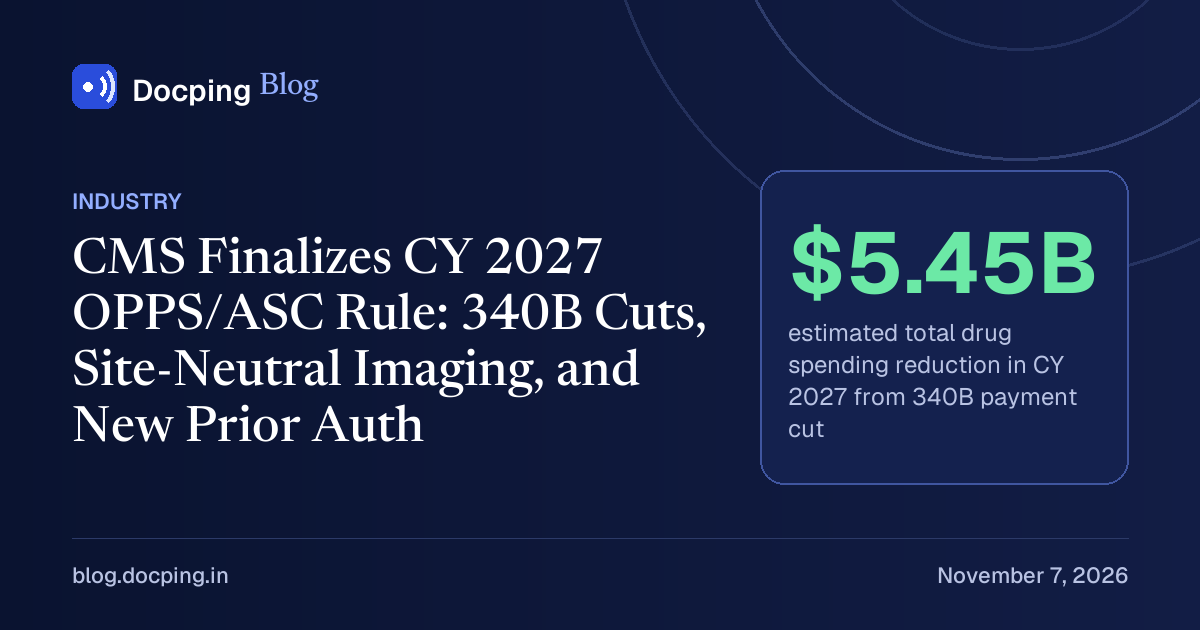
The final rule sets Medicare payment for 340B-acquired drugs at the Average Sales Price (ASP) minus 28%, moderated from the proposed ASP minus 33.4% 4. CMS based the adjustment on a drug acquisition cost survey and HRSA ceiling-price data 4. The agency estimates the policy will reduce Original Medicare drug payments by $4.35 billion and beneficiary drug payments by $1.1 billion in CY 2027, with beneficiaries who receive a qualifying drug in a hospital outpatient department saving an average of $900 3. Because the cut must be budget-neutral, OPPS payments for non-drug services will increase by 7.5% 4. The conversion factor for the accelerated 340B recoupment (often called a clawback) was finalized at 2%, down from the proposed 3% 4.
Hospital groups sharply criticized the cut. The American Hospital Association called it a “continued assault” on the 340B program 24. The Association of American Medical Colleges said the policy “will be devastating to patients” and disproportionately affects non-profit and public hospitals serving low-income patients 4. The Association of American Medical Colleges warned the cuts threaten access to critical services 4. The Federation of American Hospitals, representing for-profit non-340B hospitals, praised the rule as “a win for patients, taxpayers, and the hospitals that communities depend on” 4.
Site-neutral payments for imaging without contrast
CMS is extending its policy of paying the lower Physician Fee Schedule (PFS) equivalent rate — rather than the OPPS rate — for imaging without contrast services performed at off-campus provider-based departments 3. This applies to certain bone density scans, x-rays, ultrasounds, CT scans, and MRIs 3. The policy already covers clinic visits and drug administration services at those locations. CMS estimates the change would save beneficiaries and taxpayers a total of $260 million in CY 2027 and over $9 billion from CY 2027 to CY 2036 3. The agency argues the policy reduces a market incentive for provider consolidation 4.
Inpatient-only list phase-out continues
The rule removes additional services from the inpatient-only (IPO) list, allowing them to be delivered and paid for in outpatient settings. The Federal Register summary references the Consolidated Appropriations Act, 2026 provisions for off-campus outpatient departments 1. Coverage reports differ on the count: Healthcare Dive cites 637 services removed 2, while Fierce Healthcare cites 647 4. CMS proposes phasing out the IPO list over three years, arguing medical advances enable these procedures in more convenient, cheaper outpatient settings 2.
Prior authorization expanded for botulinum toxin injections
CMS finalized adding eight botulinum toxin injection codes to the list of hospital outpatient services requiring prior authorization 13. Hospital outpatient department claims for these codes rose 42.8% from 2017 to 2024 (averaging 4.6% per year) while overall hospital outpatient service volume fell 8.3% 3. CMS found no clinical or coding explanation for the increase, and DOJ reports have documented fraudulent billing, misbranded products, and improper payments involving botulinum toxin services 3. Medicare will continue to cover medically necessary injections for conditions such as chronic migraines when a physician documents the need 3.
EMTALA oversight via accrediting organizations
The rule finalizes a policy allowing hospital accrediting organizations (AOs) with CMS-approved deeming authority to assess hospital compliance with certain EMTALA administrative requirements (42 CFR 489.20) during routine accreditation and reaccreditation surveys 13. This integrates EMTALA administrative oversight into the existing deeming framework 3.
Quality reporting and other updates
The rule updates and refines requirements for the Hospital Outpatient Quality Reporting Program and the Ambulatory Surgical Center Quality Reporting Program, with no changes to the Rural Emergency Hospital Quality Reporting Program 1. The OPPS/ASC payment increase for providers meeting quality reporting requirements is 2.3%, reflecting a 3.2% projected hospital market basket increase and a 0.9 percentage point productivity adjustment 4 — slightly below the proposed 2.4% 2.
Requests for information: price transparency and prior authorization
The final rule includes two Requests for Information (RFIs) 1: - Strengthening standardization and comparability of Hospital Price Transparency (HPT) data — CMS seeks input on making hospital price transparency data more standardized and comparable. - Prior authorization — CMS requests information on prior authorization processes, likely to inform future rulemaking.
Comments on the RFIs and the final rule with comment period are due by January 4, 2027 1.
What this means in practice
Revenue-cycle teams should model the 340B payment shift immediately. The move from ASP+6% to ASP-28% changes drug margin calculations for every 340B-eligible outpatient claim. The budget-neutral 7.5% boost to non-drug services partially offsets the hit, but the mix shift matters. Update chargemaster logic, contract modeling, and denial-management rulesets for the January 1, 2027 effective date.
Clinical informatics and prior-auth automation teams need to add the eight new botulinum toxin injection codes to prior-authorization workflows. Check whether your EHR or prior-auth vendor has updated code sets and clinical criteria templates. The 42.8% claim-volume spike (2017–2024) suggests audit risk is high; documentation requirements for medical necessity should be hardened now.
API and integration engineers building on EHR data should verify that imaging service line mappings reflect the new site-neutral PFS rates for off-campus provider-based departments. If your product surfaces patient cost estimates, the $260 million first-year savings figure implies material changes to beneficiary cost-sharing for CT, MRI, x-ray, ultrasound, and bone density scans without contrast at those locations.
Compliance and legal should track the two RFIs. The price transparency standardization RFI may signal future structured-data mandates (e.g., machine-readable files with stricter schemas). The prior authorization RFI could preview federal standards that align with or extend the CMS Interoperability and Prior Authorization Final Rule. Submit comments by January 4, 2027 if your organization has operational data to contribute.
Strategic planners at health systems and digital-health companies should note the continued IPO list phase-out. Each year’s expansion of ASC-covered procedures and outpatient-eligible services shifts volume — and revenue — across settings. The three-year phase-out timeline means more procedures will move outpatient in the coming years.
What we’d watch
The 340B cut is litigation-prone; prior rounds of 340B payment reductions have drawn lawsuits that reached the Supreme Court. The moderated ASP-28% rate (versus proposed ASP-33.4%) may reflect CMS attempting to strengthen the administrative record, but the AAMC has signaled it will pursue “all available avenues” to reverse the cuts 4.
The site-neutral imaging policy applies only to off-campus provider-based departments, not on-campus HOPDs or ASCs. Watch for whether future rulemaking extends site-neutral rates to those settings or to additional service lines beyond imaging without contrast.
The RFIs are the clearest signal of where CMS may go next. Price transparency standardization could evolve into a FHIR-based or structured-data reporting requirement. Prior authorization RFI responses may shape a future federal prior-auth API standard beyond the current scope.
*Sources: Federal Register final rule 1; CMS press release 3; Healthcare Dive 2; Fierce Healthcare 4.
Sources
- Medicare Program: Hospital Outpatient Prospective Payment and Ambulatory Surgical Center Payment Systems; and Quality Reporting Programs; including the Hospital Outpatient Quality Reporting Program and Ambulatory Surgical Center Quality Program; Request for Information on Strengthening the Standardization and Comparability of Hospital Price Transparency (HPT) Data; Prior Authorization; Accrediting Organization (AO) Deeming for Emergency Medical Treatment and Labor Act (EMTALA); and Notices of Closure of Teaching Hospitals and Opportunities To Apply for Available Slots — Federal Register, 2026-11-06
- Medicare will cut billions from 340B, expand site-neutral payments in 2027 — Healthcare Dive, 2026-11-05
- Medicare Outpatient Final Rule Expands Surgical Options, Lowers Out-of-Pocket Costs for 340B Drugs — cms.gov
- CMS’ final 2027 outpatient pay rule brings hospitals little relief on 340B, site-neutral changes - Fierce Healthcare — fiercehealthcare.com, 2026-11-05
- CMS Finalizes CY 2027 Physician Fee Schedule to Accelerate Value-Based Prevention and Curb Duplicate Billing - HIT Consultant — hitconsultant.net, 2026-11-05
Researched and drafted with AI from the sources above, and checked claim by claim against them before publishing.