DOL PBM Disclosure Rule Forces Fee Transparency by 2027
The Labor Department finalizes mandates requiring pharmacy middlemen to reveal rebates, spread pricing, and broker fees to self-insured plans.
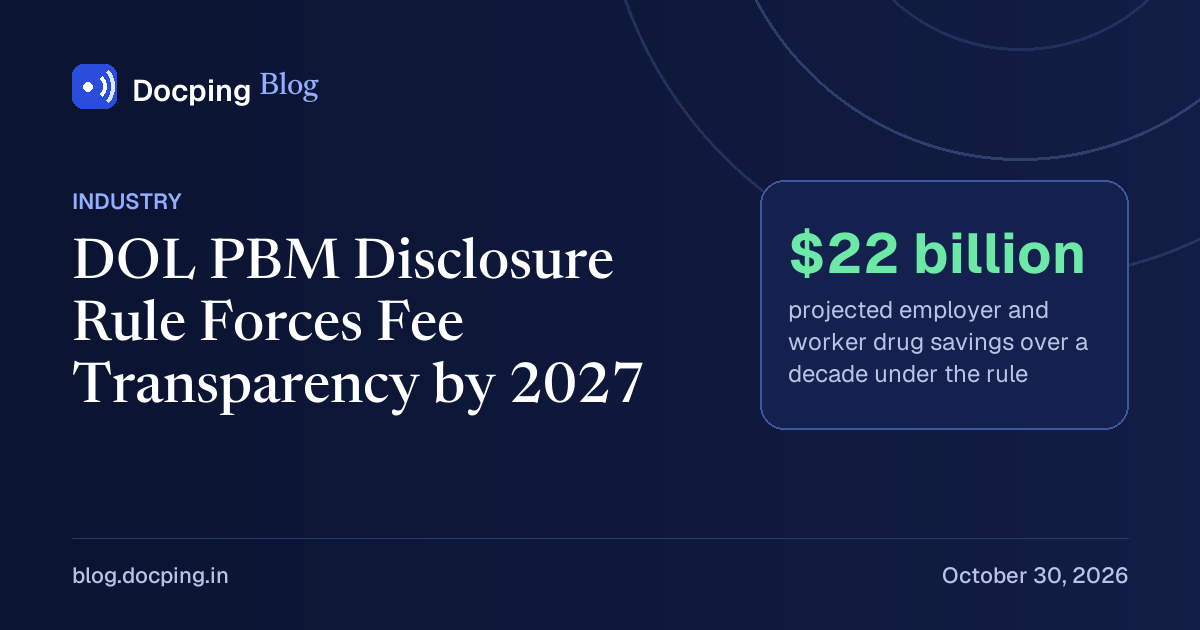
The Department of Labor finalized a regulation on Thursday requiring pharmacy benefit managers (PBMs) to disclose their compensation, drug manufacturer payments, and pricing structures directly to self-insured employer health plans 12. Taking effect on July 1, 2027, the DOL PBM disclosure rule aims to eliminate long-standing blind spots around prescription drug purchasing, a shift federal regulators estimate will lower drug spending for employers and workers by $22 billion over a decade 12.
Key takeaways - PBMs must disclose all manufacturer rebates, spread pricing retained on prescriptions, and financial ties with brokers to large self-insured employers beginning July 1, 2027 12. - Regulators project the mandate will affect more than 70 PBMs and 130,000 employers, yielding over $800 million in annual drug cost savings 2. - Covered entities must deliver pricing disclosures during contract negotiations, renewals, and every six months, with employers granted an annual audit right 1.
What does the DOL PBM disclosure rule require?
The final rule forces prescription drug middlemen to deliver granular disclosures detailing how they make money across the pharmaceutical supply chain 124. For years, self-funded employers have paid pharmacy invoices without visibility into the net prices negotiated behind the scenes 1. Under the new mandate, PBMs must disclose the specific fees and compensation they receive from drugmakers, consulting firms, pharmacies, and related entities 12.
Specifically, the rule targets two of the most scrutinized profit mechanisms in pharmacy benefit management: rebates and spread pricing 12. PBMs will be required to disclose any drugmaker rebates negotiated on prescription products, as well as any retained spread pricing—the difference when an employer plan is billed more for a medication than what the PBM reimburses the dispensing pharmacy 1. Additionally, PBMs must disclose financial relationships with brokers and benefit consultants that could represent conflicts of interest during plan design and procurement 2.
Reporting is not structured as a one-time compliance filing. PBMs will be obligated to provide these detailed compensation figures whenever negotiating or renewing an employer contract, followed by ongoing disclosures every six months 1. The regulation also grants employers the explicit right to audit these PBM disclosures once a year 1. PBMs that fail to comply face strict enforcement measures, including direct financial penalties and the potential invalidation of their commercial contracts 1.
Which plans and vendors are covered under the mandate?
The Labor Department structured the rule to apply specifically to large self-insured group health plans and the entities administering their pharmacy benefits 1. According to federal estimates, the framework encompasses more than 70 PBMs and approximately 130,000 employers nationwide 2.
The regulation targets a heavily concentrated market where three corporate entities—Cigna’s Express Scripts, CVS’ Caremark, and UnitedHealth’s Optum Rx—jointly control roughly 80% of all prescription drug claims across the United States 1. Regulators tweaked the rule to align with the CAA, limiting disclosures to large self-insured group health plans, harmonizing disclosure timelines, and using the same terminology and definitions 1.
To comply with the setup and recurring operational requirements of the disclosure system, the Labor Department estimates that each PBM will spend $1 million during the first year of implementation, followed by $300,000 annually in subsequent years 1.
How does the rule differ from the Consolidated Appropriations Act of 2026?
A central point of contention during the rulemaking process was whether the DOL action duplicated statutory requirements passed earlier this year under the Consolidated Appropriations Act of 2026 (CAA) 1. Industry groups argued that federal law already mandated transparent pharmacy reporting, making an administrative rule redundant 1.
In the final text, the Labor Department acknowledged areas of statutory overlap but rejected claims of redundancy, explaining that the two frameworks perform distinct functions 1. The CAA establishes retrospective transparency, obligating PBMs to report historical utilization and drug spending data on a claim-by-claim and pharmacy-by-pharmacy basis 1. In contrast, the DOL rule focuses on upfront and recurring operational disclosures 1. By requiring fee and spread details during contract negotiations, renewals, and biannual intervals, the DOL mechanism is engineered to help plan fiduciaries compare competing vendors before entering or renewing long-term commitments 1.
Regulators adjusted definitions, timelines, and reporting thresholds to harmonize directly with CAA statutory provisions 1. As Affirmed Rx chief executive Greg Baker pointed out, the DOL rule clarifies fiduciary responsibility by defining what constitutes complete disclosure and who carries legal liability under the Employee Retirement Income Security Act (ERISA), while the CAA outlines the specific data entities must disclose 1.
Why are employers demanding pharmacy fee transparency now?
Self-insured employers bear the direct financial burden of rising prescription drug spending, which has outpaced overall corporate healthcare budgets 1. Advisory firm WTW found that employer drug costs are projected to increase 11.5% in 2026, accelerating from a 9% increase the year before 1.
Despite funding these pharmacy programs, plan sponsors have routinely lacked basic visibility into the true cost of care. A survey released last week by KFF found that fewer than half of large employers report receiving sufficient insight into the payments pharmaceutical manufacturers provide to their health plans or PBMs 1. Employers complain that it is difficult to tell whether their PBM is being a good steward of their dollars, given the middlemen maintain a complex web of hidden fees, opaque business contracts, and rebate arrangements 1.
Employer coalitions praised the final rule’s release on Thursday 1. James Gelfand, president and CEO of the ERISA Industry Committee, stated: “Large employers pay for their workers’ prescriptions, but many can’t see how much of that money their PBM and any affiliated entity keeps. This rule changes that. Employers will be able to check the numbers, ask hard questions, and hold their vendors accountable to the contract” 1.
What pushback is the PBM industry mounting?
The Pharmaceutical Care Management Association (PCMA), representing the national PBM sector, has strongly criticized the regulation as administrative overreach 1. PCMA president and CEO David Marin labeled the regulation “a solution in search of a problem,” arguing that existing statutory requirements enacted under the CAA already established claim-level transparency 1.
PBM trade representatives maintain that establishing a separate Labor Department reporting pipeline creates an unnecessary, burdensome compliance apparatus that will fall heaviest on mid-sized PBMs and potentially force smaller administrators out of the market 1. The industry has also questioned whether the Labor Department holds statutory authority under ERISA to compel commercial pricing terms and private vendor contracts to this degree 1.
Our read: Given the PCMA’s explicit objections regarding statutory authority and overlap with the CAA, legal challenges seeking an administrative stay or vacatur in federal district court are highly probable before the July 2027 compliance date 1.
What this means in practice
The period leading up to July 1, 2027, establishes clear milestones for benefit leaders, technical teams, and vendor networks 12:
- Self-insured plan sponsors should review all existing PBM administrative services agreements ahead of 2027 renewals, establishing formal protocols to conduct the newly authorized annual audits of PBM compensation schedules 1.
- PBM compliance and IT departments must build automated reporting feeds capable of assembling rebate allocations, pharmacy spread differentials, and consultant payment records on a semiannual cadence for employer clients 12.
- Digital health and benefits software developers should prepare data ingestion models for newly accessible pharmacy pricing schedules, building auditing modules that allow employer fiduciaries to cross-reference upfront fee disclosures against retrospective CAA claims data 1.
Sources
- Labor Department finalizes sweeping PBM disclosure rule — Healthcare Dive, 2026-10-29
- STAT+: New federal rule will require prescription drug middlemen to share secret payments data — STAT, 2026-10-29
- Labor Department issues PBM transparency rule - Modern Healthcare — modernhealthcare.com, 2026-10-29
- Exclusive | Drug Middlemen Will Soon Have to Share Details on How They Are Paid - WSJ — wsj.com, 2026-10-28
Researched and drafted with AI from the sources above, and checked claim by claim against them before publishing.