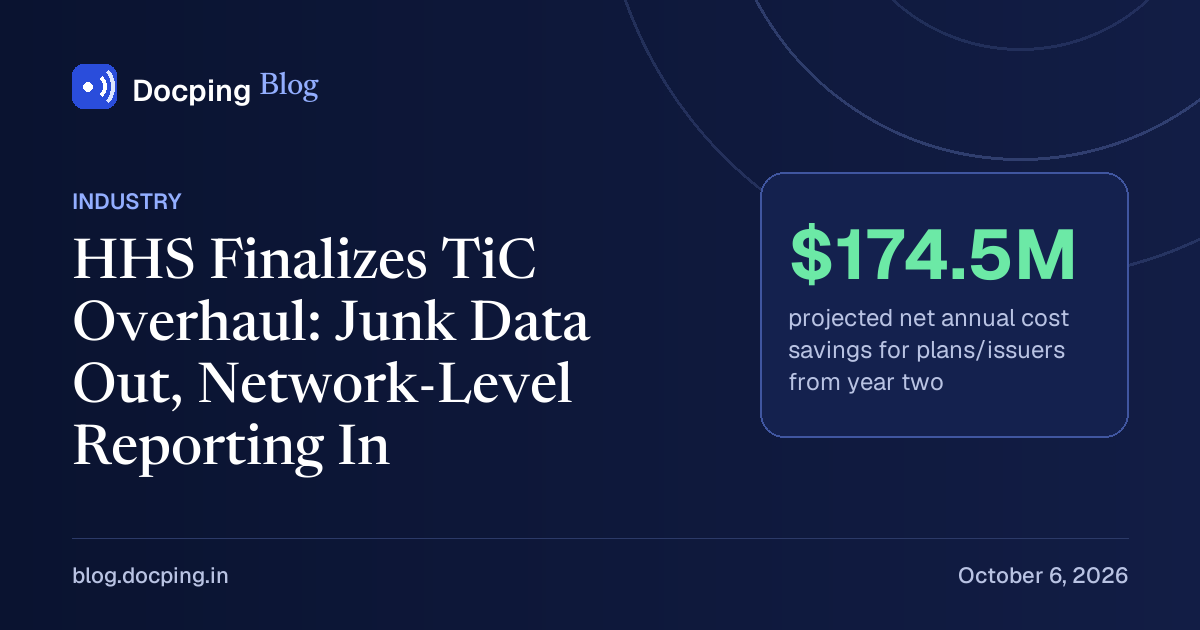
HHS Finalizes TiC Overhaul: Junk Data Out, Network-Level Reporting In
The final Transparency in Coverage rule strips ghost rates, shifts to network-level files, lowers out-of-network thresholds, and moves to quarterly JSON reporting.
The Departments of HHS, Labor, and Treasury published the final Transparency in Coverage rule on October 6, 2026, effective December 7, 2026 1. It rewrites the machine-readable file requirements that have governed payer price disclosures since 2022, targeting the “gargantuan data files often filled with cluttered and ambiguous information” that made the first round of data nearly unusable 2.
What the rule actually changes
Ghost rates are gone — but payers define “unlikely”
Payers must now exclude in-network rates for provider-service combinations a provider would be unlikely to furnish given their specialty (e.g., a psychiatrist performing heart surgery) 13. The payer uses its own internal provider taxonomy or claims-adjudication rules to decide what to drop, and must publish that taxonomy in a new Taxonomy File alongside each In-network Rate File 3. A companion Utilization File lists every provider who submitted and was reimbursed for at least one claim in the most recent plan year ending six months before posting 3.
Reporting shifts from plan-level to network-level
Instead of one In-network Rate File per plan or policy, payers now produce one file per provider network they maintain or contract with 13. Since multiple plans often share the same network and negotiated rates, this collapses duplicate files and aligns with how hospitals report their own price transparency data 3.
Out-of-network data gets a lower bar and broader aggregation
The claims threshold for reporting out-of-network allowed amounts drops from 20 to 11 claims 123. Payers must also aggregate out-of-network data by insurance market type — large group, small group, individual, and self-insured — which the Departments say will “significantly increase the amount of out-of-network data disclosed” and make cross-plan comparisons feasible 3. The reporting period for historical out-of-network data is also extended 1.
Quarterly cadence replaces monthly; JSON becomes the standard
In-network and out-of-network files move to a quarterly publishing schedule 13. The Departments note that networks and rates “do not change significantly from month to month” and that monthly downloads strained ingest pipelines 3. Technical guidance will specify JSON as the single required format for all machine-readable files except the plain-text locator file 3.
Attestation and named accountability
Every In-network Rate, Out-of-network Allowed Amount, Taxonomy, and Utilization file must include an attestation that the data is “true, accurate, and complete” and must encode the name of the CEO, president, or senior official designated to oversee accuracy 3. A plain-text locator file in the website root folder — with a monitored email contact — and a footer link titled “Price Transparency” or “Transparency in Coverage” are now mandatory for findability 13. These locator and footer requirements also apply to the prescription drug machine-readable file 3.
Phone access for cost-sharing tools
Cost-sharing information already required via web tool or paper must also be available by phone on request, satisfying No Surprises Act section 114 for both non-grandfathered and grandfathered plans 13.
Compliance deadlines
- Five months after Federal Register publication: changes to existing In-network Rate and Out-of-network Allowed Amount files take effect 23.
- Eleven months after publication: new Taxonomy, Utilization, and locator text files must be live 23.
The rule projects ~$174.5 million in net annual cost savings for plans and issuers beginning in year two, driven largely by the reduced cadence 3. First-year one-time compliance costs are estimated near $400 million 2.
What we’d watch
The prescription drug machine-readable file schema is still absent; CMS says it will be finalized separately, targeting this coming spring 2. The locator file, footer link, and attestation requirements now apply to the drug file as well 3.
Payers’ internal taxonomy rules will determine how aggressively “unlikely” rates are pruned. The Taxonomy File is the only transparency into that judgment — watch for wide variation in the first quarter of filings.
Network-level reporting should shrink file counts, but the initial re-mapping effort is non-trivial. Teams ingesting TiC files today should plan for a schema change (network identifier, product type, network name) and a shift to quarterly JSON pulls.
What it means in practice
- Data engineers: Update ingest pipelines for JSON-only, quarterly, network-level files; add Taxonomy and Utilization file parsers; map new fields (product type, network ID, attestation officer).
- Cost-estimation tools: Expect cleaner in-network rate sets and a meaningful increase in out-of-network allowed-amount rows once the 11-claim threshold and market-type aggregation kick in.
- Revenue-cycle teams: The locator file and footer link make payer file discovery automatable — build a crawler now.
- Compliance leads: Identify the attesting executive per issuer; document the internal taxonomy logic; schedule the two-phase rollout (5 months for rate-file changes, 11 months for new contextual files).
The prescription drug file overhaul remains the next shoe to drop. For now, the TiC data that feeds your cost models, network analytics, and patient-facing estimators is about to become smaller, structured, and — if the taxonomy disclosures hold up — more trustworthy.
Sources
- Transparency in Coverage — Federal Register, 2026-10-06
- Trump administration revamps insurer price transparency reporting — Healthcare Dive, 2026-10-05
- Transparency in Coverage Final Rules (CMS 9882-F) — cms.gov
Researched and drafted with AI from the sources above, and checked claim by claim against them before publishing.