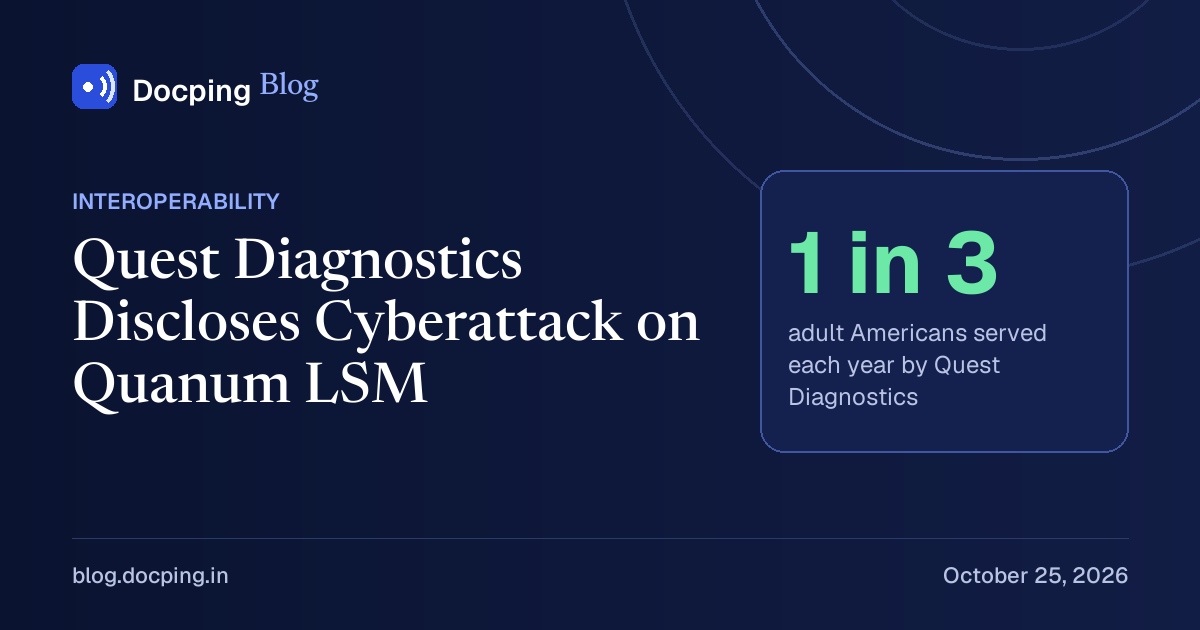
Quest Diagnostics Discloses Cyberattack on Quanum LSM
Unauthorized access to Quanum Lab Services Manager exposed patient records while direct EHR interfaces remained operational.
Quest Diagnostics disclosed unauthorized access to its Quanum Lab Services Manager (LSM) system in an October 22, 2026 regulatory filing, warning that patient records were likely compromised during the intrusion 123. For digital health platforms and hospital IT teams that rely on diagnostic interfaces, this Quest Diagnostics cyberattack highlights the boundary between web-based provider portals and direct electronic health record (EHR) feeds 13.
Key takeaways - Quest Diagnostics identified unauthorized access to its Quanum LSM portal on October 21, 2026, and confirmed in a Securities and Exchange Commission (SEC) Form 8-K filing that patient records were exposed 123. - Direct electronic medical record (EMR) and laboratory information system (LIS) interfaces were not impacted, though Quest took Quanum LSM, Essential Insights, and LabHQ offline as containment measures 13. - The commercial laboratory company serves one-third of adult Americans and half of U.S. physicians and hospitals across 7,700 North American access points 13.
What happened in the Quest Diagnostics cyberattack?
Quest Diagnostics first identified unauthorized access to its Quanum LSM system on October 21, 2026 13. The Secaucus, New Jersey-based testing company filed a Form 8-K with the SEC on October 22, 2026, stating that an unauthorized third party is believed to have accessed certain patient records 124. In an update published on its website, the company confirmed that protected health information (PHI) or personally identifiable information (PII) was part of the unauthorized access 2.
Quest stated that it engaged third-party cybersecurity experts to investigate the intrusion and notified federal law enforcement authorities 12. The company confirmed to The Associated Press that this incident was unrelated to recently discovered vulnerabilities in the PHP programming language 4. As of its initial disclosures, no threat group had claimed responsibility for the breach 13, and Quest did not disclose additional technical specifics during its third-quarter earnings call 2.
Which lab ordering and reporting systems are affected?
The breach centers on Quanum LSM, an online software platform that clinic personnel, hospital staff, and physicians use to manage laboratory services, place test orders, look up patient results, track testing status, and order supplies 123. Upon detecting the intrusion, Quest paused access to the Quanum LSM platform to contain the activity and prevent further unauthorized access 123.
To safeguard its environment during the ongoing investigation, Quest also temporarily halted access to other related software systems, specifically Essential Insights and LabHQ 3.
However, Quest reported that core business operations have not been disrupted and the incident has not affected its ability to test specimens or serve patients 12. Direct-customer LIS interfaces and direct EMR integrations were not impacted by the incident 13. To maintain routine clinical workflows while Quanum LSM remains offline, Quest advised clients to transmit orders and retrieve results via fax, paper requisitions, Quanum eLabs, or their established direct EMR and LIS interfaces 13.
How large is Quest’s footprint across clinical workflows?
Quest Diagnostics is one of the largest clinical laboratory networks in the United States, generating more than $11 billion in annual revenue and employing 65,000 people 13. The company maintains more than 7,700 patient access points across North America, including approximately 2,000 patient service centers spanning 51 U.S. states and territories 1.
Because Quest provides testing services for roughly half of all U.S. physicians and hospitals and touches one in three American adults annually, any security incident involving its software footprint draws immediate attention from compliance and integration leads 13.
The company has navigated large-scale third-party exposures before 14. Between August 2018 and March 2019, an intrusion at its debt collection vendor, American Medical Collection Agency (AMCA), compromised the PHI of approximately 11.9 million Quest patients 134. That incident led to at least 19 class-action lawsuits that were consolidated into multidistrict litigation that remains unresolved 3. In 2016, an online breach at Quest exposed lab results and contact details for about 34,000 people 4. Unlike the AMCA event, Quest’s early assessment of the current incident suggests a narrower exposure footprint because only a subset of clients utilize the Quanum LSM application 12.
What does this mean for health tech engineering teams?
For digital health engineering teams, the incident serves as an operational case study in architecture separation. Modern clinical pipelines often connect to national reference laboratories via two distinct tracks: direct, standardized system-to-system connections (such as HL7 or FHIR interfaces linking an EHR or LIS directly to the laboratory) and browser-based management portals used by office staff for administrative or manual ordering tasks.
Because Quest’s direct EMR and direct LIS connections remained operational, clinics and digital health platforms that exchange lab orders through dedicated system-to-system interfaces did not experience downtime in processing patient tests 13. The exposure was isolated to the web-based Quanum LSM tier and related portal applications 13.
Health-system risk leaders tracking recent vendor exposures—such as the incident detailed in our look at the Oracle Health Cerner breach tally—routinely monitor how access credentials on third-party provider portals can serve as initial attack vectors. While Quest continues to analyze which specific data elements and patient counts were exposed 23, health systems must manage the administrative burden of verifying whether their local provider accounts had active Quanum LSM logins.
Our read: When reference laboratories take secondary portals offline as a protective containment measure, the clinical burden immediately shifts to backup channels 13. Teams that have built resilient integrations that ingest lab results directly into native EHR workflows avoid the manual friction of switching back to paper slips, fax queues, or alternative portal logins like Quanum eLabs 13. Isolating web portal authentication from direct API and interface credentials remains an essential practice for third-party lab integrations.
What should health-system IT and compliance teams do now?
Health-system IT leaders, clinic administrators, and digital health compliance officers should take three specific steps while Quest’s investigation proceeds:
- Audit Quanum LSM, Essential Insights, and LabHQ usage. Determine whether any clinicians, medical assistants, or administrative staff within your organization hold accounts on Quanum LSM, Essential Insights, or LabHQ 3. Because credentials and patient lookup histories inside web portals represent primary risk vectors during account compromises, security teams should review and flag any shared administrative credentials associated with these specific platforms.
- Verify direct interface integrity. Check the status of your direct EMR-to-Quest and LIS-to-Quest feeds. Quest confirmed that direct-customer LIS interfaces and EMRs are not impacted 13. Confirm that inbound result parsing and outbound orders are flowing normally without routing errors.
- Prepare alternative requisition workflows. For clinics that rely on Quanum LSM for manual ordering, supply tracking, or lookup of historical test results, ensure operational staff are trained on approved interim methods 3. Quest has advised clients that they can continue operations using paper requisitions, fax transmissions, or Quanum eLabs while the LSM platform remains paused 13.
Quest has stated that it will disclose additional findings regarding the scope, affected data types, and patient volumes as its forensic investigation progresses 123.
Sources
- Patient Data Likely Accessed in Quest Diagnostics Hack — The HIPAA Journal, 2026-10-23
- Quest Diagnostics hit by cyberattack — Healthcare Dive, 2026-10-22
- Quest Diagnostics confirms data breach exposed patient records — bleepingcomputer.com, 2026-10-23
- Quest Diagnostics Reports Cyber Breach Affecting 'Certain Patient Records' - SecurityWeek — securityweek.com, 2026-10-23
Researched and drafted with AI from the sources above, and checked claim by claim against them before publishing.