HTI-5 Final Rule: ONC Scraps AI Model Cards, Cuts 14 Criteria
Federal regulators preserve core EHR privacy and security baselines while eliminating predictive AI disclosures and extending C-CDA transitions to 2030.
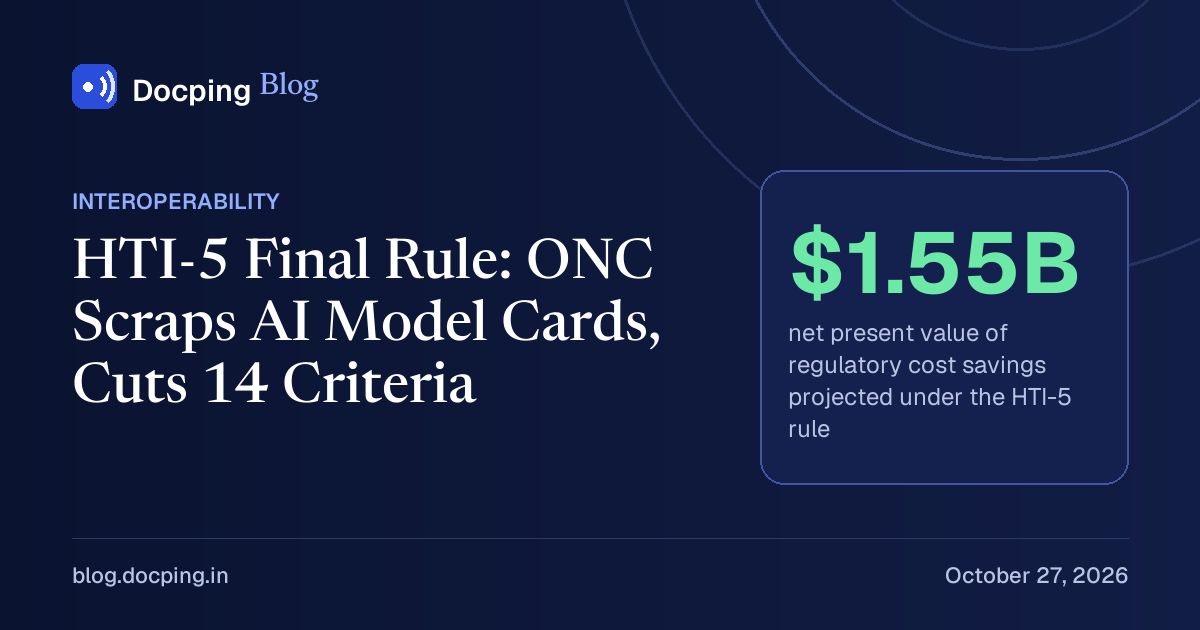
The Department of Health and Human Services (HHS) and the Office of the National Coordinator for Health Information Technology (ONC) released the HTI-5 final rule on Monday, dismantling federal artificial intelligence “model card” mandates for certified electronic health records (EHRs) and removing 14 certification criteria to save an estimated $1.55 billion in compliance costs 14. Titled Health Data, Technology, and Interoperability: ONC Deregulatory Actions to Unleash Prosperity, the measure alters engineering roadmaps across health technology by pulling back complex documentation requirements while retaining fundamental privacy, security, and application programming interface (API) baselines 145.
Key takeaways: - ONC removed 14 out of 60 certification criteria and revised seven others, abandoning its initial proposal to scrap all 13 privacy and security criteria after fierce pushback from healthcare providers 145. - The rule completely eliminates predictive decision support intervention (PDSI) “source attribute” display and technical model card mandates under 45 CFR § 170.315(b)(11) 15. - Consolidated Clinical Document Architecture (C-CDA) transition-of-care requirements receive an extended compliance runway through January 1, 2030, giving the market time to build out bidirectional Fast Healthcare Interoperability Resources (FHIR) exchange 1.
What did the HTI-5 final rule change for health IT?
The final rule implements directives under Executive Order 14192 (“Unleashing Prosperity through Deregulation”) and Executive Order 14267 (“Reducing Anti-Competitive Regulatory Barriers”), aiming to cut compliance and testing overhead for software developers 14. HHS estimates the changes will deliver $108.1 million in annualized net savings discounted at 7% beginning in 2027 in perpetuity, with a total net present value of $1.55 billion 14. ONC projects $0 in new ongoing compliance implementation costs for developers of certified health IT under the update 1.
The final regulation represents a notable retreat from the far more sweeping proposal issued in December 2025 4. In that draft, federal regulators proposed eliminating 34 out of 60 certification requirements, which would have altered nearly 70% of the program’s framework 45. Instead, ONC chose to remove 14 criteria, revise seven, and keep 39 criteria completely intact 14. Those 39 retained requirements include criteria recently adopted under the Health Data, Technology, and Interoperability: Electronic Prior Authorization and Real-Time Prescription Benefit (HTI-4) Final Rule 4.
Beyond individual criteria, the rule resets program governance. HTI-5 strips references to the “Assistant Secretary for Technology Policy (ASTP)” across 45 CFR Part 170 and Trusted Exchange Framework and Common Agreement (TEFCA) rules under Part 172, formally reinstating the regulatory title and primacy of ONC 1.
Why did ONC scrap the AI model card requirements?
The sharpest policy reversal in the rule centers on predictive Decision Support Interventions (DSIs) under 45 CFR § 170.315(b)(11) 1. Under the earlier HTI-1 rule, ONC had established transparency mandates that forced EHR developers to build user interfaces displaying standardized “source attributes”—often described as nutrition labels or model cards—for predictive algorithms 15. These cards required granular disclosures detailing training data, demographic validation benchmarks, funding sources, and ongoing model drift monitoring 1. We previously covered how these disclosures created friction in our analysis of how EHR AI transparency disclosures vary widely despite certification.
Under HTI-5, ONC eliminated those requirements entirely 15:
- Source Attribute Display (§ 170.315(b)(11)(iv) & (v)): Developers no longer have to design, test, or maintain clinician-facing interfaces that show underlying training metadata or model provenance at the point of care 1.
- Maintenance of Certification (§ 170.402(b)(4)): Conforming edits remove ongoing developer obligations to routinely audit and update external risk management records and algorithmic metadata 1.
- Intervention Risk Management (§ 170.315(b)(11)(vi)): Health IT vendors are relieved of certification-driven audits governing ongoing model drift and risk mitigation 1.
- Narrowed Clinical Data Triggers: The data classes required to trigger predictive DSIs are narrowed strictly to data found in Clinical Notes and the Assessment and Plan of Treatment, removing requirements to evaluate non-clinical fields such as phone numbers 1.
- Legacy CDS Struck (§ 170.315(a)(9)): Regulators formally struck and reserved the legacy clinical decision support criterion that expired on January 1, 2025 1.
In agency briefings and regulatory text, officials explained that practicing clinicians rarely accessed technical model cards during high-pressure workflows, while the administrative burden of maintaining them was dampening developer investment in advanced clinical models 15. ONC emphasized that algorithmic safety oversight belongs within the Food and Drug Administration (FDA) and civil rights enforcement under 45 CFR § 92.210 rather than general EHR certification 1.
How did ONC handle privacy, security, and usability floors?
While developers secured relief on predictive AI documentation, healthcare providers successfully blocked proposals to scrap fundamental security and design safeguards 15. In the proposed rule, ONC had weighed eliminating all 13 privacy and security certification criteria, including access control, authorization, and encryption standards 5.
Hospital systems, medical societies, and rural clinics pushed back vigorously 5. Commenters argued that eliminating certified security capabilities would shift the burden of evaluating software cryptography onto provider IT teams and make it harder to demonstrate HIPAA Security Rule compliance 15. In response, ONC abandoned the proposal and preserved the full privacy and security framework under § 170.315(d) and § 170.550(h) 1.
Regulators also adjusted several other operational criteria:
- Safety-Enhanced Design (SED) (§ 170.315(g)(3)): Instead of eliminating usability testing entirely, ONC converted SED from a heavy summative laboratory testing protocol into an attestation-based standard, preserving user-centered design baselines without demanding external lab reports 1.
- Quality Management Systems (QMS) (§ 170.315(g)(4)): Mandatory QMS criteria were preserved across all certified modules to ensure baseline adherence to ISO or federal software quality frameworks 1.
- Accessibility-Centered Design (ACD) (§ 170.315(g)(5)): Kept intact to maintain accessibility standards during product development 1.
- Implantable Device List (IDL) (§ 170.315(a)(14)): Preserved to align with the Centers for Medicare & Medicaid Services (CMS) FY 2027 Inpatient Prospective Payment System (IPPS) final rule, which added a Unique Device Identifier (UDI) measure within the Base EHR definition 1.
What is the timeline for C-CDA and FHIR transitions?
Rather than forcing an abrupt end to document-based exchanges, ONC established an extended glidepath toward an API-centric framework 13.
For transitions of care (§ 170.315(b)(1)), the final rule extends the compliance sunset for C-CDA creation and Direct secure messaging edge protocols to January 1, 2030 1. This four-year extension prevents disruption across long-term post-acute care (LTPAC) facilities, behavioral health clinics, and small practices that still rely heavily on structured document exchanges while vendor FHIR implementations mature 1.
Simultaneously, the agency simplified data ingestion. It eliminated secondary Consolidated CDA creation performance testing (§ 170.315(g)(6)) to cut duplicative testing cycles 1. It also converted clinical information reconciliation and incorporation (CIRI) under § 170.315(b)(2) into a functional standard, removing rigid document formatting requirements and ending the mandate to display data sources side-by-side in user interfaces 1. This change allows developers to deploy native, automated reconciliation directly from FHIR resources 1.
At the same time, ONC maintained public endpoint accountability. Regulators rejected industry requests to drop the requirement to publish service base URLs under § 170.404(b)(2), keeping public FHIR endpoint directories mandatory so third-party applications can onboard without private gatekeeping 1. In its preamble, ONC noted that modernizing the certification program around FHIR APIs is a necessary step to support agentic AI tools and emerging context protocols like the Model Context Protocol (MCP) 1.
What happened to the information blocking proposals?
The final rule did not adopt proposed modifications to federal information blocking regulations 14. In the December 2025 draft, ONC had proposed revising the definitions of “access” and “use” to explicitly accommodate autonomous AI agents, alongside changes to several information blocking exceptions 4. HHS confirmed that public feedback on those proposals remains under active evaluation and will be addressed in future rulemaking 14.
What it means in practice
The rule is scheduled for official publication in the Federal Register on October 28, with most provisions taking effect 60 days after publication on December 28, and certain criteria adjustments taking effect on January 1, 2027 45. Health tech leaders should adjust operations across three fronts:
- Health IT product and engineering teams: Halt engineering sprints assigned to patient- or clinician-facing DSI model card display UIs under § 170.315(b)(11) 1. For SED usability compliance under § 170.315(g)(3), transition internal processes from formal third-party laboratory reports to attestation documentation packages 1.
- Regulatory and compliance officers: Remove annual Real World Testing (RWT) plan generation from upcoming compliance cycles, as HTI-5 aligns with earlier enforcement discretion to restrict annual RWT results reporting strictly to certified FHIR APIs (§ 170.315(g)(10)) and electronic prior authorization APIs (§ 170.315(g)(31)–(33)) 14.
- Health system IT and informatics leadership: Re-anchor clinical exchange strategies to the January 1, 2030 sunset for C-CDA transition documents, maintaining existing Direct messaging bridges while expanding FHIR-based reconciliation pipelines under revised CIRI standards 1. Confirm that 2027 Base EHR configurations retain the implantable device list criterion (§ 170.315(a)(14)) to protect CMS Promoting Interoperability scores 1.
Our read: HTI-5 gives health-tech engineering teams substantial breathing room by discarding point-of-care model card interfaces that few clinicians ever clicked, but it stops well short of the deregulatory free-for-all originally proposed. By defending core security criteria, endpoint directories, and quality systems, ONC preserved the market rails needed for secure API exchange while clearing away static documentation mandates.
Sources
- ONC Finalizes HTI-5 Deregulatory Rule to Cut $1.55B in Health IT Compliance and Accelerate FHIR APIs — HIT Consultant, 2026-10-26
- STAT+: HHS relaxes security, transparency rules for health record software used by hospitals — STAT, 2026-10-26
- HTI-5 Final Rule — healthit.gov
- HHS finalizes health IT rule projected to slash $1.5B in costs — fiercehealthcare.com, 2026-10-26
- HHS Retreats on Plan to Scrap EHR Security, Privacy Regs — govinfosecurity.com
Researched and drafted with AI from the sources above, and checked claim by claim against them before publishing.